
 Bitaigen Research
 Bitcoin Funding Rate Hits New Low in March, Shorts Have Already Hedged Downward Ahead of the Non‑Farm Payrolls
The funding rate for Bitcoin fell to a fresh low in March, and shorts have, while the funding rate turned negative and open interest remained elevated, already positioned a downward hedge, anticipating adverse macro data and preparing to hold their positions until liquidation triggers.
This article explains an important market mechanism: the Bitcoin derivatives market has already written clear risk signals through three dimensions—funding rates, open interest, and forced liquidations—before macro data materializes. Understanding this logic lets you see the market’s real pressure earlier than any narrative.

The Bitcoin derivatives market provides the best explanation for this week’s macro pressure.
- Funding rates turned sharply negative
- Open interest stayed at a high level
- The U.S. employment report was released afterward
Together, these three events show that the market had already built a sizable short‑hedge position before the real macro catalyst arrived.
Grasping the order of these steps is crucial because it reveals how macro volatility permeates the crypto market. The signal typically appears first in perpetual contracts—the venue where hedging is fastest and leverage usage is highest.
- Funding rates tell you which side is paying to keep its positions alive.
- Open interest shows how much exposure remains in the system.
- Forced liquidation data reveals when those positions start to unwind.
On 28 February, the Bitcoin perpetual contract funding rate fell to roughly ‑6 %, one of the most negative readings in the past three months. Open interest denominated in BTC rose from about 113,380 BTC at the start of the year to 120,260 BTC.
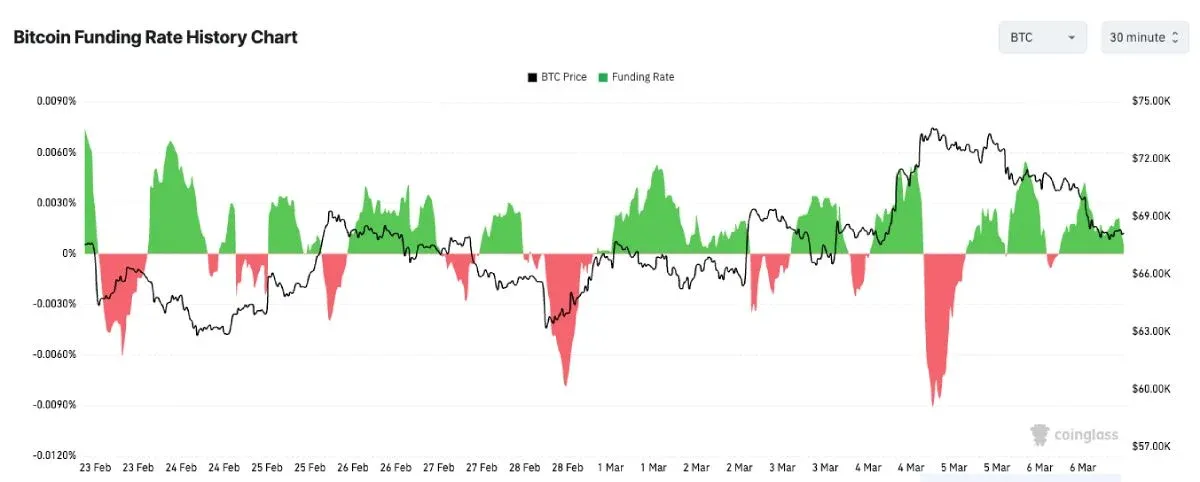
This combination is significant because it points to two things simultaneously:
- Traders are betting heavily on a downside move.
- They are doing so while more leverage is flowing into the market.
Consequently, the market is both tense and crowded.
This is the most direct way macro pressure can enter the crypto space: it shows up on the derivatives ledger rather than in packaged narratives or economists’ reports. Traders act first on perpetual contracts because they are liquid, cheap to use, and always available.
When they become concerned about growth, interest rates, or broader risk‑off sentiment, they short perpetual contracts; once the contract price falls below the spot price, the funding rate turns negative because shorts must pay longs to maintain their positions.
In this piece we break down the three key signals from Bitcoin derivatives—funding rates, open interest, and forced liquidations—to help readers spot potential downside pressure before macro data is released. Mastering this logic lets you perceive the market’s real direction earlier than blindly following narratives. Keep reading for the full analysis.
Why a Negative Funding Rate Can Persist
A negative funding rate in itself is not a bottoming signal; it merely indicates the market’s directional bias. Traders often treat every extreme reading as a forecast, but it is essential to differentiate:
- An extremely negative funding rate may foreshadow a short‑covering rally.
- When hedging demand is genuine and sustained, a negative rate can linger longer than expected.
Extreme rate swings reflect one‑sided positions that can endure throughout a strong trend. Their persistence mainly stems from two types of participants:
- Hedgers: Protecting real spot exposure rather than trying to time the market precisely.
- Trend‑followers: Willing to pay the fee as long as the price moves in their favored direction.
Both groups can keep the funding rate negative even after the initial panic subsides. The real signal is not simply that the rate is negative, but that when the rate stays markedly negative while prices stop making new lows, pressure is building beneath the surface. Shorts continue to pay to stay in the market, yet the market no longer rewards them in the same way, creating conditions for short‑covering.
The Employment Report Delivered Concrete Macro Input
This week’s macro catalyst came from the U.S. labor market. On 6 March, the Bureau of Labor Statistics reported that non‑farm payrolls fell by 92 k in February and the unemployment rate stood at 4.4 %.
Such employment reports trigger broad re‑pricing because they affect several market themes simultaneously:
- A weaker labor market can push yields lower, suggesting the Federal Reserve may adopt a more dovish policy path.
- It can also erode risk appetite, being read as a sign of real‑economy slowdown.
The crypto market feels this debate more acutely, and leverage translates macro concerns into position‑level events.
- If traders are already heavily short and macro conditions briefly ease financial stress, forced short‑covering can cause a rapid price surge.
- If the data deepens risk‑off sentiment, the crowded short side will keep pushing prices down, while longs may start cutting losses.
Within this framework, funding rates act as the pressure gauge, open interest supplies the fuel, and forced liquidations mark the moment the pressure breaks through the system.
Forced Liquidation Data as a Scoreboard
Forced liquidation data helps determine whether a market move is orderly or forced:
- Short liquidations usually confirm a short‑covering episode.
- Long liquidations usually confirm a downward clean‑up.
When both sides are liquidated within a short time frame, volatility has taken over, leaving little room for either side to hold positions. Therefore, liquidation data works best as a confirmation layer: funding rates set the conditions, while liquidations verify whether those conditions have already manifested in price.
Open interest is equally important. If participation contracts shrink in sync, the significance of a price drop and a negative funding rate diminishes, possibly indicating that traders are merely watching and stepping out. However, when open interest rises alongside a negative rate, it signals that new bearish or defensive positions are being built.
Tracking open interest denominated in BTC removes distortion caused by price fluctuations. Consequently, during a price decline, an increase in BTC‑denominated open interest more clearly reflects market participation.
From this perspective, the past week was not just a simple debate over Bitcoin’s strength versus weakness; it was about where pressure was accumulating. The derivatives market had already shown a large‑scale short or hedge structure before the employment data arrived; the employment report then supplied the real macro input.
When the two met, the crypto market displayed larger candles, faster reversals, and more violent position clean‑ups, mirroring the macro uncertainty faced by all participants.
- Funding rates only reveal leverage bias.
- Open interest only reveals the size of positions on the board.
- Forced liquidations only reveal when the market loses control.
For this reason, derivatives became the best macro interpreter this week. Before narratives settled, the ledger had already sketched the risk: traders were short, leverage remained in the system, and the employment report gave the market a concrete reaction point. Everything that followed was simply price reflecting how crowded the “room” had become.
This concludes the analysis of “Bitcoin funding rate hits a March low—did shorts race ahead of the non‑farm payrolls?” For more content on Bitcoin funding rates, search for previous Bitaigen (比特根) articles or continue browsing the related posts below. We look forward to your continued attention to Bitaigen (比特根)!
*All fiat references are expressed in USD; European users may use SEPA/SWIFT for transfers. U.S. residents should trade on Binance.US rather than the global Binance platform. Crypto gains may be taxable in your jurisdiction; please consult a tax professional for guidance.*
Related Reading
- Bitcoin Price Forecast 2026‑2040: Extreme Panic vs Institutional Accumulation
- Bitcoin Stock‑to‑Flow vs Rainbow Chart: 2025 Investor Guide
- Top Bitcoin Bottom‑Finding Indicators: RSI, MVRV, NUPL & More
💡 Register on Binance with referral code B2345 for the maximum trading fee discount. See Binance complete guide.



