 Bitaigen Research
 After buying roughly 400,000 BTC at what appeared to be a bottom, the price has climbed back to around $74,000. Considering the average cost basis of existing positions and the recent inflow of capital, this movement resembles a short‑term price rebound rather than a completed trend reversal.
The cryptocurrency market has recently experienced a long‑awaited strong bounce. On March 5, Bitcoin briefly surged past the $74,000 mark, delivering an almost 8 % gain within 24 hours and setting a new high for the past month. At the time of writing, BTC is trading in a relatively narrow band between $72,000 – $73,000, indicating a renewed optimism across the broader digital‑asset space. Ethereum (ETH) has risen to roughly $2,100, up more than 7 %, while several altcoins have also posted modest recoveries.
- Liquidation data: According to Coinglass, the total value of open‑interest contracts that were liquidated worldwide in the past 24 hours amounted to $595 million, of which $482 million came from short‑position liquidations.
- Fear index: The market volatility index (VIX) has retreated from the “extreme fear” zone to a level of 29.
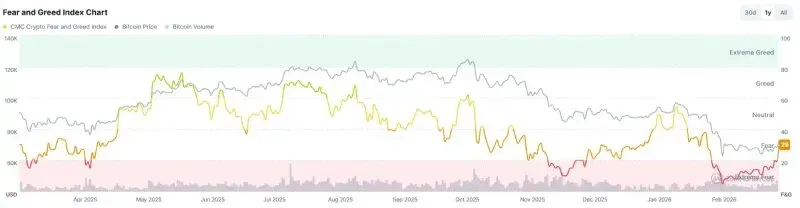
Recently, two major political developments have lifted global risk appetite: the White House submitted Kevin Warsh’s nomination to the Senate as a candidate for Federal Reserve Chair, and the U.S. Senate voted down a resolution that would have limited former President Trump’s ability to conduct military actions against Iran. Market participants generally interpret Warsh’s nomination as a signal of continuity and a relatively dovish stance from the Fed, while the Senate vote eased concerns about an escalation of Middle‑East conflict, thereby averting a worst‑case scenario.
- Gold: As a traditional safe‑haven, gold is fluctuating between $5,150 – $5,300 per ounce.
- U.S. equity crypto‑related stocks: MSTR +10.37 %, COIN +14.57 %, CRCL +5.63 %.
In addition, data from Bitget shows that Asian equity markets opened higher: South Korea’s KOSPI jumped 565.69 points (+11.02 %) to 5,654.72, while Japan’s Nikkei 225 rose 2,319 points (+4.28 %) to 56,564.54.
In this article we dissect the logic behind the recent price recovery that followed a sizable bottom‑buy of Bitcoin. By combining information on cost bases, contract liquidations, and macro‑policy signals, we conclude that the current move is more consistent with a short‑term rebound than with a structural turning point. Detailed data interpretation helps readers gauge the genuine direction of market sentiment; subsequent sections will explore potential risks and opportunities that may lie ahead, so a careful read is recommended.
BTC Spot ETF — Large Net Inflows Since Late February
- From the end of 2025 through early February 2026, Bitcoin spot ETF flows displayed occasional spikes of large net inflows, interspersed with several episodes of sizable net outflows.
- Since the record‑high inflow observed in October 2025, the cumulative holdings of U.S. Bitcoin spot ETFs have decreased by roughly 100,300 BTC as of February 20, 2026, representing the largest drawdown in the current cycle.
Starting on February 20, the inflow trend reversed, producing multiple periods of substantial net inflows.
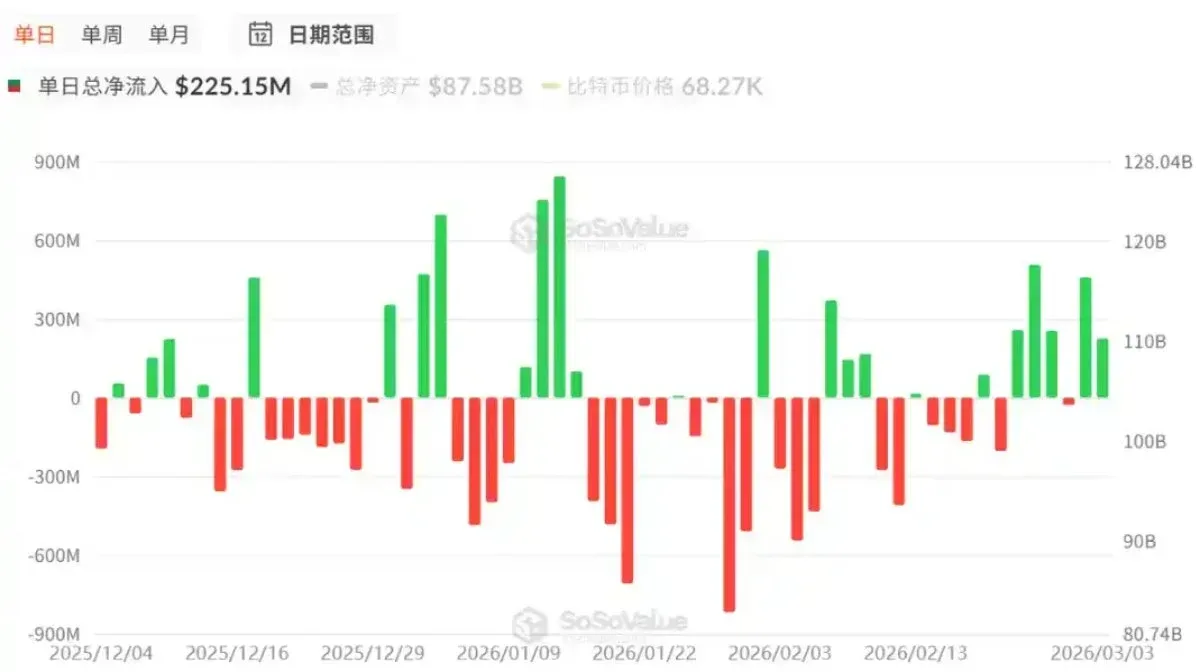
As of March 5, only two net outflow events were recorded, both of modest size; on the same day, single‑day net inflows peaked at $458 million and $506 million respectively. The resurgence of capital has helped push BTC prices upward, confirming the observed pattern.
400,000 BTC Accumulated in the $60k‑$70k Range, Selling Pressure Eases
During Bitcoin’s pullback in February, Glassnode data revealed a pronounced buildup of coins in the $60,000 – $70,000 price band, with more than 400,000 BTC being accumulated by investors—a clear “bottom‑buy” signal. Supply in this range grew from roughly 997,000 BTC on January 1 to about 1,430,000 BTC at present, an increase of approximately 429,000 BTC (≈ 43 %). This quantity accounts for over 8 % of the circulating supply that is not held on exchange platforms, forming a dense holding zone.
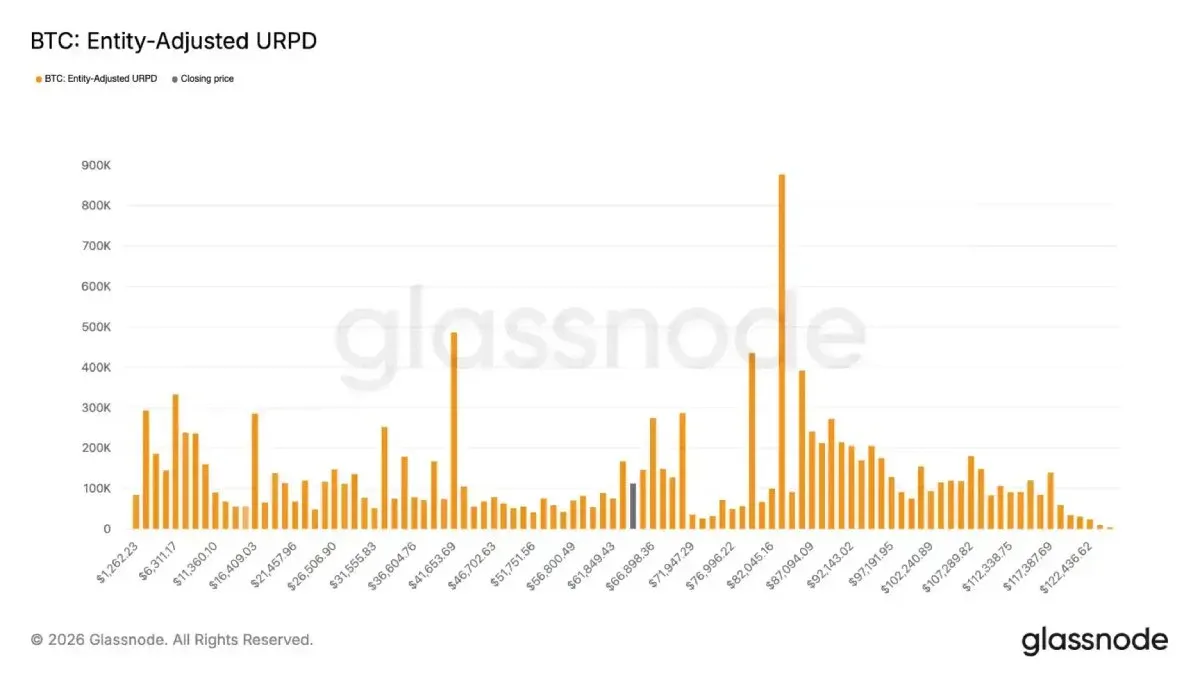
A chart dated March 3 shows that the net position change of Long‑Term Holders (LTH) has begun to flatten, suggesting that as Bitcoin’s price stabilises, seasoned holders are reducing their sell pressure. Supply resistance remains, but the intensity of selling has diminished.
Stablecoin Market Capitalisation Remains Elevated, Up $1.737 B Over the Past 7 Days
Stablecoins serve as a key barometer for capital flows within the crypto ecosystem. According to DefiLlama, the total market cap of stablecoins is holding steady at a lofty $310.848 billion. Over the last seven days, USDT grew by 0.03 %, while USDC expanded by 1.84 %.
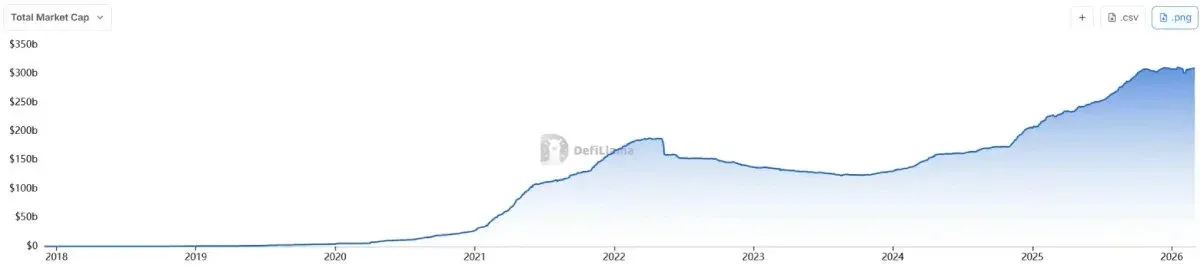
Looking at the past month, USDC market cap rose by 8.6 %, PYUSD by 16.7 %, U by 29.04 %, and USDG by 12.87 %. The sustained high‑level operation of stablecoins not only supplies ample liquidity but also reflects a continued influx of capital into the broader crypto ecosystem—trading volumes remain in the trillion‑dollar range, and stablecoins act as a bridge that stores momentum for the next growth phase of assets such as Bitcoin. Although the growth is not explosive, the steady supply itself signals a maturing market and a restoration of confidence.
Institutional Opinions and Market Outlook
- Michael Saylor—through MicroStrategy’s unlimited‑purchase strategy—now holds more than 720,000 BTC at an average cost of roughly $76,000 per coin. He likens Bitcoin’s current stage to Apple’s early “valley of despair,” asserting that the digital asset is poised to outperform traditional investment classes in the future.
- Cathie Wood, founder of ARK Invest, noted in the February 2026 outlook report that Bitcoin’s down‑cycle may be nearing its end. She emphasized Bitcoin’s low correlation with other assets, which can enhance risk‑adjusted returns in diversified portfolios, and highlighted the deepening institutional interest in crypto.
- Tom Lee, Chairman of BitMine, told CNBC that despite lingering geopolitical risks involving the United States, market performance has exceeded expectations and the asset is presently in a bottom‑building phase. He observed that the declines in software, “MAG 7,” and crypto assets are roughly 90 % complete; even if global trade disruptions arise, AI and the MAG 7 companies retain solid fundamentals. Lee advised investors to stay patient and prudent, keep a portion of cash on hand, but recognise that new opportunities are beginning to surface.
---
That concludes this piece. For more Bitcoin bottom‑buy analyses, please search for Bitaigen (比特根) archives or continue scrolling to the related content below. Thank you for your support!
Related Reading
- Bitcoin Breaks $62K Resistance: Altcoin Rally Ignites
- Bitcoin Halving Explained: Impact on Supply and Markets
- Best Platforms to Buy Bitcoin (BTC) for Beginners in 2024
💡 Register on Binance with referral code B2345 for the maximum trading fee discount. See Binance complete guide.



