
 Bitaigen Research
In this article we dissect the recent strength of Bitcoin’s rebound and the tangled contradictions within the DeFi ecosystem, focusing on the fissures that have emerged in Aave and what they may imply for the broader reshaping of financial structures. By cross‑examining multi‑dimensional data and industry viewpoints, we aim to help readers clarify the potential risks and opportunities present in the current market, enabling more rational judgments.
Overview of the DeFi Market
According to data from Cointelegraph Markets Pro and TradingView, the top‑100 crypto assets by market cap showed an overall upward trend this week. The biggest weekly gainer was the River (RIVER) token, which surged 94 % over the past seven days, followed by the Humanity Protocol (H) token with a 39 % increase.
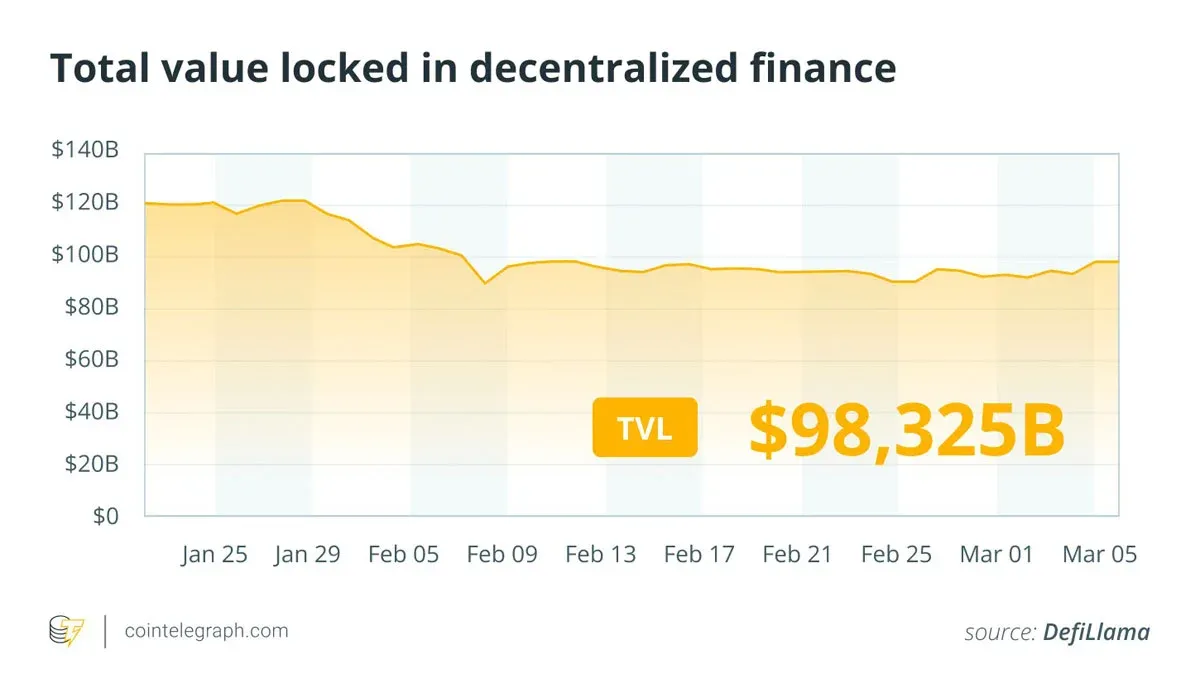
The total value locked (TVL) in DeFi also fluctuated in line with these movements; detailed figures can be consulted on DefiLlama.
Stablecoin Inflows Rebound to $1.7 Billion, Washington Engages in Yield‑Rule Dispute
Messari’s latest report shows that, driven by a resurgence in on‑chain activity, the net inflow of stablecoins last week climbed to $1.7 billion, a 414.5 % month‑over‑month increase. The 30‑day average daily inflow turned positive at $162.5 million after previously being negative, while trading volume rose 6.3 %. Average transaction size, however, fell, indicating that retail demand for stablecoins is recovering.
The report notes that two weeks earlier the weekly inflow was only $249 million, and that the 30‑day cumulative net outflow up to February 18 had reached $4.4 billion.
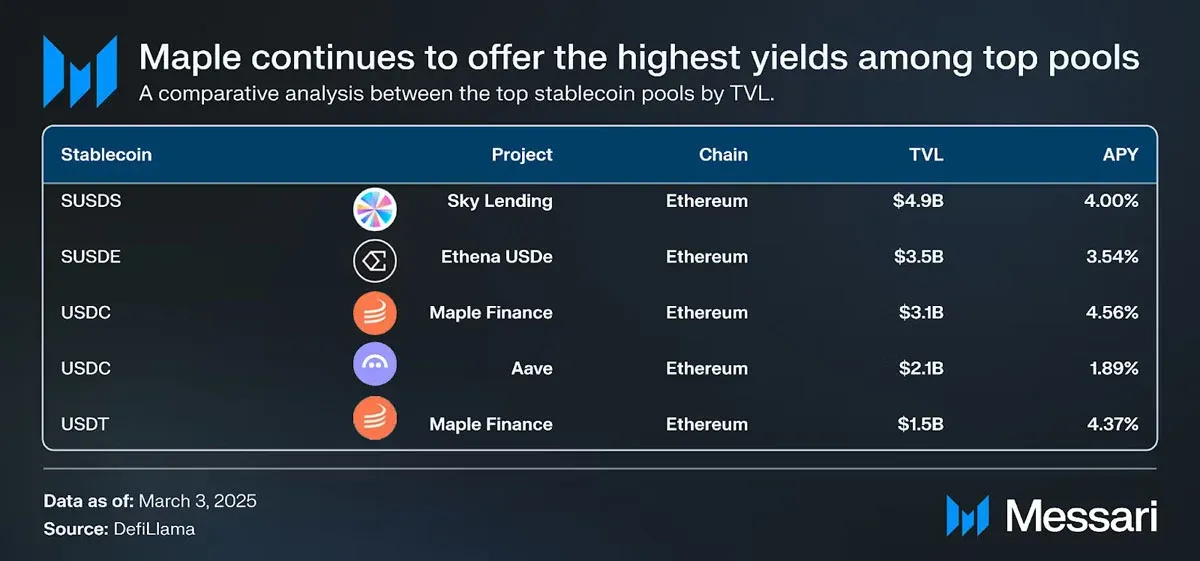
Below is the list of stablecoins ranked by yield (source: Messari).
Aave Chan Initiative Exits Aave DAO Following Governance Conflict
The Aave Chan Initiative (ACI)—a key governance representative and service provider within the Aave ecosystem—announced it will not renew its partnership with the Aave DAO and will wind down operations over the next four months.
Founder Marc Zeller stated in a public comment on Tuesday that the organization will complete any outstanding governance tasks before transferring its infrastructure and responsibilities to the DAO or a successor entity.
“The Aave Chan plan was built for Aave. If there is no future for it within the Aave ecosystem, the name loses its meaning. As our obligations conclude, ACI will terminate accordingly.”
ACI emphasized that the primary driver for the exit is concern over governance standards and voting dynamics observed during the proposal process, marking a new phase for Aave’s governance architecture.
Solv Protocol Offers 10 % Bounty After $2.7 M Treasury Exploit
The Bitcoin‑backed decentralized finance platform Solv Protocol recently disclosed that its token treasury suffered an attack resulting in an estimated loss of $2.7 million. To incentivize the return of the stolen assets, the project is offering a bounty equal to 10 % of the amount taken.
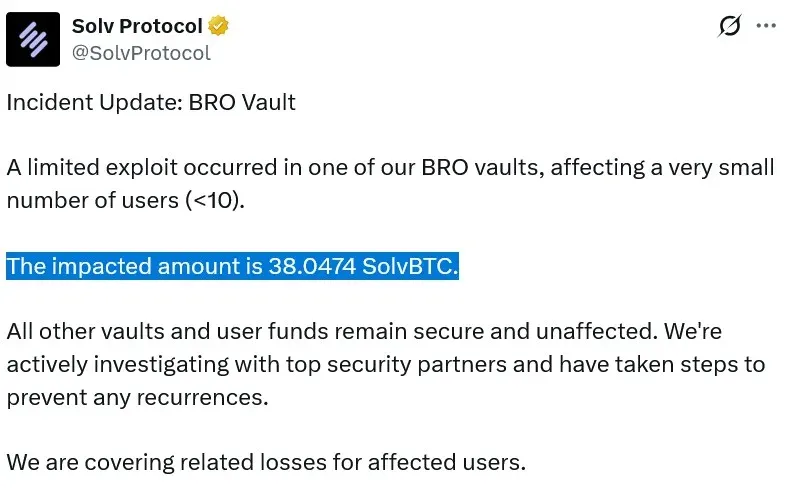
On X (formerly Twitter), Solv explained that fewer than ten users were affected and that compensation will be provided in 38.05 SolvBTC (a Bitcoin‑pegged token). The team has partnered with security firms Hypernative, SlowMist, and CertiK to investigate the breach and implement safeguards against similar vulnerabilities.
The platform allows users to deposit Bitcoin into the SolvBTC contract, which can then be used for lending or collateralizing assets on other chains. Solv claims to hold 24,226 BTC, valued at over $1.7 billion, making it one of the largest on‑chain Bitcoin reserves. Security researchers identified the exploit as a contract flaw that permitted the attacker to over‑mint tokens.
Bybit Claims New Fraud‑Prevention System Thwarted $300 M of High‑Risk Withdrawals in Q4 2025
In a corporate blog post, Bybit revealed that its AI‑assisted risk‑monitoring system, launched in the fourth quarter of 2025, successfully blocked or halted more than $300 million in suspected fraudulent withdrawal attempts. During the same quarter the system processed roughly $500 million in withdrawal requests; real‑time risk alerts or outright transaction blocks prevented potential losses for over 4,000 users.
Risk‑control head David Zong explained that most of the intercepted funds were voluntarily canceled by users after receiving warnings, leaving the assets safely within their accounts and eliminating the need for recovery actions. The system also flagged 350 high‑risk fraudulent addresses, protecting approximately 8,000 users from further withdrawal threats and stopping over 3 million credential‑filling attacks.

In 2025, hacking incidents across the crypto sector resulted in cumulative losses of about $3.4 billion, with attackers increasingly targeting large cryptocurrency platforms.
Strive Strategist Suggests AI‑Driven Deflation Could Push Bitcoin to $11 Million by 2036
In its latest research note, Joe Burnett, Vice‑President of Bitcoin Strategy at Strive, posits that technological deflation driven by artificial intelligence may force central banks to continuously expand monetary supply, potentially propelling Bitcoin’s price to $11 million within a decade.
Burnett argues that AI‑accelerated productivity will depress the prices of goods and services, compress profit margins, and compel policymakers to adopt more accommodative monetary stances. His model forecasts a $68,070 baseline budget for Bitcoin in the first quarter of 2036, with the price breaking the $11 million threshold during the same period.
“My baseline budget for the first quarter of 2036 is $11 million per Bitcoin.”
The projection rests on several aggressive assumptions: Bitcoin’s market cap will represent roughly 12 % of global financial assets, and global wealth will compound at an annual rate of 7 % leading up to 2036. Currently, Bitcoin accounts for about 0.2 % of total financial assets; at this growth pace, its market cap could expand more than 176‑fold over ten years, reaching approximately $230 trillion.
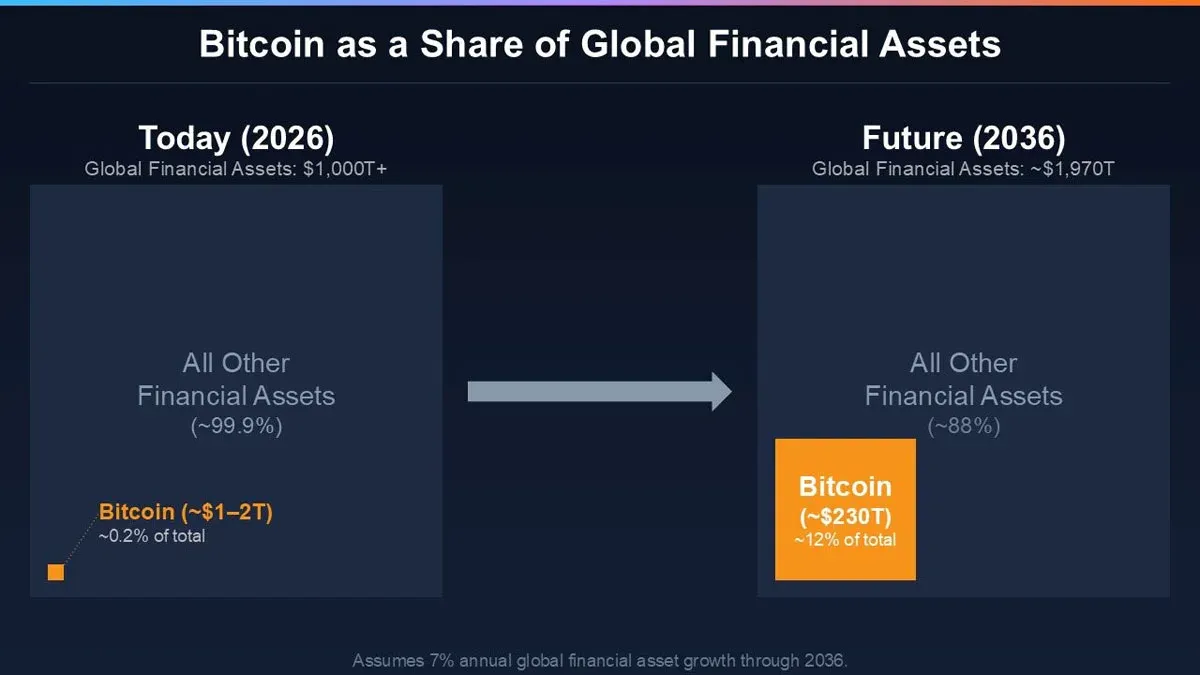
Nic Puckrin, co‑founder and chief market analyst at educational platform Coin Bureau, commented that the forecast suggests Bitcoin could become a primary global reserve asset within the next decade, implying that monetary policy will remain structurally loose.
“The projection indicates Bitcoin’s total value could approach ten times the current U.S. M2 money supply, roughly four times the size of the U.S. stock market, and even comparable to twice the global GDP.”
Puckrin further noted that this equates to an annual compound growth rate of around 53 %—higher than Bitcoin’s average 60 % compound growth from 2015‑2024—but acknowledges that as the market cap scales, the growth rate is likely to moderate.
Shawn Young, chief analyst at MEXC Research, concurred with the outlook, warning that while the model suggests a 16,318 % price increase over ten years, reduced volatility may keep the realistic price corridor near the $1 million mark.
Bitcoin (BTC) Rebound Meets DeFi Turbulence
During the past week, Bitcoin fell to a low of $63,245 on Sunday before briefly climbing back to $73,000 on Thursday, buoyed primarily by renewed demand for the U.S.-listed spot Bitcoin ETF. The ETF recorded net inflows of $1.1 billion in the week preceding Thursday.
The ETF’s trading volume has reached the million‑dollar level (source: Farside Investors).
As Bitcoin’s price recovers, the DeFi sector simultaneously wrestles with Aave’s governance dispute, the Solv treasury exploit, and broader platform‑security regulatory challenges, signaling an unprecedented period of financial system redefinition.
This concludes the full analysis titled “Bitcoin (BTC) Rebound Meets DeFi Turbulence, Aave Fissures Intensify, Where Is Finance Redefined?” For additional insights, please follow other articles from Bitaigen.
💡 Register on Binance with referral code B2345 for the maximum trading fee discount. See Binance complete guide.



