
 Bitaigen Research
 BlackRock Quietly Hoards 3% of Bitcoin (BTC): An In-Depth Analysis of the Institutional Giant's Strategic Positioning

BlackRock’s ownership of 3% of the total Bitcoin supply signifies that the world's largest asset manager has officially designated BTC as a core strategic asset. This move has not only injected massive liquidity into the global market through the iShares Bitcoin Trust (IBIT) but also marks the definitive transition of Bitcoin from a fringe speculative asset to a regulated, institutional-grade reserve asset. This shift significantly bolsters Bitcoin's legitimacy and market stability within the broader global financial ecosystem.
In this article, we provide an in-depth analysis of the recent maneuvers by the world's largest asset management firm in the Bitcoin space. We explore the underlying investment logic, regulatory implications, and the potential ripple effects on market liquidity and price volatility. Through a cross-examination of data and industry perspectives, we aim to clarify the long-term significance of institutional entry into the Bitcoin ecosystem for our readers.
1. What Percentage of Bitcoin Does BlackRock Currently Hold?
BlackRock entered the market through its iShares Bitcoin Trust (IBIT), ushering in a new era of large-scale institutional accumulation of Bitcoin.
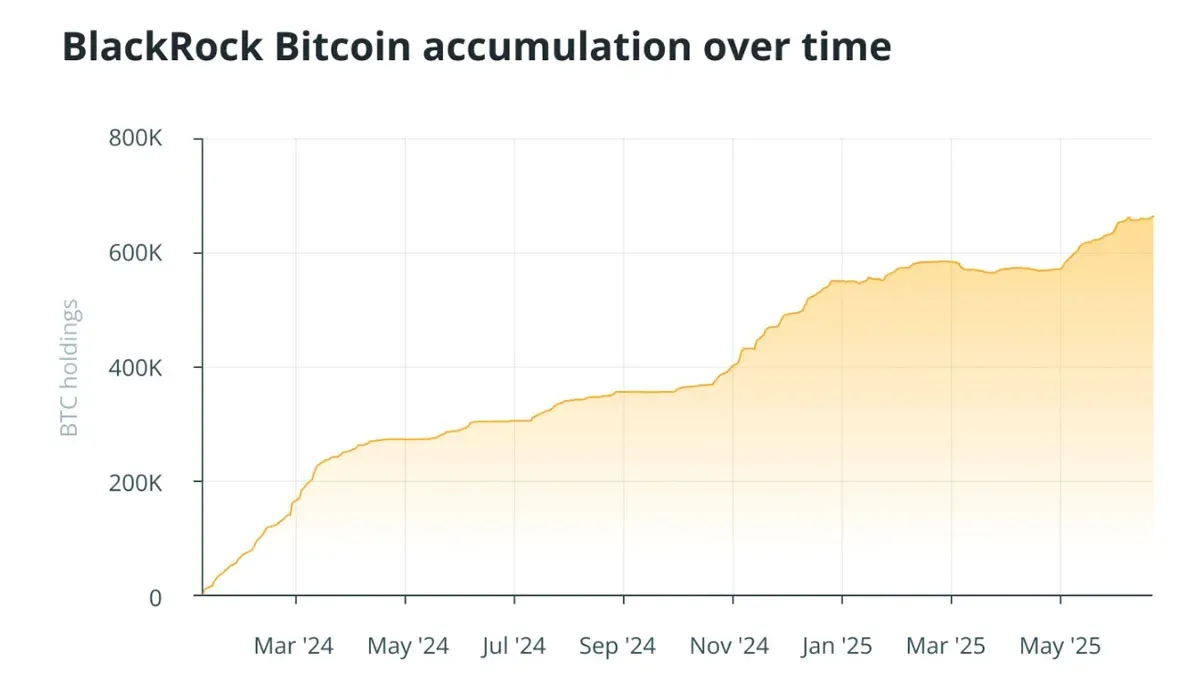
Since receiving regulatory approval for listing on January 11, 2024, IBIT’s growth rate has shattered multiple records in ETF history. As of June 10, 2025, the amount of Bitcoin held by BlackRock has surpassed 662,500 BTC, accounting for more than 3% of the total circulating supply of Bitcoin. Based on market prices at that time, this represents a massive financial exposure of approximately $72.4 billion USD.
| Metric | Detailed Data |
|---|---|
| **Total Holdings** | Over 662,500 BTC |
| **Percentage of Supply** | 3% + |
| **Assets Under Management (AUM)** | Approx. $72.4 Billion USD |
| **Time to Reach $70B AUM** | 341 Trading Days |
By comparison, the traditional SPDR Gold Shares (GLD) took more than 1,600 trading days to reach $70 billion in assets under management, whereas IBIT achieved this milestone in just 341 days. Currently, BlackRock's Bitcoin holdings have surpassed those of the vast majority of centralized exchanges and corporate giants like MicroStrategy. In terms of raw holdings, only the estimated 1.1 million BTC held by Satoshi Nakamoto remains ahead of BlackRock, and this gap is steadily narrowing as institutional inflows continue.
BlackRock's Long-Term Bitcoin Custody Mechanism
Coinbase Custody serves as the critical service provider for IBIT’s assets. BlackRock does not manage the private keys directly; instead, Coinbase is responsible for securely storing the Bitcoin in offline cold wallets. This setup is further protected by commercial insurance, ensuring the security of institutional-grade capital. For individual investors looking to follow suit, it is important to note that platform availability varies by region: users in the United States must use Binance.US, while those in the global market typically use the standard Binance platform.
2. Why Has BlackRock Chosen a Massive Bitcoin Allocation in 2025?
The strategic perspective of institutional investors toward Bitcoin has undergone a fundamental transformation, with the asset now viewed as an indispensable component of a long-term diversified investment portfolio.
BlackRock’s Core Bitcoin Strategy
BlackRock’s internal logic is based on the premise of accepting Bitcoin’s high Volatility in exchange for its potential for significant high-end upside. The firm believes that as compliant tools like IBIT become more widespread, broader institutional participation will gradually stabilize the market, improve Price Discovery mechanisms, and enhance overall liquidity. This endorsement has shifted the global conversation from "Is Bitcoin safe?" to "How should Bitcoin be allocated?"
Three Main Investment Logics for Institutional Accumulation
- Scarcity Value: Bitcoin’s hard cap of 21 million coins and its Halving mechanism every four years give it deflationary properties similar to gold. However, within its digital architecture, Bitcoin is far easier to transfer and subdivide.
- Hedge Against Fiat Risk: Against a backdrop of global debt expansion and geopolitical instability, Bitcoin’s decentralized nature makes it a neutral reserve asset. It serves as an effective hedge against currency devaluation and the risks associated with government intervention.
- Intergenerational Wealth Transfer: BlackRock views Bitcoin as the core of financial digitization. As younger generations of investors increasingly take the reins of global wealth, the recognition of this "digital gold" is growing at an exponential rate.
By comparing Bitcoin to high-volatility tech stocks like the "Magnificent Seven," BlackRock suggests that allocating 1% to 2% of Bitcoin within a traditional 60/40 stock-bond portfolio can optimize the risk-reward ratio for modern investors.
3. The Profound Impact of Bitcoin ETFs on the Crypto Market
The emergence of Spot ETFs has become a major turning point for Bitcoin across regulatory, transactional, and cognitive dimensions.
In the past, the Bitcoin market was often subject to extreme volatility due to insufficient liquidity. Proponents argue that the involvement of institutions like BlackRock will bring a deeper pool of capital, making the market more resilient. However, critics worry that large-scale institutionalization may introduce systemic risks from traditional finance, such as high-leverage trading and algorithm-driven flash crashes.
The double-edged sword of Financialization means that while Bitcoin may gain stability, it may also see an increased correlation with traditional stock markets, potentially weakening its independence as a safe-haven asset.
4. Institutional Accumulation Grants Mainstream Legitimacy
BlackRock’s deep involvement has pushed Bitcoin from the fringes as an "experimental asset" onto the mainstream financial stage.
IBIT provides a regulated, low-barrier investment channel, resolving concerns regarding custody, taxation, and compliance for institutional investors. It is not just retail investors participating; top-tier institutions, such as Abu Dhabi’s Mubadala sovereign wealth fund, have also indirectly allocated approximately $409 million USD to Bitcoin assets through their holdings in IBIT.
Investors should be mindful that as Bitcoin integrates into the traditional financial system, tax obligations become more transparent. In most jurisdictions, including the US and Europe (utilizing SEPA/SWIFT for fiat transfers), cryptocurrency gains are typically taxable. Investors are encouraged to consult local tax regulations regarding capital gains.
5. The Paradox of Centralization: Institutionalizing a Decentralized Asset
When the world’s largest asset manager holds more than 3% of the supply, a paradox regarding Centralization arises.
The original intent of Bitcoin was decentralization, yet in reality, the majority of users now interact with the asset through Centralized Exchanges (CEX) or ETFs. This "centralization of the access layer," while contradicting the vision of some crypto purists, is seen as a necessary compromise for Bitcoin to achieve global adoption. The market has largely accepted this hybrid model of a "decentralized base layer + centralized access layer."
6. Evolution and Challenges of Regulatory Policy
The U.S. Securities and Exchange Commission (SEC)’s approval of spot Bitcoin ETFs in 2024 was a milestone for the industry, but the regulatory framework remains incomplete.
Currently, disputes persist over whether assets like Ethereum (ETH) and Solana (SOL) should be classified as securities. This regulatory ambiguity limits the development of innovative products, such as staking-based ETFs. Institutional investors remain in a "wait-and-see" mode regarding assets beyond Bitcoin, pending the establishment of clearer and more unified global regulatory rules.
In summary, BlackRock’s 3% stake in Bitcoin is more than just a numerical accumulation; it is a powerful vote of confidence in Bitcoin as a "Digital Currency Standard." As institutional capital continues to penetrate the market, Bitcoin is accelerating its integration into the global financial infrastructure.
This concludes our in-depth analysis of BlackRock's accumulation of 3% of the Bitcoin supply and its broader implications. For more professional insights into cryptocurrency and institutional dynamics, please stay tuned for further reports from Bitaigen.
Related Reading
- Bitcoin Evolution: From Niche Asset to Global Financial Pillar
- Bitcoin (BTC) Price Prediction 2026-2040: Long-Term Analysis
- Bitcoin Price Forecast 2026: Technical Analysis & Sentiment
💡 Register on Binance with referral code B2345 for the maximum trading fee discount. See Binance complete guide.



