
 Bitaigen Research
 In this article we outline how Zest Protocol introduces BTCz to the Bitcoin‑compatible Proof‑of‑Stake (PoS) public chain Babylon, analyze its innovative mechanisms and yield pathways within the Bitcoin DeFi ecosystem, help readers grasp the core value of cross‑chain positioning, and will later discuss operational details and associated risks. Stay tuned.

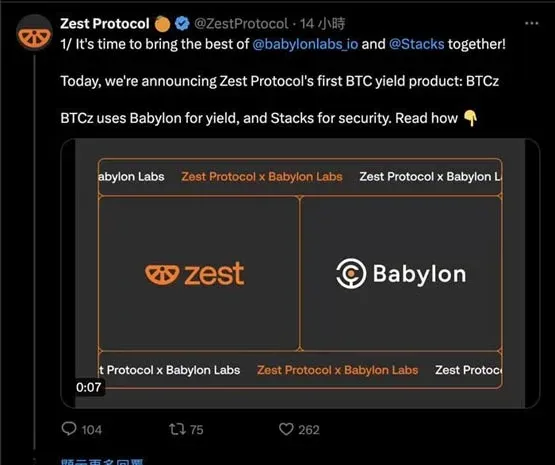
Zest Protocol, which received investment from Binance Labs, has recently deployed its yield‑bearing Bitcoin staking certificate BTCz onto the Bitcoin‑compatible PoS public chain Babylon, opening a new chapter for Bitcoin DeFi.
Zest Protocol has now deployed BTCz on Babylon, launching yield‑generating staking of Bitcoin on a PoS public chain and providing liquidity and yield channels for Bitcoin DeFi.
Zest Protocol is a lending platform incubated with the help of Binance Labs. It has released a Bitcoin‑backed yield‑bearing certificate $BTCz. Holders can stake $BTCz on the Bitcoin‑compatible PoS public chain Babylon to earn additional staking rewards. The protocol belongs to the Stacks second‑layer network ecosystem, and its locked value currently stands at roughly USD 24.16 million. Users can collateralize or borrow $STX on the platform, and the issuance of $BTCz enables Zest Protocol to generate revenue directly from Bitcoin for the first time.
What are the key features of BTCz?
- Enhanced capital efficiency: Zest co‑founder Tycho Onnasch believes that $BTCz can earn staking yields on a Bitcoin PoS network while preserving the asset’s liquidity.
- Security guarantee: More than a dozen Bitcoin‑derived assets already circulate on compatible networks; $BTCz is the only one that benefits from the high‑security guarantees provided by Stacks.
- Complementary to $sBTC: Compared with the native $sBTC on Stacks (which focuses on main‑net DeFi applications but lacks a yield component), $BTCz offers a yield‑bearing attribute and can complement $sBTC.
Definition: A yield‑bearing Bitcoin asset is one that generates additional returns by staking in a PoS network while retaining the liquidity of the underlying Bitcoin.
At present $BTCz is not yet generating yields because Babylon’s PoS functionality is still in the testing phase. Onnasch indicated that once PoS officially launches in the coming months, the staking rewards for $BTCz will commence.
A surge of Bitcoin‑compatible public chains
The year 2024 is being viewed as a breakout year for Bitcoin‑based applications. Numerous projects are working to build DeFi solutions atop Bitcoin. Recent weekly reports show that several Bitcoin‑compatible public chains—including CORE, BounceBit, BSquared, and Babylon—have experienced a noticeable increase in total value locked, turning the public‑chain segment into a hot topic. It is worth noting that the market‑wide downturn last week could temper this upward trend.
Future challenges for Bitcoin DeFi applications
- Code security: Staking, re‑staking, and cross‑chain interoperability on these PoS public chains rely on smart contracts; thorough security audits remain a critical risk factor.
- Decentralization principle: While PoS staking can boost network security, the model may clash with Bitcoin’s original “trust‑less, decentralized” design philosophy, introducing potential external‑dependency risks.
- Long‑term sustainability: Whether Bitcoin DeFi solutions truly enhance Bitcoin’s security and decentralization will need to be validated through real‑world operation.
---
The above provides a comprehensive overview of how Zest Protocol, backed by Binance Labs, has deployed BTCz onto Babylon to promote Bitcoin DeFi development. For the latest updates on Bitcoin DeFi, please follow the subsequent reports from Bitaigen.
Additional notes for a global audience
- All fiat references are expressed in USD; transfers can be made via SEPA or SWIFT where applicable.
- U.S. residents who wish to interact with Binance‑related services should use Binance.US rather than the global Binance platform, in compliance with local regulations.
- Crypto gains may be subject to taxation in the holder’s jurisdiction; users should consult local tax advisors for guidance.
Related Reading
- SatLayer (SLAY) Review: Bitcoin‑Based DeFi, RWA & Insurance
- Lombard (BARD) DeFi Token: Bitcoin Liquidity & Governance
- Lombard (BARD) Guide: Unlocking Bitcoin DeFi (BTCFi) Utility
💡 Register on Binance with referral code B2345 for the maximum trading fee discount. See Binance complete guide.



