
 Bitaigen Research
 Proof of Stake (PoS)
PoS is a consensus mechanism for public blockchains whose core revolves around the economic stake held by validators. Unlike Proof‑of‑Work (PoW), which relies on computational competition, PoS determines voting weight based on the amount of ETH that is staked. Validators take turns proposing blocks and voting on them, and the size of their stake directly influences their influence within the network. Advantages of PoS include higher security, reduced centralisation risk, and a dramatic reduction in energy consumption. In Ethereum 2.0, activating a single validator requires a stake of 32 ETH.
---
In this article we outline the core concepts of Ethereum 2.0, from proof‑of‑stake to the beacon chain, sharding, and the key terminology of each development phase, helping readers quickly build a complete mental framework. Once these fundamentals are mastered, the subsequent technical details and upgrade paths become easier to understand. Feel free to continue reading for a deeper dive.
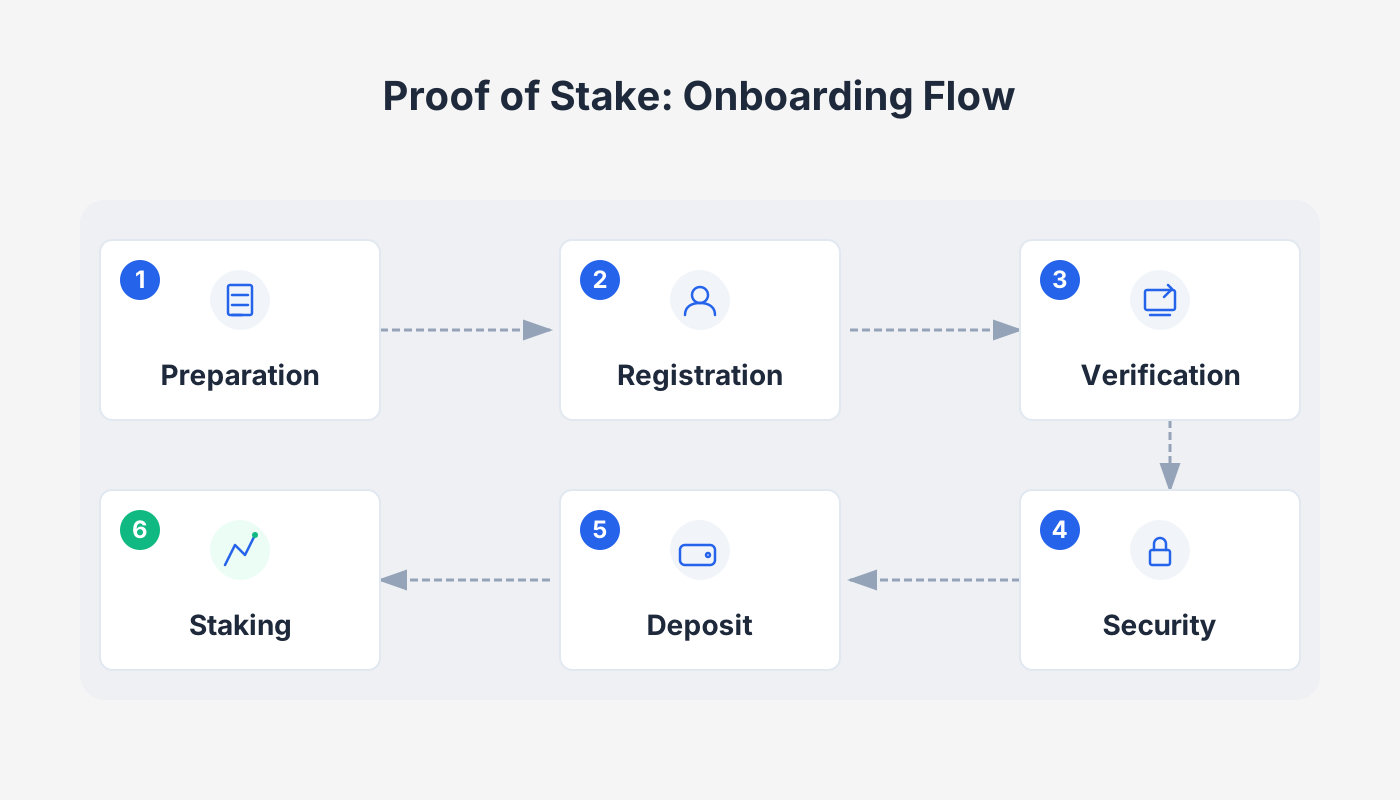
Phases of Ethereum 2.0
Phase 0
Phase 0 marks the official launch of the beacon chain (genesis on 1 December 2020), initiating the transition from PoW to PoS. This phase is solely responsible for managing validators and completing the consensus switch; it does not provide sharding or contract‑execution capabilities, and users cannot submit transactions or call smart contracts during this phase.
Phase 1
In Phase 1 the system will introduce shard chains and write data to those shards, aiming to increase Ethereum’s throughput. The current plan is to deploy 64 data shards in this phase, with the possibility of further expansion later.
Phase 1.5
This phase is the merger period between Ethereum 1.0 and the 2.0 chain. All state and functionality of Ethereum 1.0 will be migrated to the execution‑capable beacon chain, achieving seamless data consistency.
Phase 2
Phase 2 intends to integrate the full suite of 2.0 functionality, including an eWASM‑based virtual machine that provides an execution environment for shards, thereby enabling scalable applications on 2.0. At the same time, the 1.0 chain will be completely replaced by 2.0 and the Proof‑of‑Work mechanism will be fully retired. The latest roadmap has temporarily set this phase aside, but the possibility of a built‑in virtual machine remains.
---
Validators and Their Lifecycle
Validator in a PoS system is analogous to a “virtual miner.” Users activate a validator by depositing 32 ETH into the deposit contract; each deposit corresponds to a distinct validator entity. Validators run client software to participate in network duties; the client can either run a beacon node directly or connect to an existing beacon node.
Key Lifecycle Stages
- Deposit: After transferring 32 ETH to the deposit contract on ETH‑1, the state remains for roughly 7 hours to provide a safety buffer in case the ETH‑1 chain is attacked.
- Pending Activation: Until the total number of active validators reaches 327 680, at most 4 validators can be activated per epoch (about 900 per day). Once that threshold is passed, 5 validators can be activated per epoch, and for every additional 64 000 active validators the activation quota increases by 1, up to a maximum of (total active validators ÷ 64 000).
- Active: An active validator will be paused if any of the following occurs:
- Balance falls below 16 ETH (triggering ejection)
- Voluntary exit
- Slashing
---
Deposit Contract
Deposit Contract is deployed on the Ethereum PoW chain and serves as the entry point for staking. Users who wish to become Eth2 validators must send a specified amount of ETH to this contract; the contract records the staking history and locks the funds on the PoW chain before they are transferred to the beacon chain. It is important to note that, in the early stages, the deposit contract only supports one‑way transfers—staked ETH cannot be moved back from Eth2 to the PoW chain.
---
Beacon Chain
The beacon chain is the core layer of Eth2 Phase 0 and is also regarded as the system’s “coordination layer.” It carries out the following responsibilities:
- Assigning duties and roles to validators
- Finalising checkpoints
- Generating randomness on‑chain (RANDAO)
- Maintaining overall chain security and connectivity
- Providing voting data for fork choice
- Managing the transition and data exchange with shard chains
The most recent block at the tip of the chain is called the Chain head, and every block within a slot undergoes an LMD GHOST vote to confirm the legitimacy of the chain head.
---
Block Proposer and Committees
Block proposer
In each 12‑second slot, RANDAO randomly selects one validator to act as the block proposer; this single validator is responsible for submitting the next block.
Committees
Both the beacon chain and shard chains form committees of at least 128 validators in every slot. Validators are assigned to different committees through the pseudo‑random process of RANDAO and are tasked with Attestation voting on the proposed block to assess its validity.
---
Attestation and Related Concepts
- Attestation: A vote broadcast by a validator; after signature aggregation it is used to confirm a block’s validity, with voting power weighted by the validator’s balance.
- Attester: A validator on the beacon chain who can both propose blocks and vote on them.
- Justification: When more than two‑thirds of validators agree on both the source checkpoint and the target checkpoint of the same epoch, those two checkpoints are considered “justified.” If two consecutive epochs are justified (or a cross‑epoch justification occurs), the first epoch is regarded as Finalisation.
---
Checkpoints and Epochs
- Checkpoint: The block at the first slot of each epoch. If no block is produced in that slot, the most recent preceding block is used as the checkpoint. A single block can serve as the checkpoint for multiple epochs.
- Epochs: Groups of 32 slots; each slot lasts 12 seconds, so an epoch lasts 6.4 minutes.
- EBB (Epoch Boundary Block): In some literature, EBB is synonymous with checkpoint and denotes the boundary of an epoch.
---
Fork‑Choice Rule
Eth2 uses LMD GHOST (Latest Message Driven GHOST) as its fork‑choice rule. This rule relies on the “latest messages”—i.e., validators’ attestations—to determine which fork has received the most votes and therefore becomes the chain head. Compared with the traditional longest‑chain rule, LMD GHOST reduces the effectiveness of attackers in high‑latency networks and keeps chain reorganisation depth to a minimum.
---
Casper FFG and Voting Mechanism
Casper FFG is a PoS‑based block finalisation framework that incorporates Byzantine Fault Tolerance (BFT) principles. It provides an independent finality layer for blocks, allowing their immutability to be verified without depending on chain growth. Validators vote for the target checkpoint of the most recent epoch and the source checkpoint of the previous epoch; these votes are broadcast across the P2P network and eventually packaged into blocks by block producers.
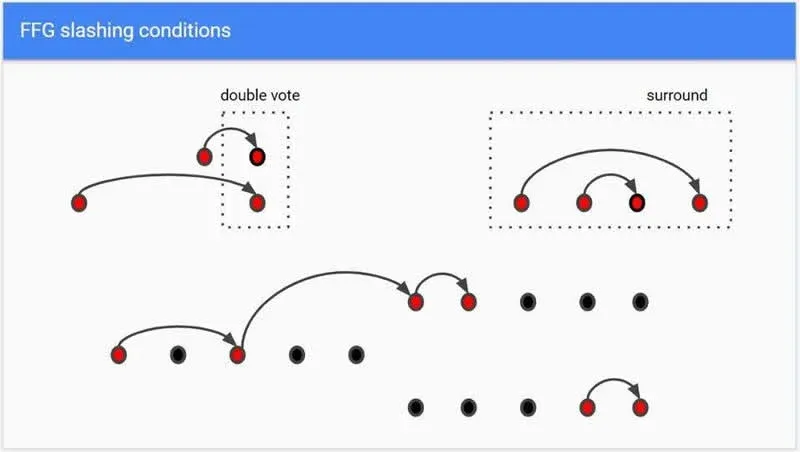
Types of Vote Violations
- Double proposal: Submitting more than one block in the same slot by the same validator.
- Double vote: Casting two votes for the same target checkpoint but with different source checkpoints, equivalent to a PoS “double‑spend.”
- Surround vote: The second vote’s source‑target interval completely encloses the first vote’s interval, which is prohibited.
These offences trigger Slashing.
---
Slashing Mechanism
When a validator is proven to have performed any of the above offences (double vote, surround vote, or double proposal), a portion or all of its staked ETH is destroyed and the validator is forcibly exited. The minimum slashing amount is 1 ETH, with a maximum that can reach the validator’s entire balance. Destroyed stake is redistributed proportionally among validators who are slashed in the same time window, preventing a single mistake from causing excessive punishment. An attacker would need to control a substantial number of validators for a successful attack, which in turn raises the slashing penalties.
---
Balance Concepts
- Current Balance: The total amount of ETH a validator presently holds.
- Effective Balance: The amount used for rewards or slashing calculations, derived from the current balance and capped at 32 ETH.
The effective balance can increase only when the condition “Current Balance ≥ Effective Balance + 1.25 ETH” is met. For example, if a validator’s effective balance is 20 ETH, the current balance must reach at least 21.25 ETH before the effective balance can be raised to 21 ETH. If the current balance falls below the threshold, the effective balance is correspondingly reduced.
Examples
- Current 32 ETH → Effective 32 ETH
- Current drops from 22 ETH to 21.76 ETH → Effective remains 22 ETH
- Current falls to 21.749 ETH → Effective drops to 21 ETH
- Current rises to 19.25 ETH with prior effective 18 ETH → Effective rises to 19 ETH
- Current rises to 22.25 ETH with prior effective 21 ETH → Effective rises to 22 ETH
---
Slots
Each slot lasts 12 seconds, during which a validator is randomly chosen as the block proposer. A slot may produce a block or remain empty. Within each epoch, validators are randomly assigned to specific slots and shards, forming committees of at least 128 members; those members other than the proposer are responsible for Attestation.
---
Sharding and the Shuffling Mechanism
Sharding is the concept of horizontally partitioning a large database; in blockchain it is used to enhance decentralised scaling capacity. Each shard chain has its own dedicated set of validators and nodes that only process transactions on that shard. Eth2 plans to implement 64 shards in Phase 1 and to establish interaction between the beacon chain and the shards.
Shuffling randomly reassigns validators to different shards, ensuring that no single shard can be controlled by a small group of malicious nodes. Mathematical models show that as long as an attacker controls fewer than one‑third of the total validators, a successful attack on any particular shard is highly unlikely.
---
This overview covers the core concepts from the “Ethereum 2.0 Glossary,” helping newcomers quickly become familiar with the beacon chain, PoS, sharding, and other key components. For more details, follow Bitaigen and its related topic articles!
Related Reading
- Proof‑of‑Stake (PoS) Consensus: Benefits, Risks & How It Works
- Ethereum Staking Guide: How PoS Works, Earnings & Risks
- Ethereum: From PoW to PoS – Ethash, Casper & Migration
💡 Register on Binance with referral code B2345 for the maximum trading fee discount. See Binance complete guide.



