
 Bitaigen Research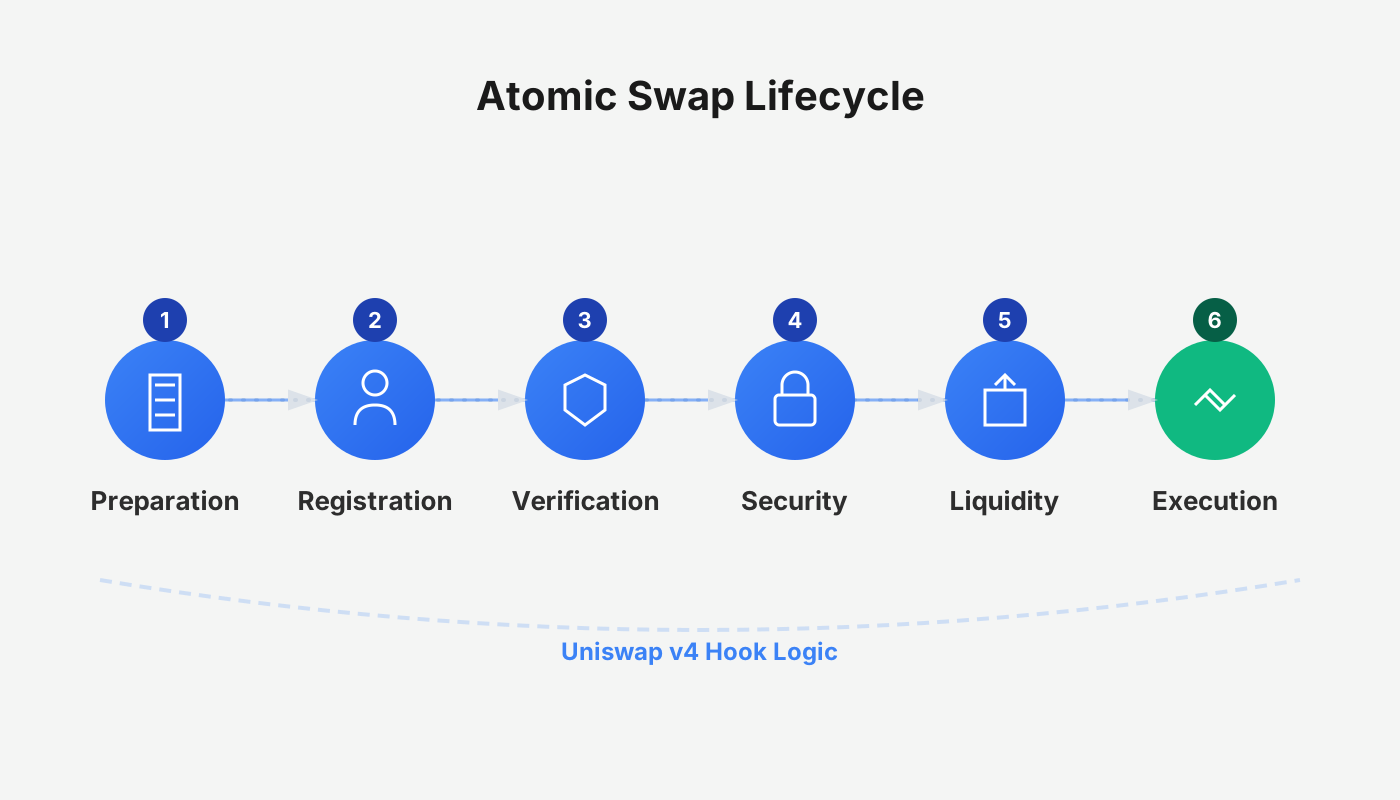
Understanding How to Leverage Symbiosis, Uniswap v4 Hooks, and Atomic Swaps in 2025 for More Efficient Crypto Swaps and Cross‑Chain Operations

Comparison of Crypto Swaps, Cross‑Chain Bridges, and Traditional Exchanges
| **Feature** | **Crypto Swap** | **Traditional Cross‑Chain Bridge** | **Spot Exchange (CEX)** |
|---|---|---|---|
| **Cost** | Low (AMM + Rollup gas) | Cross‑chain gas + slippage | Trading fee + withdrawal fee |
| **Speed** | Fast (completed on‑chain via Rollup) | Depends on bridge security, often slower | Affected by KYC processing |
| **Security** | Smart‑contract based, no custodial pool risk | May involve centralisation or contract bugs | Custodial risk |
| **KYC/Custody** | No KYC, non‑custodial | Most require KYC, custodial | Mandatory KYC, custodial funds |
| **Slippage** | Low (AMM optimisation) | Depends on bridge liquidity, generally higher | Influenced by order‑book depth |
The table shows that swaps executed directly between wallets have advantages in fee structure, speed, and decentralisation, especially in cross‑chain scenarios.
What Is a Crypto Swap?
In Q2 2025, DEX spot‑trading volume jumped 25.3 % to USD 8.76 trillion, while CEX volume fell roughly 28 % to USD 3.9 trillion over the same period. As on‑chain liquidity continues to deepen, more users prefer a “one‑click swap”: converting one digital asset to another without passing through fiat or an order book. For example, a BTC holder can directly receive ETH without first selling BTC for USD and then buying ETH.
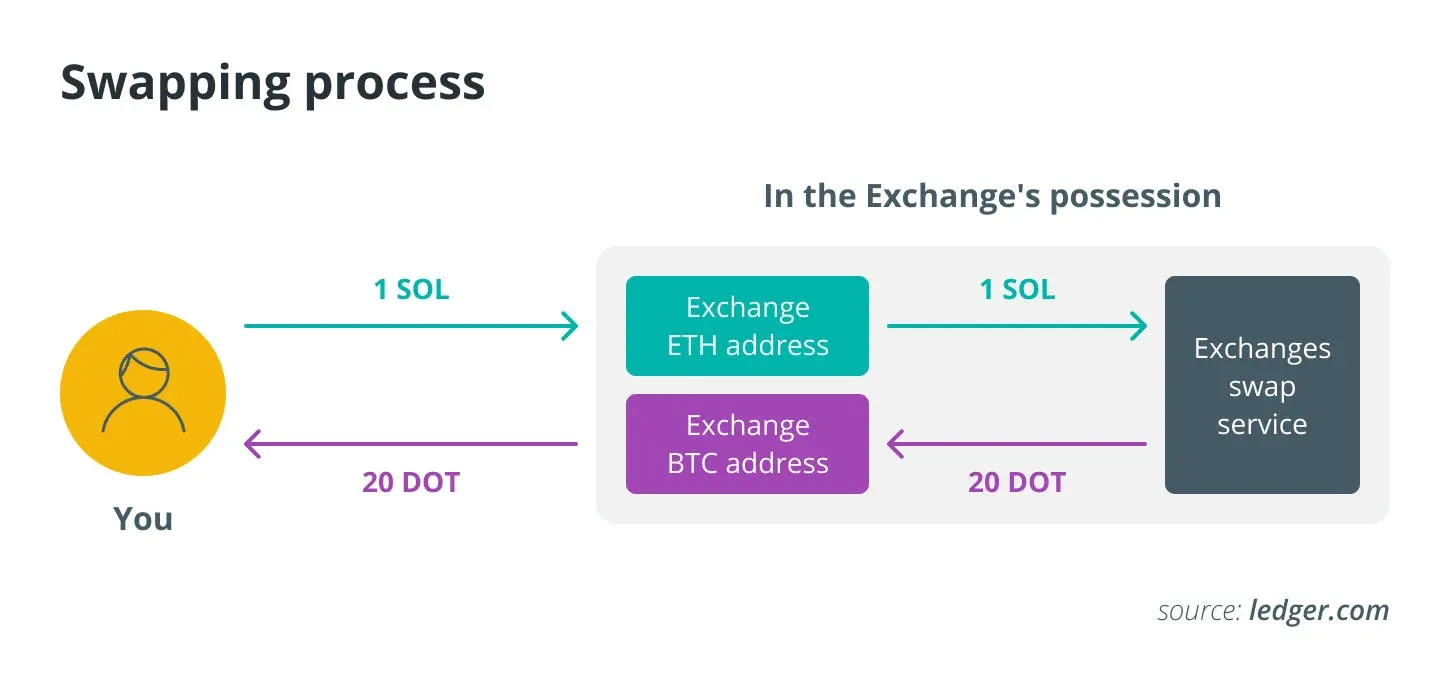
This swapping mechanism is essentially a peer‑to‑peer asset exchange between wallets, eliminating intermediaries and avoiding the traditional “sell → convert to fiat → buy” workflow. When the term “conversion” is used alone, it usually refers to platform‑internal fiat gateways or tools with hidden fees.
Advantages of Swaps Over Traditional Trading
- Lower fees: Users only pay on‑chain gas, avoiding the high fees and premiums charged by exchanges.
- Better liquidity: Automated market maker (AMM) pools supply quotes directly, resulting in almost zero slippage.
- Full self‑custody: Private keys stay with the user; no KYC or reliance on a centralized custodian is required.
- Fast execution: Most on‑chain swaps settle instantly, without waiting for fiat settlement or multi‑step cross‑chain confirmations.
Risk Points to Keep in Mind
Even though the user experience is streamlined, the following risks remain relevant:
- Contract security: Bugs in a DEX or bridge’s smart‑contract code could expose assets to theft.
- Large‑order slippage: On thinly‑liquified pairs, a big swap may still move the price noticeably.
- Functional limitations: Swaps are primarily designed for single‑step token‑for‑token exchanges and may not support complex trading strategies.
Consequently, leading cross‑chain bridges and swap platforms in 2025 typically undergo multiple audit rounds, maintain deep liquidity buffers, and implement front‑running protection to mitigate these risks.
Note: Crypto gains may be taxable in many jurisdictions. Users should consult local tax regulations and consider reporting requirements, especially when converting assets that generate realized profit.
Innovations Shaping 2025
Symbiosis Finance’s Full‑Chain Integration
Symbiosis aggregates Layer‑1 networks, Layer‑2 bridges, and liquidity from both EVM and non‑EVM chains into a single interface, allowing users to complete a cross‑chain swap with one click. The platform’s core is the proprietary SIS chain, which orchestrates bridging logic and provides two main benefits:
- Predictable fees – Bridge fees are fixed and do not fluctuate with network congestion.
- Faster execution – Cross‑chain trades settle on Symbiosis’s own Rollup, delivering reliability and speed that surpass typical decentralized bridges.
The SIS network uses a delegated Proof‑of‑Stake (PoS) consensus. Token holders can become validators directly or delegate to others, further decentralising risk and avoiding the pool‑based bridge designs that have suffered frequent attacks in recent years.
Tip: Symbiosis runs a peer‑to‑peer relay network that leverages Multi‑Party Computation (MPC) and Threshold Signature Scheme (TSS) to perform off‑chain cross‑chain validation. Relayers who stake SIS tokens earn rewards.
Uniswap v4: A New Paradigm for Single‑Chain AMMs
Uniswap v4 continues to focus on swaps within Ethereum and its Layer‑2 ecosystems, but introduces a hooks framework that lets developers inject custom logic at specific points in a trade’s lifecycle. Examples include:
- Dynamically adjusting fees based on real‑time market volatility.
- Supporting advanced order types such as TWAP (time‑weighted average price) and limit orders.
- Deep integration with on‑chain oracles for precise pricing and slippage control.
The underlying contracts adopt a monolithic architecture and incorporate flash settlement, reducing gas consumption by roughly 99 % compared with earlier versions. This makes Uniswap v4 an attractive option for users who prioritise ultra‑low fees and highly customisable trades on a single chain.
Did you know? Hook fees in Uniswap v4 can be set by developers, allowing mechanisms such as withdrawal penalties or performance‑based rewards.
4‑Swap: Peer‑to‑Peer Atomic Exchange Protocol
4‑Swap follows a completely different technical route: it does not rely on AMM pools nor on traditional bridge contracts. Instead, it uses Hash‑Time‑Locked Contracts (HTLCs) to enable direct, cross‑chain peer‑to‑peer swaps. Its “no‑worry” mechanism structures the transaction flow to prevent one party from stalling and causing the counter‑party’s funds to be locked or gas to be wasted. Key characteristics include:
- Maximum trust‑lessness – No liquidity pool is required; assets are locked and released directly on‑chain.
- Privacy‑preserving – Transaction details are visible only to the two participants.
- Price negotiation – The exchange rate is agreed upon by the parties rather than being set automatically by an AMM.
The protocol’s novelty lies in merging penalty fees with the principal amount, allowing the entire atomic swap to be executed in a single on‑chain transaction per chain (four steps total), dramatically reducing the number of on‑chain operations required.
Comparison of the Three Main Swap Solutions
| **Solution** | **Type** | **Strengths** | **Weaknesses** |
|---|---|---|---|
| Symbiosis | AMM cross‑chain swap (PoS Rollup) | Fast, low‑cost, no pool‑based bridge; own Rollup; supports EVM and non‑EVM chains | Relatively new project; depends on SIS token; less flexible than single‑chain AMMs |
| Uniswap v4 | Single‑chain AMM (Ethereum + L2) | Hooks enable high customisation; deep liquidity; gas reduced to ~1 % of earlier versions | Cross‑chain still needs external bridge; Ethereum L2 gas costs remain non‑trivial |
| 4‑Swap | Atomic exchange (HTLC) | Fully decentralised, strong privacy; no liquidity pool required | Requires counter‑party matching; slower execution; limited applicability |
The table demonstrates that by 2025 the swap landscape has solidified into three parallel tracks: high‑speed AMM aggregators, programmable single‑chain AMMs, and peer‑to‑peer atomic exchanges. Each track serves distinct user needs.
Closing Thoughts
As on‑chain liquidity continues to compound and cross‑chain bridge security improves, moving assets between networks is increasingly becoming a “one‑click” experience. Whether you prefer the proprietary Rollup of Symbiosis, the highly programmable environment of Uniswap v4, or the trust‑less ethos of 4‑Swap, all three represent noteworthy innovations worth following.
For readers interested in the latest cross‑chain trends in the crypto space, consider searching for historical articles from Bitaigen or exploring the related links below. Thank you for your continued support of Bitaigen!
---
*If you are based in the United States, remember that you must use Binance.US rather than the global Binance platform for any fiat‑on‑ramp or off‑ramp activities. For fiat transactions outside the U.S., SEPA (EUR) and SWIFT (USD) remain the common channels.*
Related Reading
- Enso: Blockchain Shortcut for Cross‑Chain Interaction
- Enso Cross-Chain Smart Layer: Fast Multi-Chain Development
- Zora Network: Cross‑Chain Architecture & Content Tokenization
💡 Register on Binance with referral code B2345 for the maximum trading fee discount. See Binance complete guide.



