
 Bitaigen Research
 We examine PUMP from three angles—token allocation, actual functionality, and the broader Solana environment—to help investors understand potential risks and opportunities, and to remind newcomers to steer clear of possible sell‑pressure. Continue reading for a full assessment.
Key Points
- Over 40% of the $PUMP supply belongs to the team and early investors, raising concerns about transparency and potential sell‑pressure.
- The token itself lacks clear use cases, holding rewards, or governance functions; its value relies mainly on short‑term meme effects.
- Historical activity records of the project’s members show that once hype peaks, they tend to quickly launch and dump the token.
- $PUMP was launched at a time when the Solana market was cooling, appearing more like a narrative climax than a long‑term protocol expansion.
- Because there is no vesting schedule or real utility, new investors should stay vigilant and avoid becoming an exit channel for insiders.
Overall Atmosphere of the Solana Ecosystem
Recently, the Solana blockchain has faced multiple challenges:
- After stabilising, SOL’s price entered a sideways range, with capital gradually flowing toward Ethereum L2s, Base, and emerging Layer‑1 projects.
- Most early Solana meme coins have stalled or suffered liquidity depletion, shaking community confidence.
- Audience attention is fatigued, and organic new‑user growth is slowing.
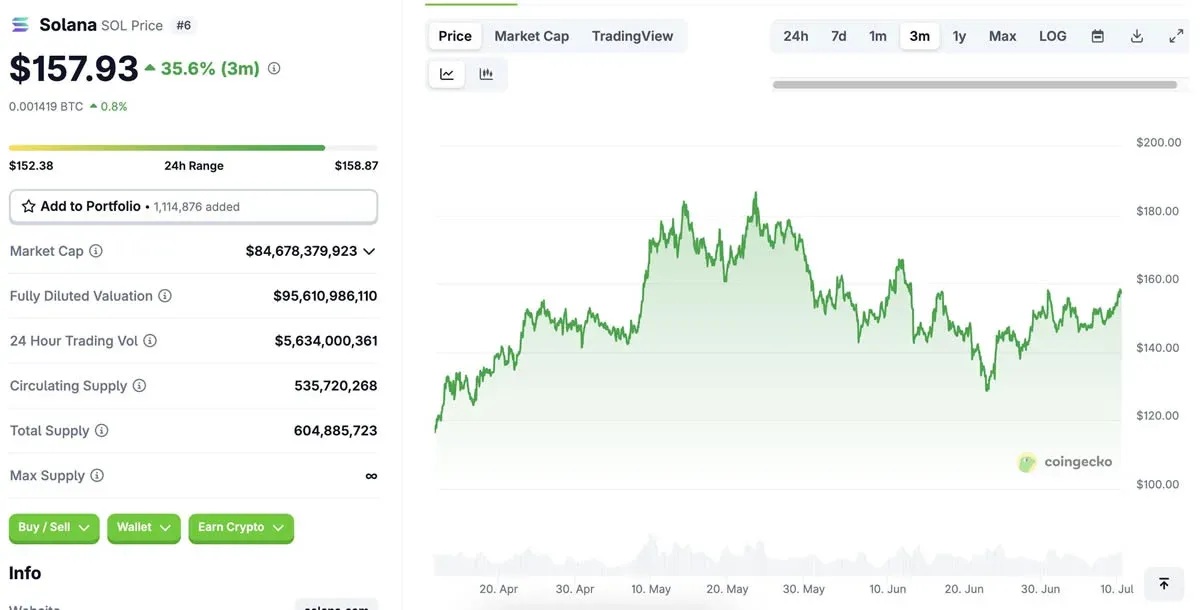
In this context, launching a token that lacks a roadmap, practical utility, or governance structure is likely to be perceived as a “last hurrah” rather than a genuine technological upgrade.
Distribution Overview of the PUMP Token
Pump.fun reports a total supply of 1 trillion tokens, allocated as follows:
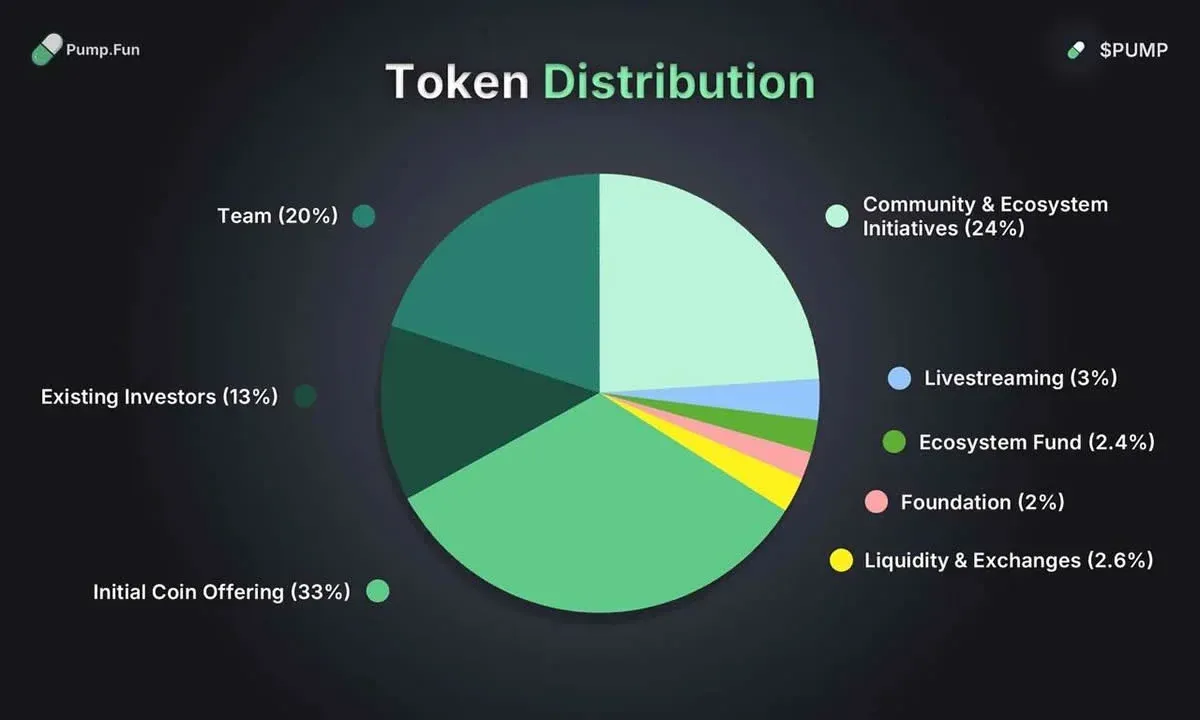
At first glance the split appears relatively balanced. However, when the team’s 20%, early investors’ 13%, and various funds (ecosystem funds, foundations, etc.) are combined, internal holdings exceed 40%. Without lock‑up contracts, a vesting timetable, or on‑chain traceable tags, this block of tokens could generate intense sell‑pressure in a short window, creating what is commonly referred to as “exit liquidity.”
What Is “Exit Liquidity”?
In crypto, exit liquidity describes a situation where retail participants buy at elevated prices unaware of insider positions, after which insiders sell at lower prices, causing a rapid price drop. For PUMP, this risk manifests in several ways:
- The project is already in a meme‑saturation phase; the token launch may signal the narrative’s peak.
- Team and investor holdings have no vesting restrictions and lack wallet tags, making potential dumping hard to monitor.
- The token offers no staking, fee sharing, or governance rights—it is purely a meme token.
When meme‑coin enthusiasm on Solana wanes and metadata disappears, PUMP could become the final round of capital rotation before a complete exit.
Historical Operational Patterns of the Team
Core members of Pump.fun have previously been involved in meme‑coin projects that featured rapid sell‑offs. While this does not prove malicious intent, it does illustrate a short‑term profit‑focused behavioural pattern. Over the past six months, a recurring cycle of “generate hype → build community → issue token → quietly sell” has been observed repeatedly on Solana, and PUMP appears to institutionalise and scale that playbook.
This does not necessarily imply deliberate fraud, but it serves as a reminder for newcomers to stay rational when following trends and not be swayed by purported long‑term visions.
What Is the Actual Function of PUMP?
Official communications do not promise any technical innovation for PUMP. It is neither a new gas token nor a DAO governance credential, nor is it tied to any protocol mechanism. A more accurate description is that it is a brand token used by community members to show support for Pump.fun, engage in interactions, and discuss the project’s narrative.
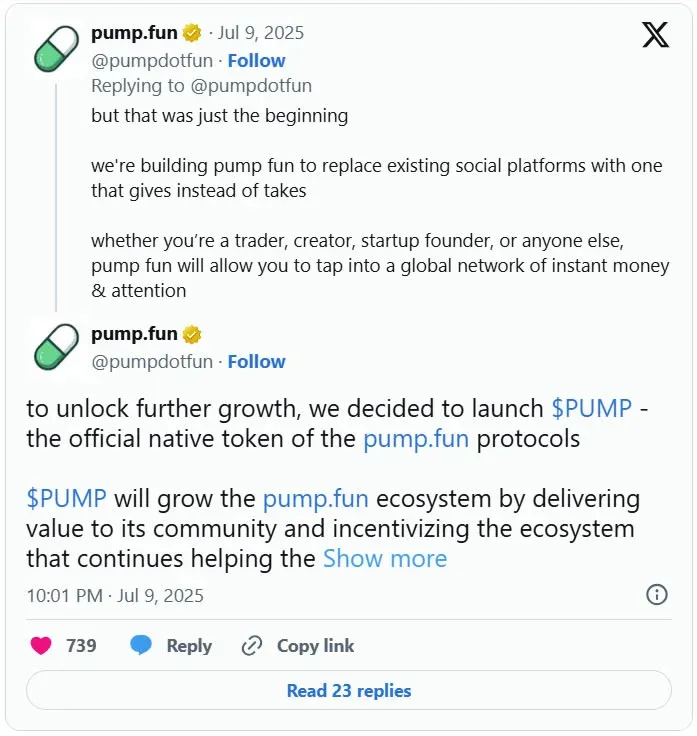
When users recognise its purpose—a narrative‑driven token with limited structural backing—there is no misperception. The team claims the token will “grow the ecosystem” and “create value for the community,” yet concrete implementation details remain undisclosed.
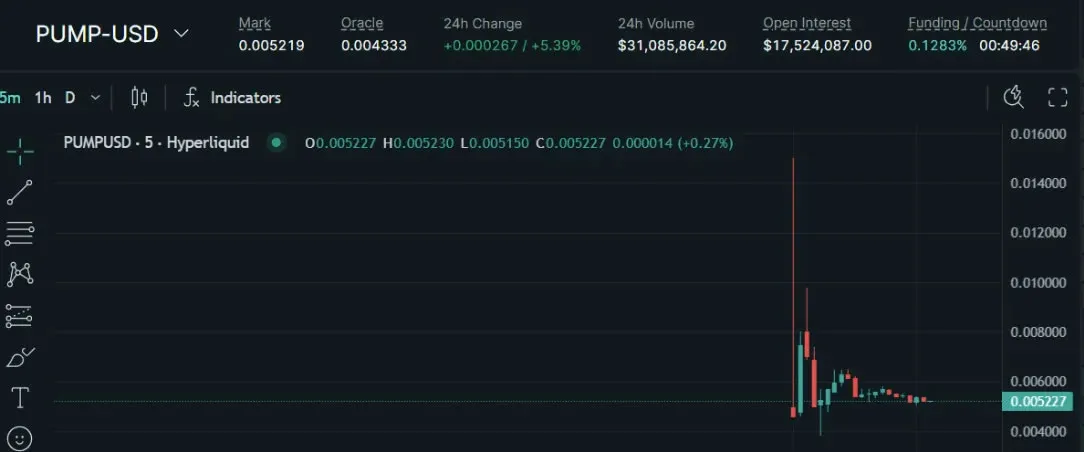
At the same time, data from Hyperliquid’s long‑short ratio shows that whale investors are predominantly short, and futures financing rates have risen to annualised levels exceeding 1,000%, indicating that many seasoned players are betting on a downside move. Without substantive use cases or a transparent unlocking plan, PUMP could devolve into a speculative “pump‑and‑dump,” with retail participants serving as the exit avenue for insiders.
Comprehensive Assessment: Exit Liquidity or Typical Meme?
While it cannot be definitively stated that PUMP is an exit‑liquidity trap, the following signals merit attention:
- High internal holding proportion
- Insufficient information disclosure
- Absence of core functional utility
- Team’s historical tendency toward short‑term trades
- Unfavourable macro market conditions
If you plan to get involved, ensure robust risk management. Even if you decide to follow the trend, do not treat it as the next Dogecoin or Pepe coin copy. Buying at elevated levels carries the risk that sellers often enter the market before you do.
In summary, PUMP may offer some entertainment value, but for early participants it could also become the final liquidity outlet.
*Note: Cryptocurrency gains may be taxable in your jurisdiction; consult local tax regulations.*
This concludes the full analysis of the investment outlook for the PUMP token issued by Pump.fun. For further details, follow other articles from Bitaigen.
Related Reading
- Pump.fun: One-Click Meme Token Issuance & Trading on Solana
- Pump.Fun: Solana Token Creator Platform with $500M Revenue
- Pump.fun: Meme Coin Launch on Solana with Bonding Curve
💡 Register on Binance with referral code B2345 for the maximum trading fee discount. See Binance complete guide.



