
 Bitaigen Research
 Summary
- Pump.Fun is the most popular decentralized token‑creation platform on the Solana blockchain, allowing anyone to launch a cryptocurrency with zero technical barriers.
- In just a year and a half since its launch, Pump.Fun has publicly reported revenue exceeding USD 500 million, making it one of the most profitable DApps in crypto history.
- The team has not yet issued its own native token. Market speculation suggests a possible official token named $PUMP, but the project has not confirmed any such plan.
Pump.Fun is a decentralized token‑issuance platform built on Solana. Users simply fill out a short form and pay a small amount of SOL to create a new token, which can then be traded directly on the platform. Pricing follows a Bonding Curve model, but the service operates without formal regulatory oversight, so participants should be aware of the heightened risk.
In this article we dissect Pump.Fun’s core mechanisms, the step‑by‑step token‑launch process, and the unique advantages it brings to the Solana ecosystem. We also evaluate potential risks from compliance, liquidity, and market‑manipulation perspectives, helping readers build a well‑rounded judgment before getting involved. The later sections will provide practical guides and the latest updates—please continue reading.
Pump.Fun—One of the Largest IDOs in Cryptocurrency History
Although Pump.Fun is rapidly becoming a breakout success on Solana—especially amid the meme‑coin surge that swept the network in 2024‑2025—the platform recently announced an IDO (Initial DEX Offering) aiming to raise USD 600 million at a valuation of USD 4 billion. This announcement has sparked a common question: Is this the biggest IDO ever recorded in crypto?
When we look purely at the amount of capital raised, Pump.Fun’s upcoming IDO does not top the historical list; several earlier IDOs have attracted substantially larger funding rounds.
EOS—The Largest ICO in Cryptocurrency History
- EOS was launched by Block.one and staged one of the most impressive Initial Coin Offering (ICO) campaigns ever seen.
- From June 2017 to June 2018, EOS conducted a year‑long token sale, successfully raising roughly USD 4.2 billion—a record that still stands.
- The ICO employed a batch‑auction mechanism to promote fair distribution rather than allowing “whale flash‑buys.”
- EOS was once hailed as an “Ethereum killer” thanks to its scalability and zero‑fee transactions, but slow main‑net development and a paucity of real‑world use cases have gradually eroded that narrative.
TON – A Billion‑Dollar ICO Stopped by the U.S. SEC
- In 2018, Telegram raised about USD 1.7 billion through the Telegram Open Network (TON) project, intending to embed a blockchain directly into its messaging app used by hundreds of millions.
- The U.S. Securities and Exchange Commission (SEC) sued Telegram for offering unregistered securities.
- Consequently, Telegram was forced to refund investors and halt TON development in 2020. An independent community later revived the codebase under the name Open Network (TON), but the project is now completely detached from Telegram.
What Is Pump.Fun?
Pump.Fun is a decentralized token‑creation platform that runs on the Solana blockchain. By simply entering basic token details—such as name, ticker, description, and optional media—any user can mint a new cryptocurrency and trade it alongside tokens issued by others, all without writing a smart contract or possessing any programming expertise. This dramatically lowers the barrier to entry for ordinary participants who want to experiment with token economics.
Since its launch in January 2024, Pump.Fun has attracted a flood of creators, most of whom launch meme‑style coins. It quickly rose to become one of the most popular DApps across the entire industry. Statistics show that as of 21 February 2025, the platform had issued over 8 million distinct tokens in just 13 months, generating massive revenue for its operators and injecting a huge user base into the Solana ecosystem.
How Pump.Fun Works
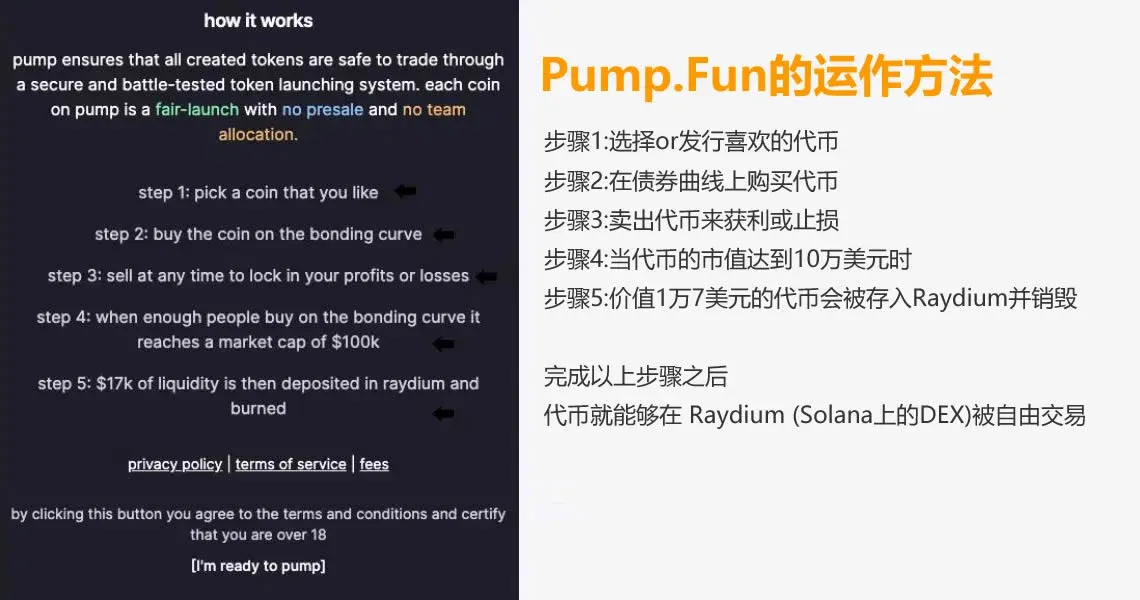
- Fixed Supply: Each newly created token starts with an initial supply of 1 billion units, priced at roughly 0.000000028 SOL per token (equating to an initial market cap of about 28‑30 SOL; the platform adjusts this figure dynamically based on market conditions).
- Market‑Cap Threshold: Once a token’s market cap surpasses USD 100 000, the system automatically lists it on Raydium—the leading decentralized exchange (DEX) on Solana—and injects USD 17 000 worth of SOL to kick‑start an automated market‑making (AMM) pool. Tokens that perform especially well may also be promoted to centralized exchanges.
Note: Earlier documentation referenced a lower market‑cap trigger of USD 69 000 and a smaller SOL injection of USD 12 000. Those figures have been updated by the platform; the numbers above reflect the official data as of February 2025.
The Bonding Curve Mechanism
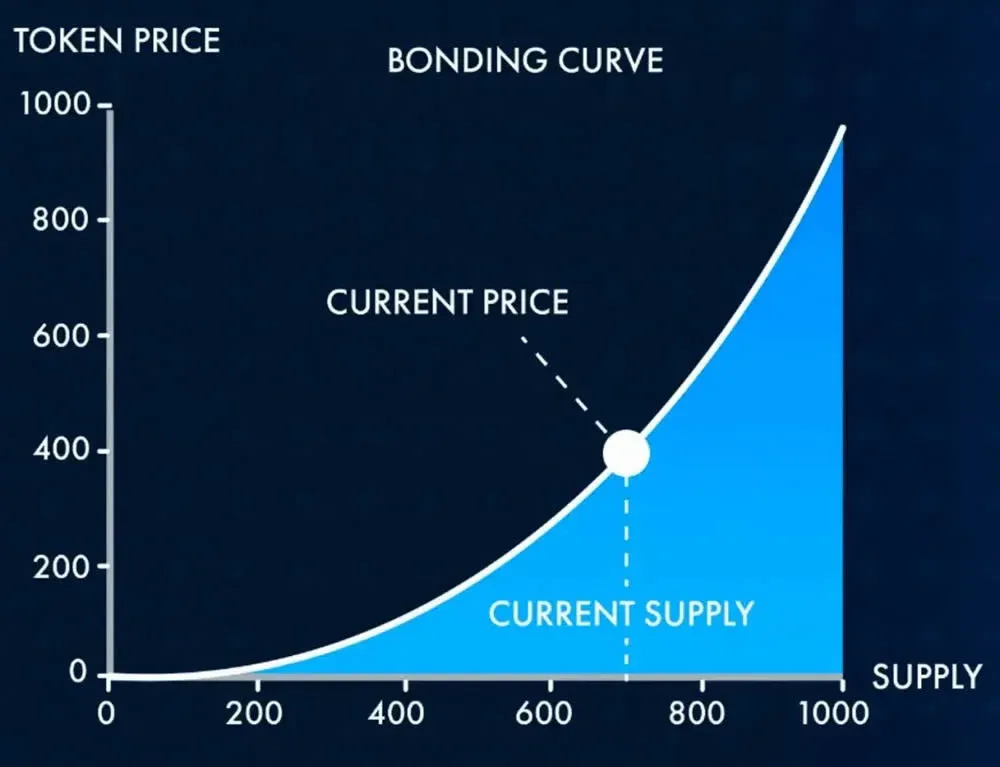
Unlike traditional order‑book matching, Pump.Fun determines token prices using a Bonding Curve. Although the exact parameters are not publicly disclosed, the basic principle is simple: the larger the cumulative purchase volume, the higher the price; conversely, the larger the cumulative sell volume, the lower the price.
- Early‑Bird Advantage: Users who buy early receive more tokens for the same amount of SOL compared with later participants.
- No Counter‑Party Required: On conventional exchanges a trade only executes when there is a matching buyer and seller. With a bonding curve, a transaction is fulfilled instantly as long as the user submits an order, eliminating concerns about insufficient liquidity.
The mathematical formulation of the curve is fairly complex and beyond the scope of this overview.
Team Background
Publicly disclosed core members are:
| Position | Name |
|---|---|
| COO | Alon Cohen |
| CTO | Dylan Kerler |
| CEO | Noah Tweedale |
All three are European Millennials, with the CTO holding only a high‑school education. The youthful composition and bold product vision have led to a tumultuous growth trajectory. In a Reddit AMA, Alon revealed that during the platform’s early days the team sent private messages to over 3 000 individuals seeking partnerships, only to be blocked by the majority.
The only known external investment comes from Alliance DAO founder Qiao Wang, who contributed several hundred thousand USD. Wang explained that his decision was driven by the team’s innovative mindset; he did not anticipate the project would become so heavily focused on meme coins, yet his investment has reportedly yielded a hundred‑plus‑fold return.
Revenue Streams
Pump.Fun’s income derives from four primary sources:
- Token‑Creation Fee – roughly USD 2‑3 (paid in SOL) per token.
- Trading Fee – a 1 % levy on every transaction executed on the platform.
- DEX‑Listing Fee – a charge of 6 SOL to list a token on Raydium.
- Raydium Trading Revenue Share – a portion of the fees generated by Raydium trades involving Pump.Fun tokens (the exact split is undisclosed).
PANews estimates that each newly launched token brings the platform an average of USD 68 in revenue; the average user contributes about USD 29 in trading fees, with Pump.Fun retaining roughly 70 % of the trading profit margin.
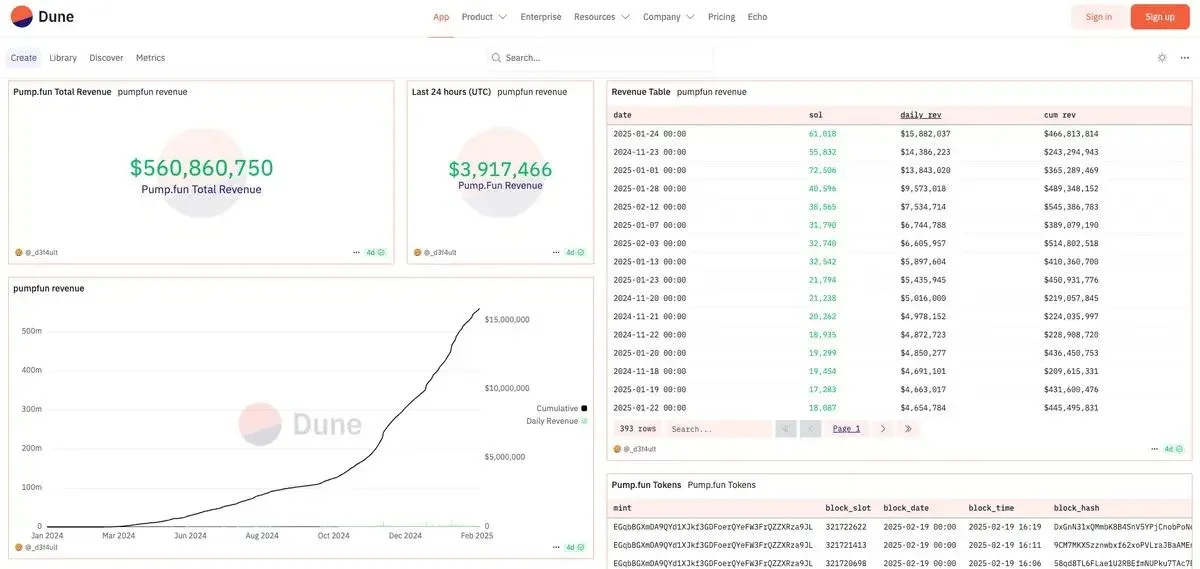
According to Dune Analytics, as of 23 February 2025 the platform’s publicly disclosed revenue had reached USD 560,860,750 (approximately NTD 18.3 billion). The single‑day peak was recorded on 24 January 2025, when the platform earned USD 15,882,037 (about NTD 5.2 billion) in a single 24‑hour window, cementing its status as one of the most lucrative DApps in crypto history.
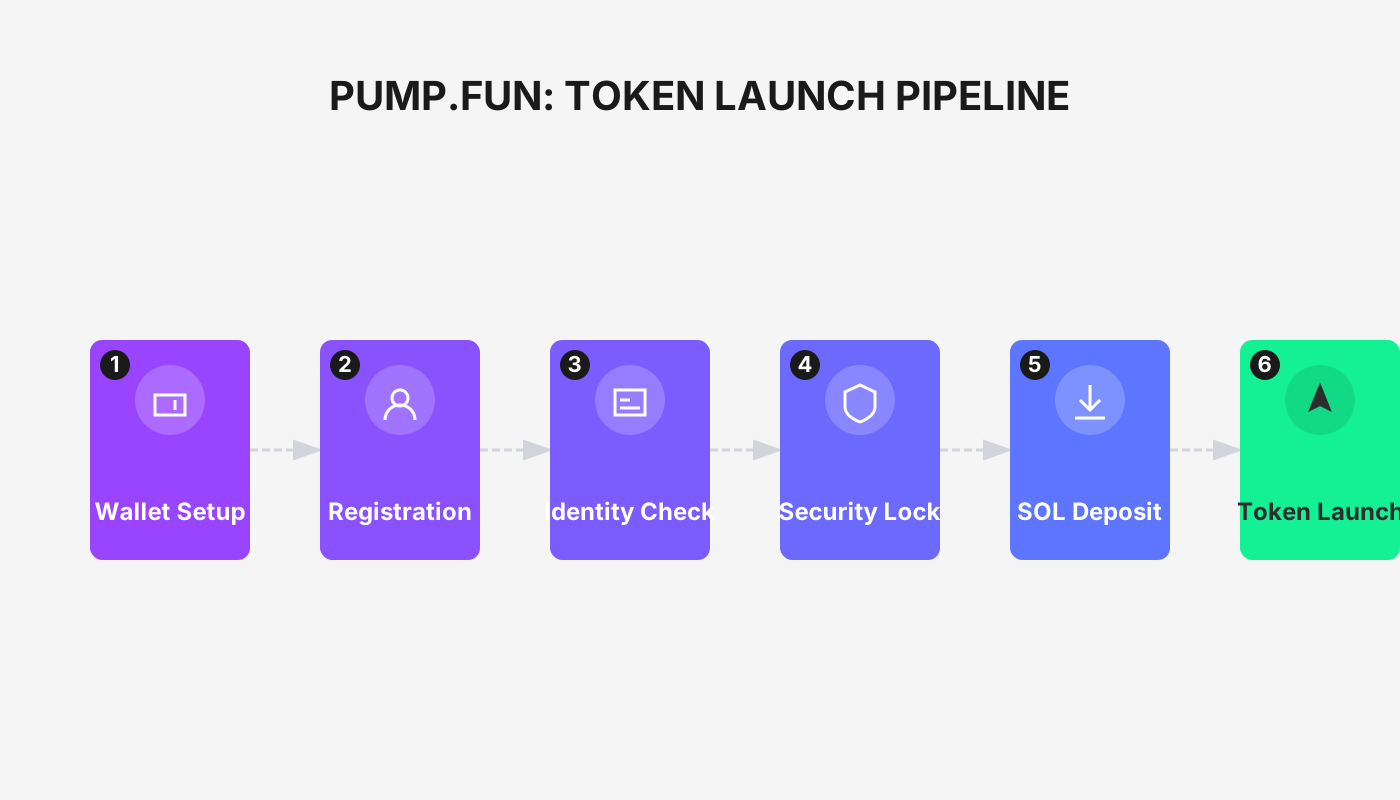
Step‑by‑Step Token‑Creation Guide
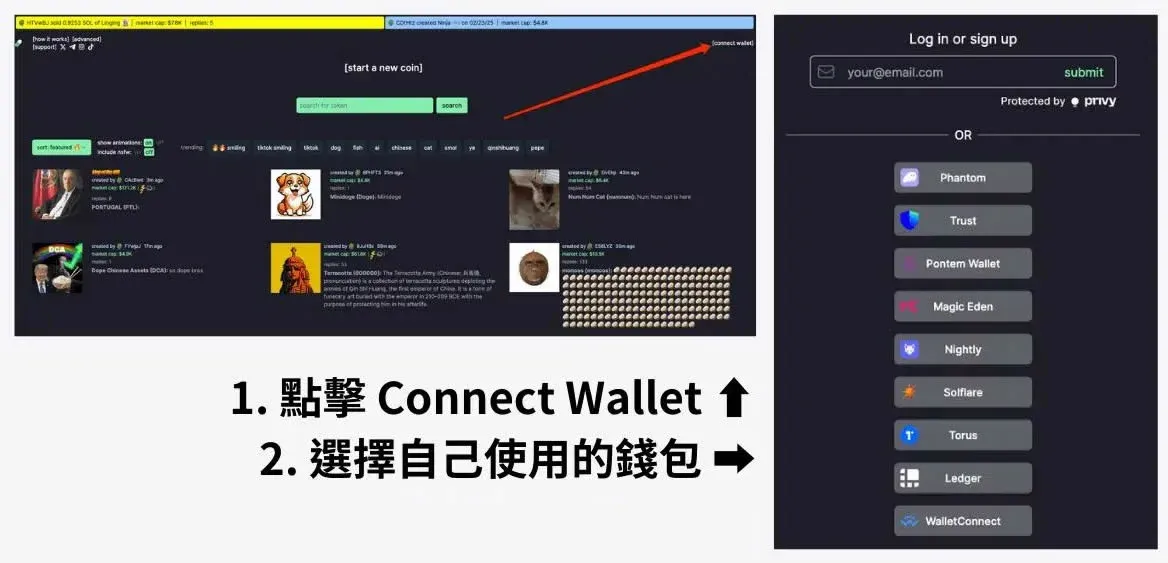
Step 1: Connect a Wallet
- Visit the official Pump.Fun website.
- Click the “Connect Wallet” button in the top‑right corner, select your preferred wallet, and grant the necessary permissions.
- Ensure your wallet holds enough SOL to cover the creation fee—at least 0.1 SOL is recommended.
Supported wallets include Phantom, Trust Wallet, Pontem Wallet, Magic Eden, Nightly, Solflare, Torus, Ledger, and WalletConnect.
Step 2: Define Token Information
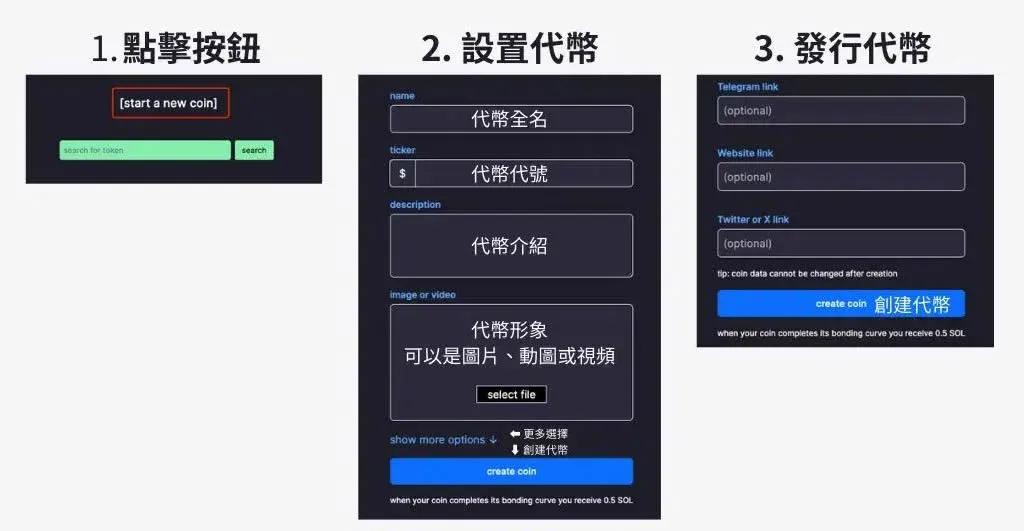
- Press the “start a new coin” button located near the middle of the page.
- Fill in the required fields: token name, ticker, a brief description, and upload a visual asset (static image, GIF, or video).
- If you wish, click “show more options” to add links to Telegram, an official website, Twitter, etc.
- Hit “create coin”, approve the transaction, and pay the USD 2‑3 SOL fee.
- Wait for on‑chain confirmation; the process usually completes within a few seconds.
Step 3: Promote the Token
- Share the token’s unique URL to attract potential buyers.
- Publicize the project on social media channels or Telegram groups to build a community.
- Monitor market activity and decide whether to add liquidity or increase promotional efforts.
Trading Tutorial
Home‑Page Overview
The main page offers several filtering options for browsing tokens:
- Featured – a curated list of highlighted or trending tokens.
- Trading Order – tokens with recent trade activity appear first.
- Creation Time – sorted by most‑recently created tokens.
- Last Reply – ordered by the latest community discussion activity.
- Market Cap – sorted from highest to lowest market capitalization.
Additional display settings include:
- Show Animations – toggle visual effects on or off.
- Include NSFW – choose whether to display content that may be unsuitable for work environments.
Trending denotes the currently hottest tokens, while King of the Hill spots are reserved for tokens that have just crossed the USD 30 000 market‑cap milestone, granting them a free “top‑spot” advertisement. Any purchase larger than 0.01 SOL causes the token to flash with a yellow highlight and a bouncing animation on the home page.
Token Trading Page
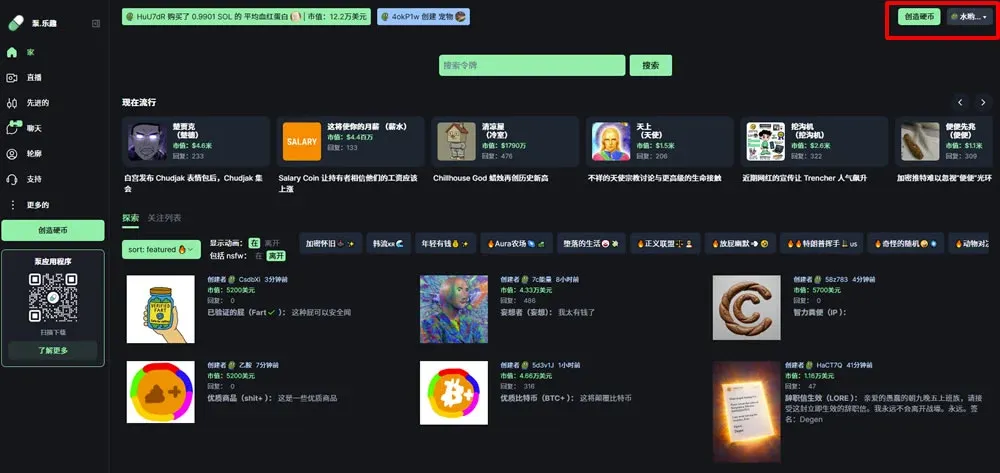
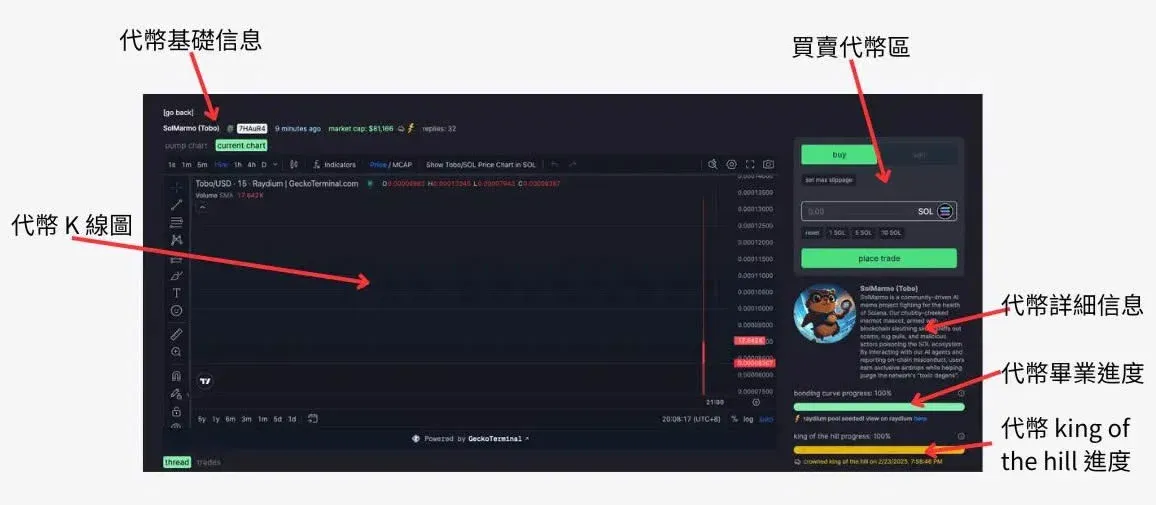
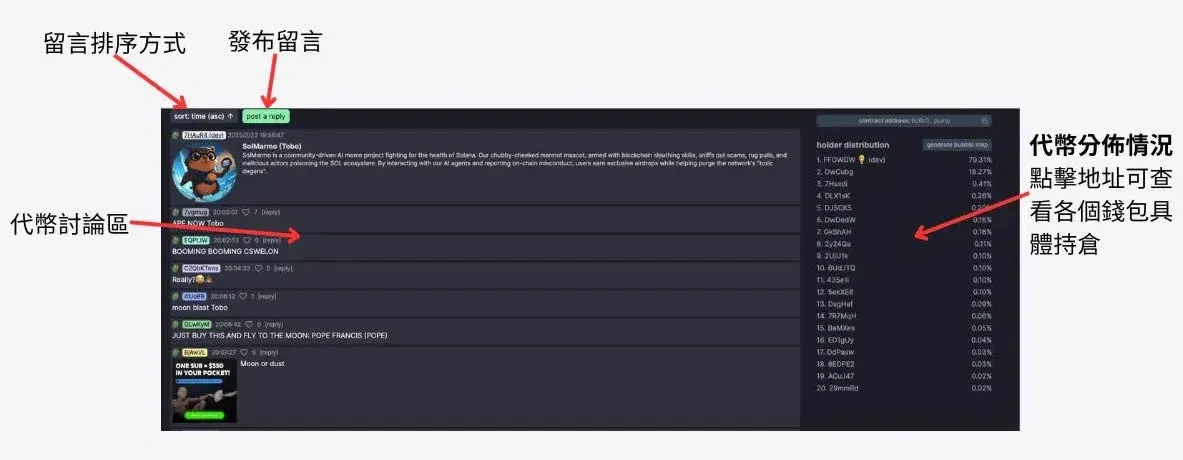
On this page you can view token details, a candlestick chart, and execute buy or sell orders directly. If a token has “graduated” and been listed on Raydium, a blue here link will appear, taking you to the corresponding Raydium trading interface.
Advanced Trading Page
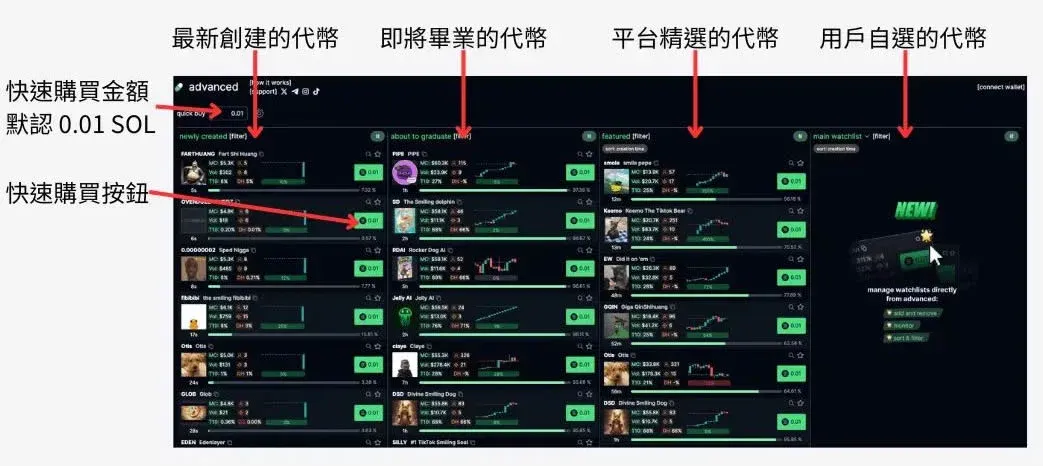
The Advanced view caters to power users, offering quick filters to surface high‑potential tokens:
- newly created – the most recent token launches.
- about to graduate – tokens on the cusp of Raydium listing.
- featured – curated or popular selections.
- main watchlist – a user‑defined list of tokens to monitor.
Fee Overview
| Item | Fee Description |
|---|---|
| Token creation | **USD 2‑3** (paid in SOL) |
| Trading | **1 %** transaction fee |
| DEX listing | **6 SOL** (liquidity deduction) |
| Listing reward | **0.5 SOL** awarded to newly created wallet addresses |
- Fees are consistent across the website, the Advanced interface, and the mobile app.
- Accessing Pump.Fun contracts through third‑party tools may incur additional costs; users should review each platform’s fee schedule.
Usage Precautions
- Although 8 million tokens have been launched in just over a year, fewer than 1 % have successfully “graduated” to Raydium, and only a tiny fraction of participants have realized profits.
- The platform does not enforce unique token‑name protection, making it easy for malicious actors to create look‑alike or duplicate tokens. Always verify the contract address before purchasing.
- Once a token is created, its name, logo, and other metadata are immutable; any mistake requires issuing a brand‑new token and paying the fee again—no refunds are offered.
- Tokens that have not graduated can only be traded within Pump.Fun; limited internal liquidity can lead to severe price slippage and potential losses.
- Orders cannot be cancelled after submission; once a transaction is on‑chain it is final.
- Be vigilant for tokens with obscure origins; some
Related Reading
- Pump.fun: Meme Coin Launch on Solana with Bonding Curve
- Solana DeFi 2025: Fast, Low‑Fee Financial Network
- Solana DePIN Revenue $458K in April 2025 – 33% YoY Rise
💡 Register on Binance with referral code B2345 for the maximum trading fee discount. See Binance complete guide.



