
 Bitaigen Research
 Binance (official registration *US users should use Binance.US instead of the global platform*) (official download) offers a variety of order types for leveraged trading.
Binance leveraged trading is margin trading on the Binance platform that uses borrowed funds to increase position size. It supports limit orders, market orders, limit take‑profit/stop‑loss, market take‑profit/stop‑loss, trailing orders, OCO, OTO/OTOCO and other order types.
Below is a detailed overview of the most common order types available in Binance leveraged trading.
This article systematically reviews the core concepts and the full suite of order types for Binance leveraged trading, helping newcomers quickly master practical tools such as limit, take‑profit/stop‑loss, and trailing orders. Illustrated explanations let you clearly understand the conditions under which each instruction applies, avoid common pitfalls, and improve risk‑management skills. For an in‑depth look at the platform’s leverage features, keep reading.
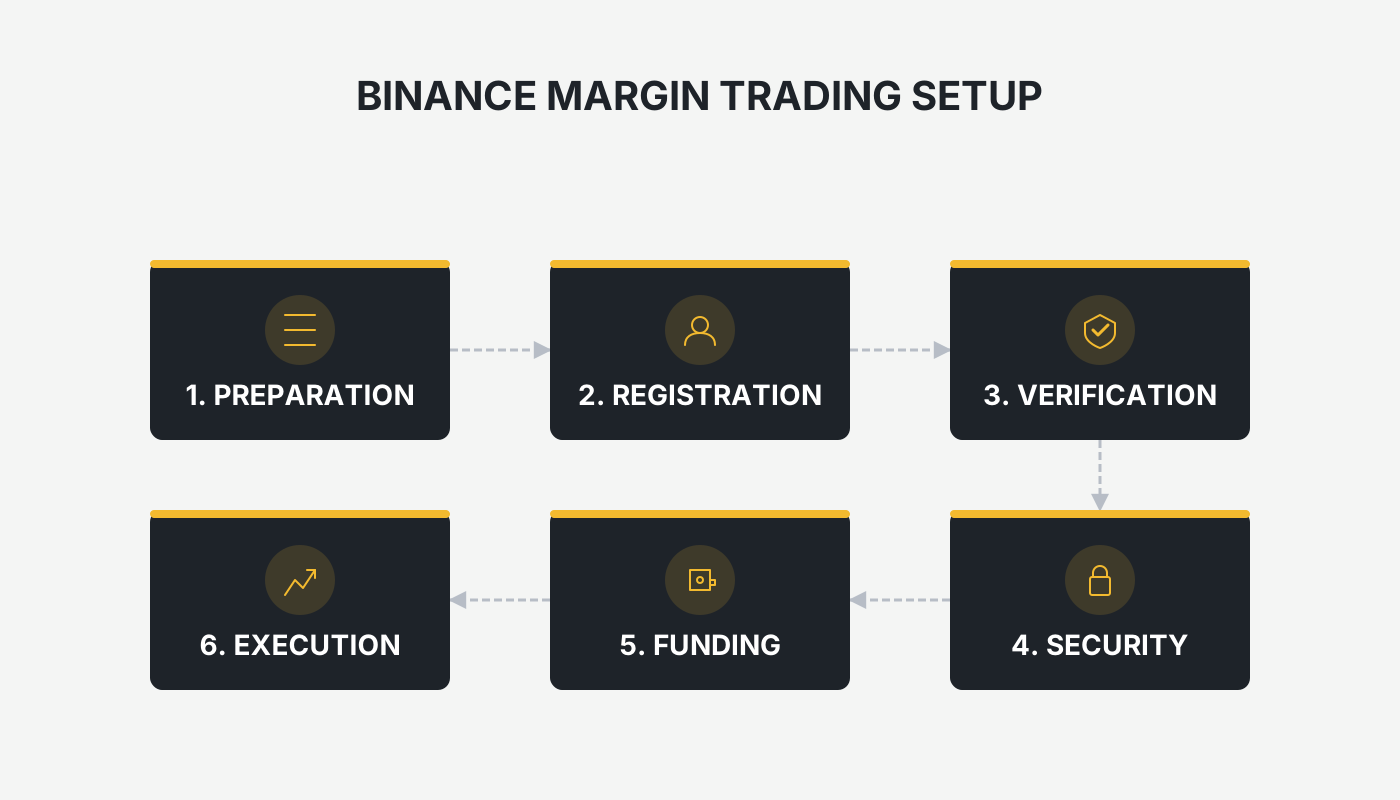
What is Leveraged Trading
Leveraged trading is a method that magnifies a position by using funds borrowed from the platform. It can amplify gains, but it also amplifies losses. Traders earn higher returns when the market moves in their favor, while they assume greater risk when the market moves against them.
All Order Types Supported for Leveraged Trading
1. Limit Order
A limit order is placed on the order book with a specified price. It only executes when the market price reaches or improves on the set limit, allowing you to buy below the current price or sell above it.
- Example: If you place a $600 buy order for 1 BNB while the current price is $500, the system will immediately fill the order at $500 because that price is better.
- If you place a $400 sell order for 1 BNB while the current price is $500, it will also fill instantly at $500.
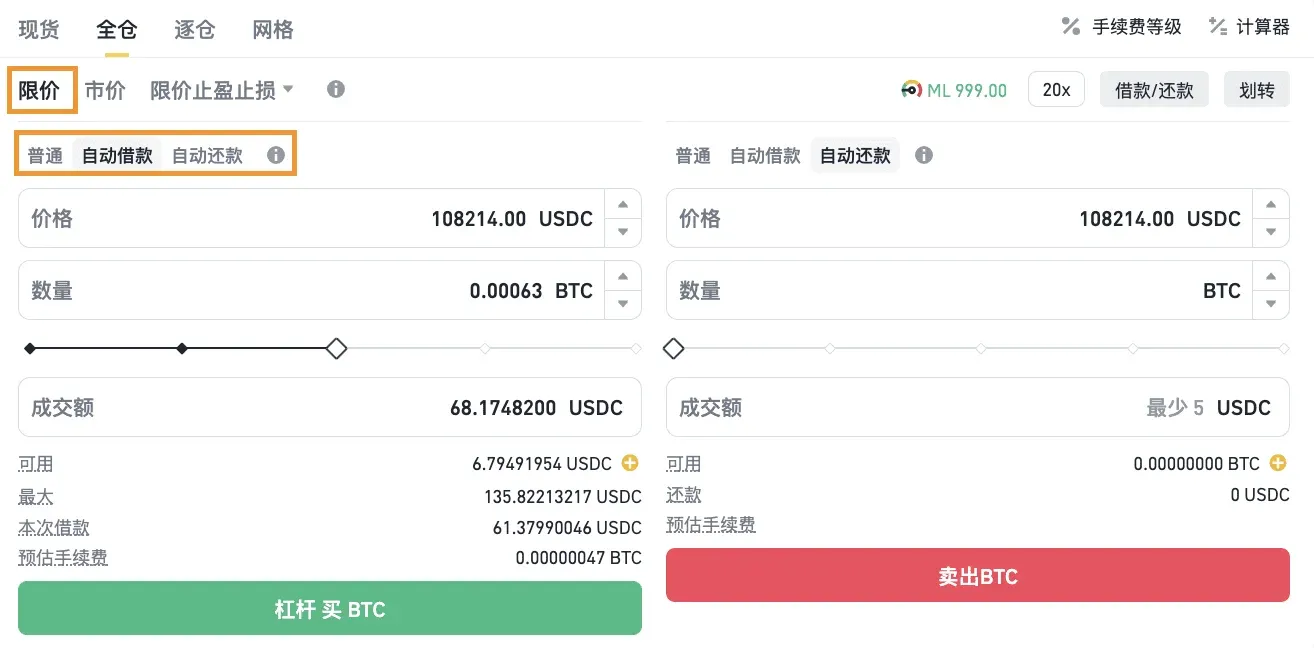
In Binance leveraged trading, limit orders can be used in Regular, Auto‑Borrow, Auto‑Repay modes, enabling simultaneous order placement, borrowing, or repayment.
| Trading mode | Logic |
|---|---|
| **Regular** | Limit order works the same as on the spot market. |
| **Auto‑Borrow** | The system automatically borrows for you after the order is placed; interest starts accruing as soon as the order is successful. |
| **Auto‑Repay** | After execution, the system automatically uses the obtained funds to repay the same‑currency debt (interest first). |
Rule: The limit price must be within ±15 % of the index price. Orders with a buy price more than 15 % above the index or a sell price more than 15 % below the index will be rejected.
2. Market Order
A market order executes instantly at the best available price, suitable for rapid entry or exit. You can specify either quantity or notional value (e.g., buy BNB with 10,000 USDC).
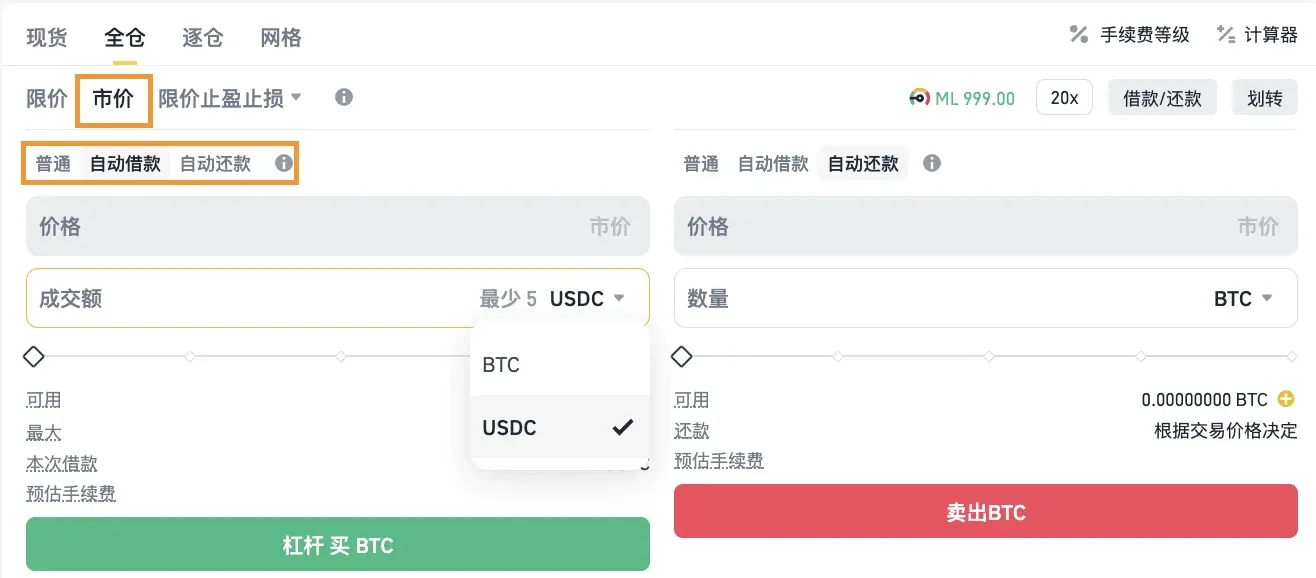
Market orders also support Regular, Auto‑Borrow, Auto‑Repay modes, with the same logic as limit orders.
3. Limit Take‑Profit/Stop‑Loss Order
This order type consists of a trigger price and a limit price. When the trigger price is reached, the system automatically places a limit order to realize profit or limit loss.
- Example: BNB is currently $400. Set the trigger at $395 and the limit at $390. When the price falls to $395, the system sends a $390 limit sell order.
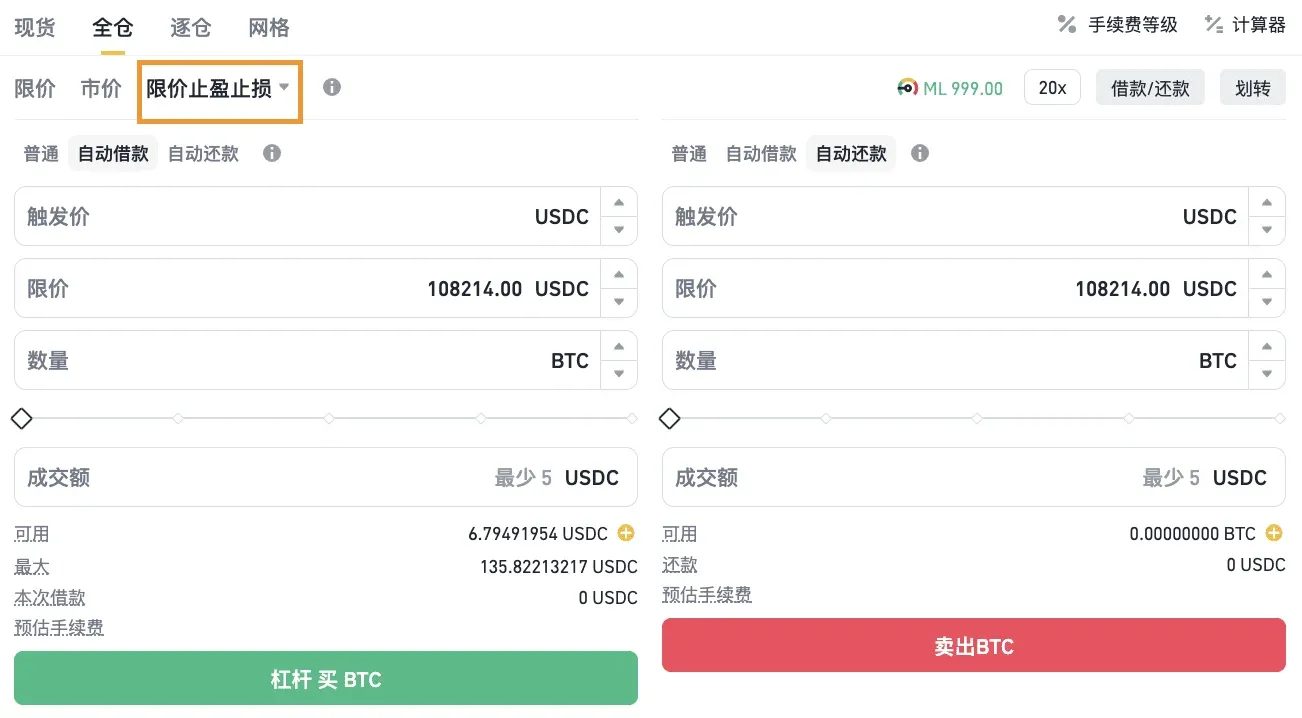
In Auto‑Repay mode, the system automatically settles borrowed assets and interest after the order fills.
4. Market Take‑Profit/Stop‑Loss Order
Works like the limit version, but once the trigger price is hit, a market order is placed. Be aware that extreme volatility can cause slippage, meaning the actual execution price may differ from the displayed price.
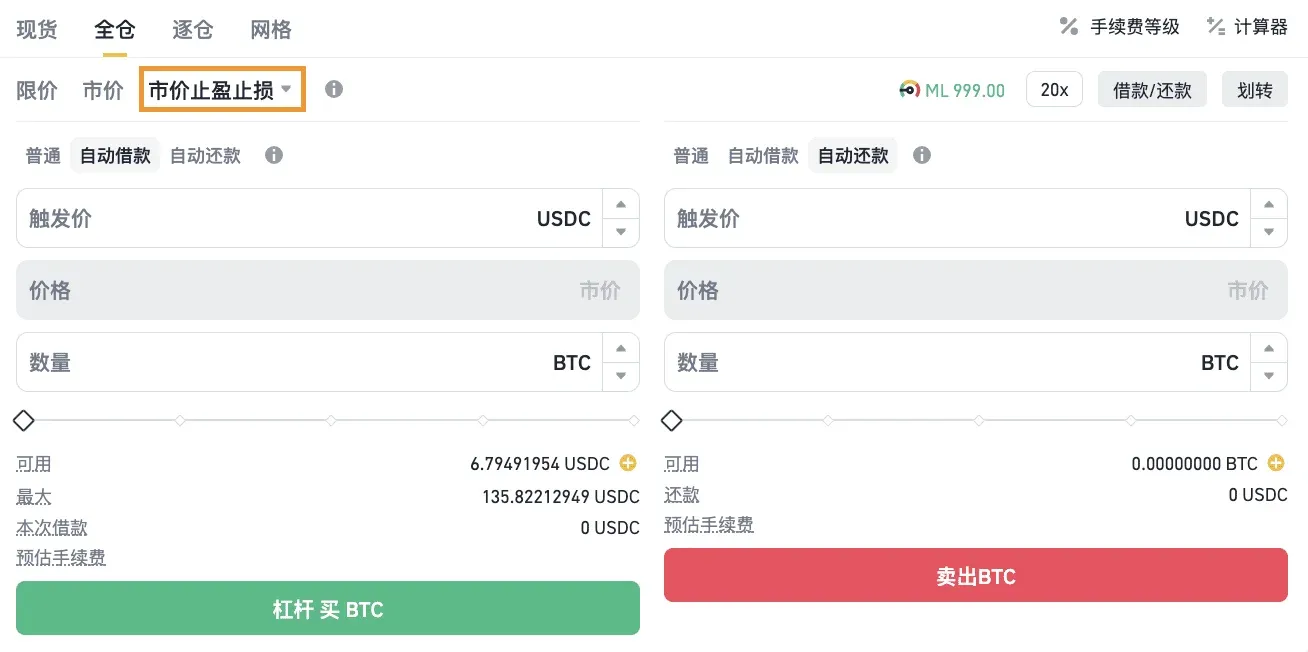
It also supports the three trading modes; in Auto‑Repay mode, the debt is automatically cleared after execution.
5. Trailing Order
A trailing order automatically triggers a limit order when the market price deviates by a specified percentage. It is commonly used for dynamic take‑profit or stop‑loss.
- Example: In a long BNB/USDC position, set a trailing increment of 1 % and a limit of $520. If the price rises 1 % (to $520), the system places a limit buy order for 0.1 BNB at $520.
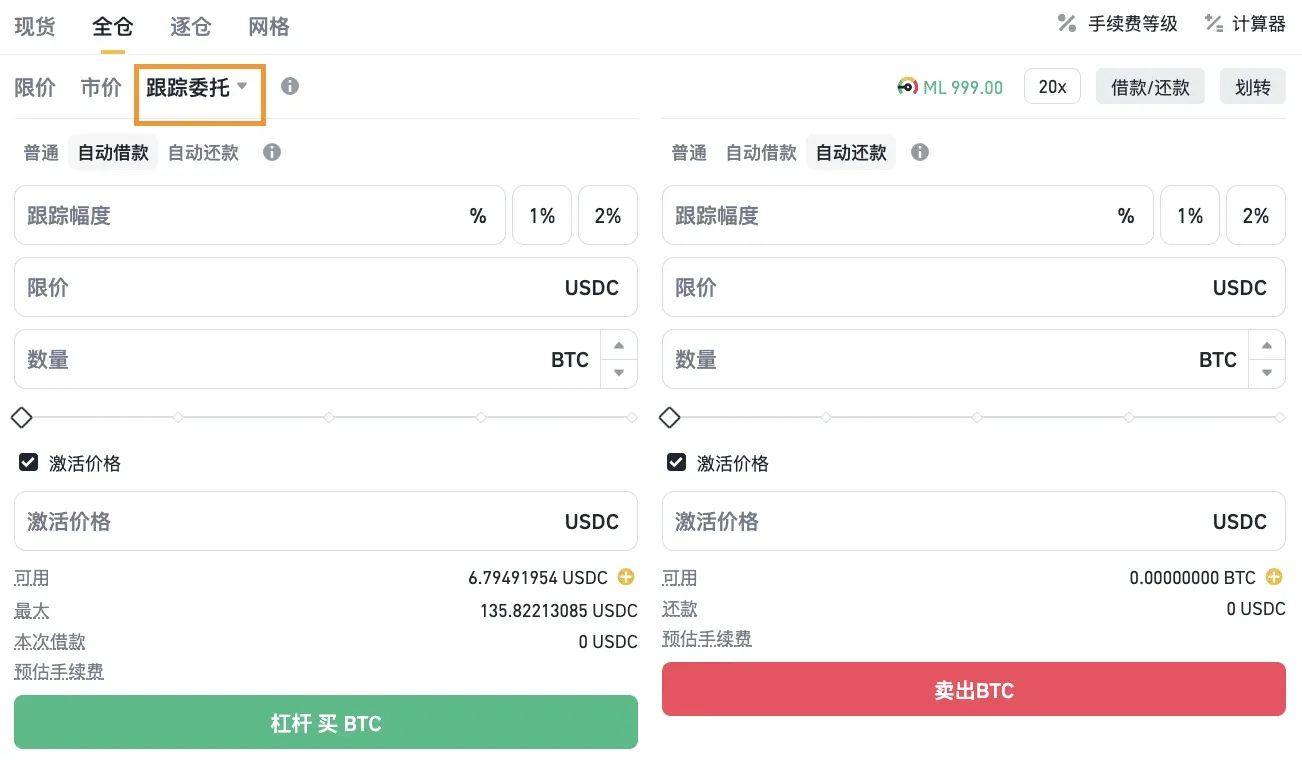
All three modes are available. In Auto‑Borrow mode, interest accrues as soon as the order is placed; in Auto‑Repay mode, the system automatically repays the debt after the order fills.
6. OCO Order (One‑Cancels‑the‑Other)
An OCO order combines a stop‑loss limit/market order with a regular limit order. When one side executes, the other is automatically cancelled, allowing you to secure execution while still chasing a better price.
- Example: BNB is priced at $400. Set an OCO: if it drops to $390, buy 1 BNB; if it rises to $410, sell 1 BNB. The first condition that is met triggers its order, and the opposite order is cancelled.
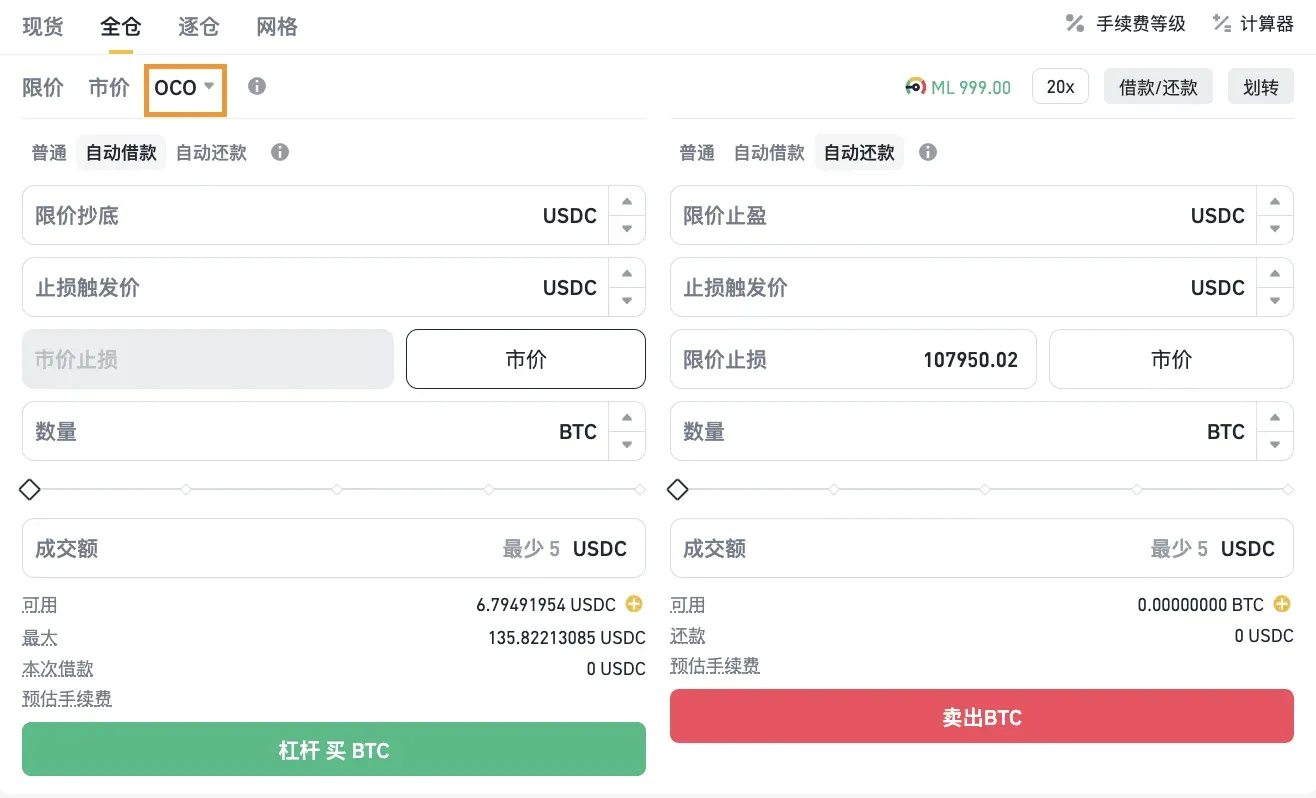
Again, all three modes are supported; in Auto‑Repay mode, the system automatically settles the relevant debt after execution.
7. OTO / OTOCO
“One‑Triggers‑Another” (OTO) or “One‑Triggers‑Another‑OCO” (OTOCO) causes a secondary order to be placed automatically once the primary order fills, often used for TP/SL combinations.
- On the trading page, tap the TP/SL button to activate OTO/OTOCO logic.
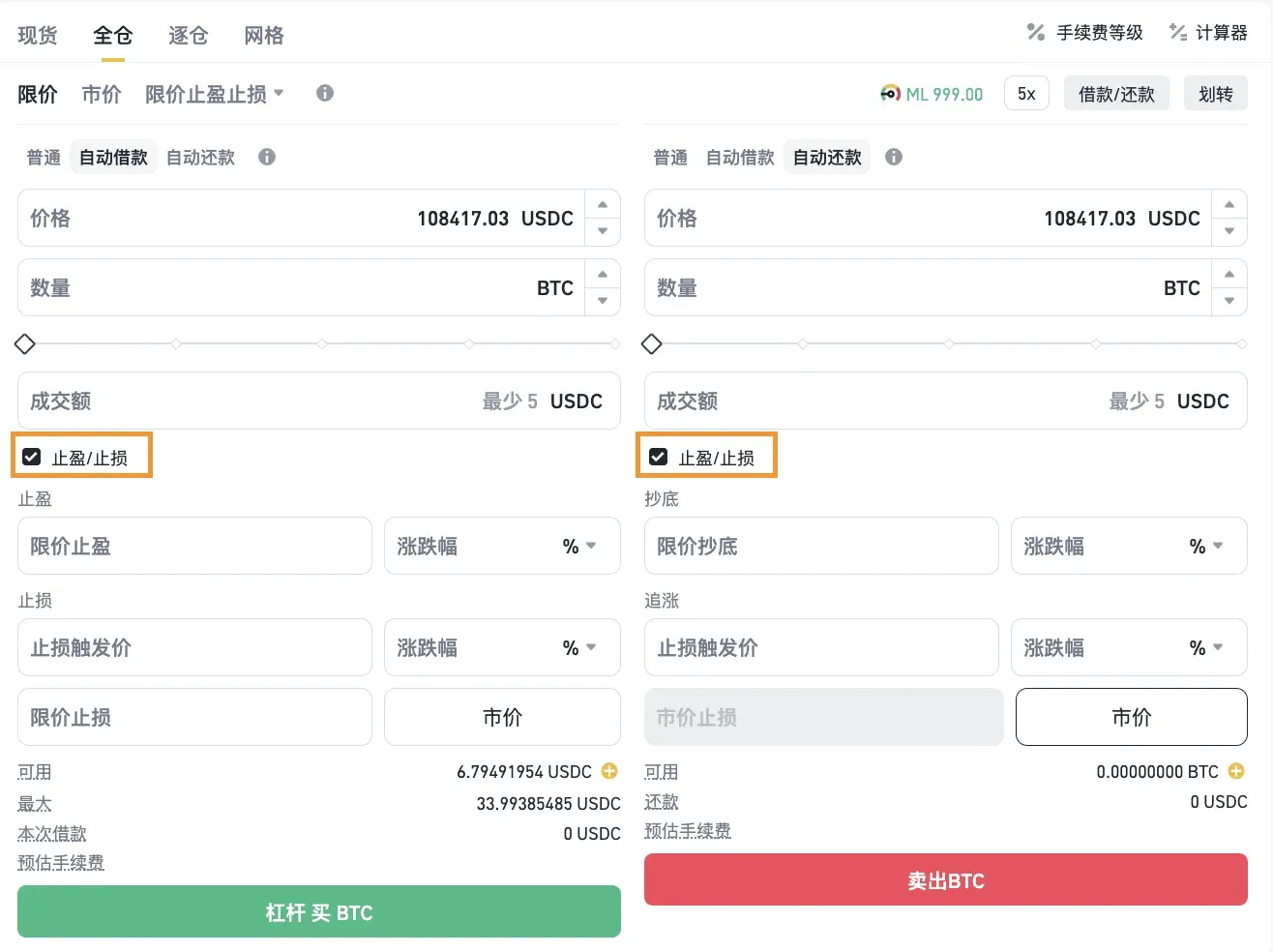
Order Types Supported Under Different Leverage Modes
| Order type | Cross‑Margin Classic | Cross‑Margin Pro | Isolated‑Margin Unified Account |
|---|---|---|---|
| **Limit order** | ✓ | ✓ | ✓ |
| **Market order** | ✓ | ✓ | ✓ |
| **Limit take‑profit/stop‑loss** | ✓ | ✓ | ✓ |
| **Market take‑profit/stop‑loss** | ✓ | ✓ | ✓ |
| **Trailing order** | ✓ | ✓ | ✓ |
| **OCO** | ✓ | ✓ | ✓ |
| **OTO/OTOCO** | ✗ | ✗ | ✗ |
How to Trade Leveraged on the Binance App
1. Register and Complete Identity Verification
- Registration link: https://accounts.binance.com/register?ref=B2345 *US residents should use Binance.US*
- Completing KYC raises your trading limits and unlocks higher leverage options.
2. Deposit Funds
After depositing fiat or crypto into your Spot wallet, you can transfer the assets to your Futures (leveraged) account for trading.
3. Step‑by‑Step Leveraged Trading Guide (Beginner)
- Open the Binance app, tap Trade → Margin. !Binance leveraged trading
- Choose Cross‑Margin or Isolated‑Margin, set the leverage multiplier, and select auto‑borrow/auto‑repay options. !Binance leveraged trading
- Cross‑Margin: the entire account serves as collateral; Isolated‑Margin: only the specific position’s margin is at risk, making risk more controllable. !Binance leveraged trading
- Using BNB/USDT as an example, if the available amount shows 0, you need to transfer funds first. !Binance leveraged trading
- After a successful transfer, if you still lack USDT you can use the Borrow function; the system will auto‑match the borrow amount according to the chosen leverage. !Binance leveraged trading
- Choose Limit or Market order: a limit order follows the price you set; a market order fills instantly. !Binance leveraged trading
- Assess market direction, then tap Buy/Long or Sell/Short. For instance, if you expect BNB to rise to $760, you might set a limit buy at $750, enter the amount, and press Margin Buy. !Binance leveraged trading
- Confirm to place the order successfully. !Binance leveraged trading
- In the Open Orders screen you can monitor order status; once the price condition is met the order fills. To set a take‑profit/stop‑loss, use the same screen; to exit immediately, tap Close Position. !Binance leveraged trading
Key Risks and Recommendations
1. Forced Liquidation Risk
When losses approach the total margin, the system will force‑liquidate the position, resulting in the loss of the entire margin (i.e., a liquidation event).
2. Psychological and Cost Risks
- Emotional pressure: High leverage magnifies emotional swings and can lead to impulsive decisions.
- Financing cost: In addition to trading fees, a financing interest accrues for the duration you hold a leveraged position.
3. Core Recommendations
- Always set a stop‑loss: It remains the most important risk‑control tool.
- Use only disposable capital: Never allocate funds needed for daily living.
- Start with low leverage: Begin with 2‑5× leverage to become familiar with the risk profile.
- Continuous learning: Leveraged trading demands ongoing improvement in market analysis and position management.
This article covered what Binance leveraged trading is, the order types it supports, and the basic workflow. For more practical tips on Binance leveraged trading, search for previous Bitaigen (BitAigen) articles or continue browsing the related links below. Trade responsibly and invest wisely.
*Note: Crypto trading gains may be taxable in your jurisdiction. Consult a tax professional for guidance on reporting and compliance.*
Related Reading
- 2026 Top 10 Spot Crypto Exchanges & Discount Codes
- Binance Pay: Send to Contacts & On‑Chain Send Guide (2024)
- Isolated Margin Leveraged Trading on Binance: BTC Borrowing
💡 Register on Binance with referral code B2345 for the maximum trading fee discount. See Binance complete guide.



