
 Bitaigen Research
 In the early days of entering Web3, many newcomers feel discouraged by issues such as private‑key management, cross‑chain transfers, and high transaction fees. Confronted with a bewildering variety of wallets and unfriendly user interfaces, they often end up in awkward situations like “forgot password, lost seed phrase, or mistyped address.” To address these pain points, OKX Pay was launched in April 2025 – a crypto‑payment tool redesigned around everyday payment needs.
In this article we outline the core features and use‑cases of OKX Pay, helping beginners overcome private‑key and cross‑chain hurdles, and analysing its potential advantages for daily spending and earnings. The goal is to get you up and running quickly with a payment solution built specifically for ordinary users.
Why would you need OKX Pay?
Traditional self‑custodied wallets, hardware cold wallets, and various Web3 applications each have their own security merits, yet they still leave newcomers grappling with the following problems:
- Losing the private key equals losing the assets: If the seed phrase is misplaced, on‑chain assets become extremely difficult to recover.
- Cross‑chain transfers are error‑prone: Sending BTC to an ETH address, or sending USDT on the wrong chain, often results in irreversible loss.
- Cumbersome workflow: Completing a single transfer can be more involved than filling out a tax form.
- Hard to fit into everyday consumption: While people have heard of buying a coffee with a stablecoin, real‑world examples remain scarce.
These issues stem not from insecure technology but from a lack of design that starts from the ordinary user’s perspective. OKX Pay was created to fill that gap.
What is OKX Pay?
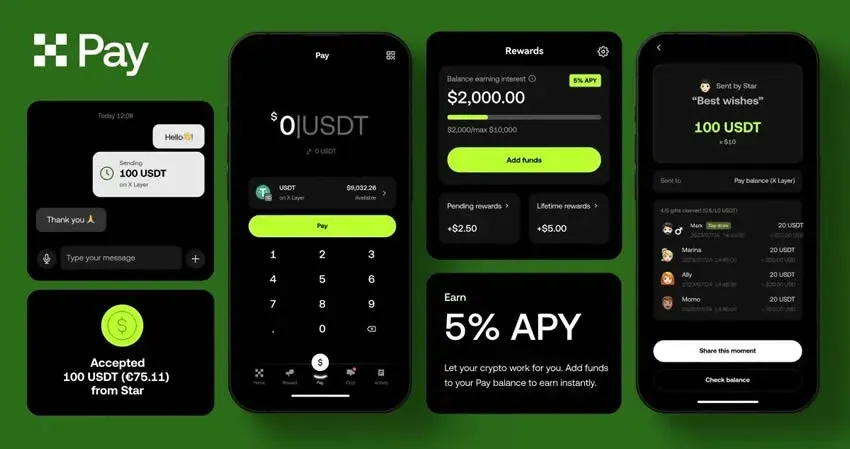
OKX Pay is an official offering from OKX, embedded directly in the OKX App as a brand‑new payment solution built around two main ideas:
- Self‑custody (non‑custodial): Assets stay under the user’s control at all times; the platform never holds discretionary rights.
- Low entry barrier, everyday‑ready: The payment flow feels like sending a message, and wallet recovery works similarly to a password reset.
Furthermore, OKX is in talks with major payment networks such as Mastercard and Stripe. In the future, users may be able to spend stablecoins like USDC or USDT directly at physical POS terminals, bringing crypto assets truly into daily life.
How does OKX Pay address the above pain points?
1. Private‑key sharding for safer recovery
OKX Pay uses key‑sharding technology, splitting the full private key into two parts:
- One part is stored on the user’s device as a Passkey.
- The other part is encrypted and kept by OKX (cannot be unlocked on its own).
This “dual‑key” mechanism works like a door lock with two separate keys – both the user and the platform must present their key to complete an action. If a user forgets their password, the platform can assist with a ZK Email verification reset, but it never gains the ability to move the assets directly. This provides fault‑tolerant recovery while preserving a non‑custodial environment.
2. Payment experience as simple as a chat app
OKX Pay currently focuses on USDT and USDC stablecoin payments. The workflow is:
- Select the recipient → enter the amount → tap Confirm.
- Supports single or batch transfers.
- Built on the X Layer public chain, it offers zero transaction fees and near‑instant settlement (subject to risk‑control limits).
Users do not need to understand the underlying blockchain; they simply operate it like LINE Pay or PayPal, while still retaining full ownership of the assets. For fiat‑on‑ramp purposes, the service accepts USD deposits via SEPA, SWIFT, or credit‑card processors, and withdrawals can be routed to the same channels.
3. Passive earnings available on demand
OKX Pay includes an auto‑yield feature. When users deposit USDC or USDT, the system automatically allocates the funds to low‑risk on‑chain protocols, currently offering up to 5 % annual percentage yield (APY). Highlights:
- Automatic selection of higher‑yielding projects.
- No lock‑up period; funds can be withdrawn at any time.
- Targeted at users who want their assets to preserve value and grow modestly without actively managing DeFi positions.
Although still in a trial phase, this option gives hands‑off users a way to “make their crypto work” without complex interactions. *Note: Crypto‑related gains may be taxable in your jurisdiction; consult a local tax professional.*
How secure is it?
Addressing the security concerns most important to beginners, OKX Pay incorporates multiple layers of protection:
- Non‑custodial architecture: Assets remain under user control; the platform cannot move them unilaterally.
- Multisignature + risk‑control engine: Combines multisig approval with real‑time fraud monitoring to reduce theft risk.
- Account Abstraction (AA) and ZK Email recovery: Even if the password is forgotten, users can recover access via email verification much like a traditional bank account.
Overall, OKX Pay aims to strike a balance between the convenience of Web 2.0 services and the security ethos of Web 3.
Who is it for?
OKX Pay is not designed for seasoned cold‑wallet users or high‑frequency on‑chain traders. It targets:
- Blockchain newcomers who want the simplest possible entry into crypto payments.
- Cross‑border payers looking to leverage stablecoins for fast, low‑cost international transfers.
- Users curious about Web 3 but reluctant to learn complex on‑chain operations.
Think of it as the first key to the blockchain world – not the most professional tool, but the easiest one to pick up.
Future roadmap
Since its official launch in April 2025, OKX Pay will gradually roll out to additional regions over the coming months. At the same time, the underlying X Layer will continue to evolve, enhancing the overall Web 3 user experience. For users who want to try crypto payments but have struggled to find an entry point, OKX Pay is poised to become the go‑to “one‑click, worry‑free” solution.
Closing thoughts
The blockchain industry often talks about returning assets to users, yet truly mass‑adoptable products remain few. OKX Pay focuses less on raw chain throughput and more on shrinking the psychological distance between people and the chain. Payments are everyday actions; they should not be reserved for technical specialists. We hope this overview helps you understand OKX Pay’s positioning, features, and scenarios, and that it assists you in taking your first step into the crypto ecosystem.
For deeper information on OKX Pay, follow Bitaigen (比特根) and watch for upcoming articles.
Related Reading
- HashKey Exchange Review: Licensing, Fees, Security & HK Pros
- OKX Pay Guide: Features, Registration & Fee‑Free Transfers
- BTCC vs Pionex: Which Crypto Exchange Is Better?
💡 Register on Binance with referral code B2345 for the maximum trading fee discount. See Binance complete guide.



