
 Bitaigen Research
If you have any experience trading cryptocurrencies, you have probably encountered derivatives—tools that help traders manage risk, bet on price movements, or boost returns. Among all derivatives, perpetual futures contracts have become the go‑to product for both novices and professionals.
In fact, perpetual futures now account for roughly 93 % of cryptocurrency derivatives trading volume. The reason is straightforward: perpetual futures have no expiration date, allowing trading to continue indefinitely, which gives traders more freedom and flexibility than traditional futures.
In this article we systematically dissect the core principles, trading mechanics, and unique advantages of perpetual futures compared with traditional contracts, while also digging into the associated risk points. With clear examples and practical tips, beginners can get up to speed quickly, and seasoned investors can find advanced references. If you want to learn how to use this tool more robustly in a volatile market, keep reading.
What a Perpetual Contract Means
A perpetual future (or perpetual contract) is a derivative that lets you trade the price of an underlying asset without actually holding the asset itself. Its operation mirrors that of ordinary futures, but with one crucial difference—it never expires.
Traditional futures have a fixed settlement date; at that point the contract is settled, and the trader either receives the underlying asset or settles in cash. Perpetual futures skip this step: as long as you maintain sufficient margin, you can hold the position indefinitely.
These contracts are especially popular in the crypto space. Platforms such as Binance, Bybit, KuCoin, and others have turned them into standard instruments, and they now comprise a significant portion of daily crypto trading volume.
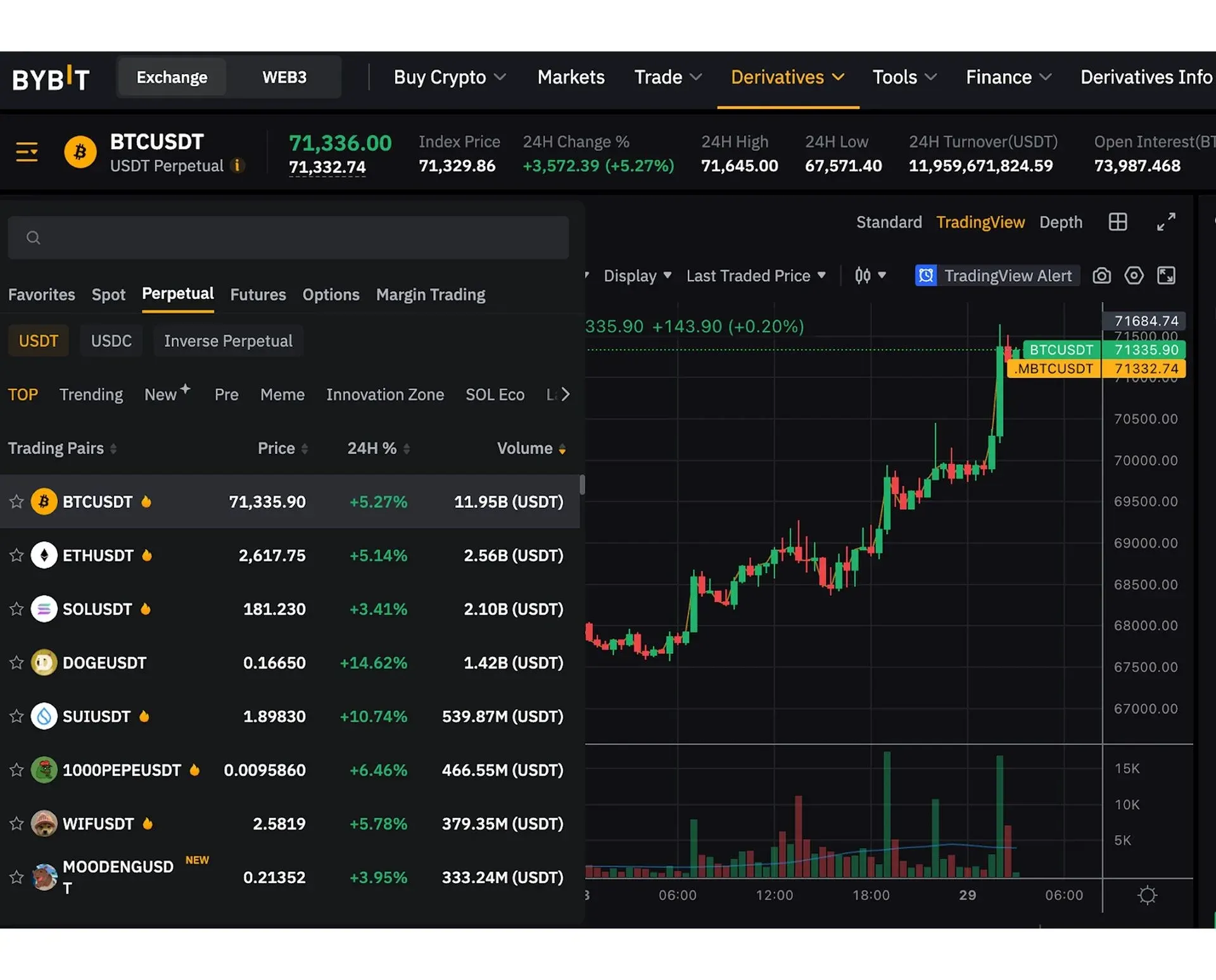
The price of a perpetual future is tied to the spot price of the underlying asset, aiming to stay close to the current market price. To achieve this, exchanges employ a mechanism called the funding rate, which will be explained in detail later.
Perpetual contracts support leveraged trading, meaning you can control a larger position with a relatively small amount of capital. However, leverage also amplifies risk—if the price moves against you, the position may be liquidated automatically.
In short:
- No expiration date
- Tracks spot price
- Supports leverage
- Widely used in cryptocurrency trading
The market is massive; in 2024 alone the total trading volume exceeded USD 58.5 trillion, making perpetual contracts a must‑have feature on any serious trading platform.
Because of this demand, our institutional‑grade platform B2TRADER has recently added full support for perpetual futures, helping clients meet the growing market appetite.
For the complete details of this update and our vision for multi‑asset trading, please refer to B2TRADER 2.5.
Key Components of a Perpetual Futures Contract
A perpetual futures contract consists of several elements, each influencing how you trade and the level of risk you assume.
Underlying Asset
This is the asset you are trading—e.g., Bitcoin, Ethereum, or any other cryptocurrency. You are not buying or selling the asset itself; you are trading a contract that mirrors its price.
Leverage
Leverage lets you control a larger position with a smaller amount of capital. For example, with 10× leverage, a USD 100 margin can be used to trade a contract worth USD 1,000. Leverage is a double‑edged sword—profits are magnified, and losses are accelerated.
Margin Requirements
Both opening and maintaining a position require meeting margin thresholds:
- Initial Margin: The amount you must provide to open a position.
- Maintenance Margin: The minimum equity needed to avoid forced liquidation.
If your account balance falls below the maintenance margin, the platform will automatically liquidate the position to cap further losses.
Mark Price vs. Last Traded Price
- Last Traded Price: The actual price of the most recent transaction.
- Mark Price: A reference price calculated from an index and the funding rate, used to prevent unfair liquidations during extreme volatility.
Liquidations are triggered based on the mark price, not the last traded price.
Liquidation Mechanism
If adverse market moves cause your margin to drop below the required level, the system will liquidate your position automatically, and you will lose the margin you posted.
The risk of forced liquidation is especially pronounced with high leverage. Even a small price swing can wipe out the entire margin.
Automatic De‑Leverage (ADL)
In markets with insufficient liquidity, the system may be unable to fully close a position. In such cases, the platform will automatically offset opposite positions to reduce overall exposure—a process known as Automatic De‑Leverage (ADL).
Funding Rate Mechanism
Because perpetual futures have no expiry, their price can drift away from the spot price. To keep the two aligned, exchanges introduce a funding rate.
What Is the Funding Rate?
The funding rate is a periodic fee exchanged between longs (buyers) and shorts (sellers), typically settled every 8 hours. Which side pays depends on the relationship between the perpetual contract price and the spot price:
- If the perpetual price is above spot, longs pay shorts.
- If the perpetual price is below spot, shorts pay longs.
The funding rate incentivizes traders to balance long and short interest, nudging the contract price toward the spot price.
Why Is the Funding Rate Needed?
Traditional futures naturally converge to the spot price at expiry. Perpetual futures lack an expiry, so without a funding mechanism the contract could stay detached from the underlying asset’s true value, undermining its usefulness.
Concrete Example of Funding Rate
Suppose you go long on a Bitcoin perpetual contract at USD 30,500:
- Spot price: USD 30,000
- Market sentiment is bullish, with many longs open
- Funding rate: +0.03 %
Every 8 hours you would pay a fee equal to 0.03 % of your position size to the short side. If your position’s notional value is USD 10,000, the fee amounts to USD 3 per funding interval.
If the price continues to rise, you still have profit potential; however, if the price stalls or falls, this fee erodes your gains and can even push you into a loss.
Implications for Traders
Funding rates affect profit and loss directly over time:
- Even with a flat price, paying a positive funding rate can turn a breakeven trade into a loss.
- Conversely, holding a short position when the funding rate is negative lets you collect the fee, adding to your return.
Risk Considerations
While perpetual futures offer flexibility and leverage, they also bring heightened risk:
- Leverage Amplification: Small adverse moves can trigger liquidation.
- Funding Costs: Persistent positive funding rates can eat into profits for long positions, and vice‑versa for shorts.
- Liquidity Gaps: In thin markets, ADL may force you out of a position at unfavorable prices.
- Market Volatility: Crypto markets can swing dramatically within minutes, increasing the chance of margin calls.
Traders should always monitor margin levels, funding schedules, and overall market depth. Using stop‑loss orders, setting reasonable leverage, and maintaining a buffer above the maintenance margin are common risk‑mitigation practices.
Important for U.S. users: If you reside in the United States, you must access perpetual futures through Binance.US (or another U.S.-compliant exchange) rather than the global Binance platform, due to regulatory restrictions.
Tax reminder: Crypto‑related gains, including profits or losses from perpetual futures, may be taxable in your jurisdiction. Consult a tax professional to ensure compliance with local tax laws.
How to Get Started
- Choose a compliant exchange – Binance.US, Bybit, KuCoin, or any other platform that offers perpetual contracts in your region.
- Complete KYC/AML verification – Required for fiat deposits via SEPA, SWIFT, or other bank transfers.
- Deposit USD (or other fiat) – Most platforms accept USD deposits through SEPA (for EU) or SWIFT (global).
- Enable margin trading – Activate the leverage feature and set your desired leverage level.
- Familiarize yourself with the funding schedule – Know when the 8‑hour funding periods occur and what the current rate is.
- Place a test order – Start with a small position to understand how margin, mark price, and funding interact.
Summary
Perpetual futures are a cornerstone of modern cryptocurrency trading, offering:
- Continuous trading without expiry
- Close tracking of spot prices via the funding rate
- Leverage to amplify exposure
- Broad adoption across major exchanges
Their massive market volume (over USD 58.5 trillion in 2024) underscores their importance for both retail and institutional participants. However, the same features that make them attractive—leverage, funding fees, and automatic de‑leverage—also introduce significant risk. Proper risk management, awareness of funding cycles, and compliance with regional regulations (including the use of Binance.US for U.S. residents) are essential for navigating this market responsibly.
💡 Register on Binance with referral code B2345 for the maximum trading fee discount. See Binance complete guide.



