
 Bitaigen Research
 Pi Coin (PI) has moved from an initial experimental concept to the public trading phase, and its market performance in 2026, ecosystem layout, and future price expectations have become focal points for the industry. This article first provides an overview of the current market data, then revisits the project's origin and core components, compares its technical differences with Bitcoin, and finally offers price range forecasts for 2026 and 2030 along with technical analysis and risk warnings.
---
We conduct an in‑depth analysis of Pi Network from market, technology, and ecosystem dimensions, evaluate its current valuation, and project price trajectories for 2026 and 2030. The article combines the latest on‑chain data and technical charts to present an objective assessment and potential risks, helping readers gauge the direction of the market.
Current Market Overview (as of April 10 2026)
- Latest trade price: approximately $0.181 USD
- Total market cap: roughly $920 million USD, ranking 68th among global crypto assets
- Circulating supply: about 5.08 billion PI, far below the project‑defined ceiling of 100 billion
Although price and market cap have entered public trading, these figures alone cannot fully capture Pi’s intrinsic value. A comprehensive assessment must also consider user activity, technical implementation, and the maturity of the ecosystem.
Price Range and Technical Support
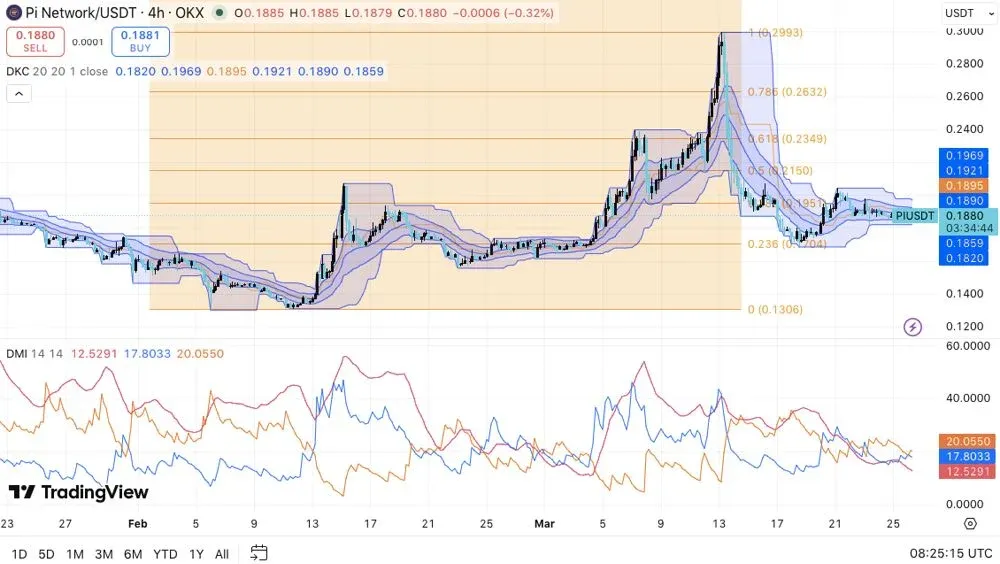
- Support level: $0.18 USD; a break below could push the price down to the $0.165–$0.150 USD range
- Resistance level: $0.195–$0.200 USD; a breakout may open upside potential toward $0.215, $0.235, and even $0.260 USD
Technical indicators show a narrowing Bollinger Band and a balanced Directional Movement Index (DMI), suggesting the market is in a consolidation phase and future moves will depend more heavily on fundamental developments.
---
Project Background and Rise
Pi Network was launched in 2019 by a group of Stanford graduates. Its core idea is to allow anyone with a smartphone to participate in cryptocurrency mining simply by checking in daily. Unlike Bitcoin’s proof‑of‑work (PoW), Pi employs a trust‑based “security circle” consensus mechanism that dramatically reduces energy consumption and hardware requirements. During the closed‑beta phase, trading was limited to internal participants; the mainnet officially launched on February 2025, marking the critical step of migrating the token onto a real blockchain.
After the mainnet went live, Pi was quickly listed on several exchanges. Gate.io was the first platform to list PI, followed by OKX and Bitget. While major exchanges such as Binance remain cautious, Pi has already established preliminary liquidity in the public market. *U.S. users seeking similar services should use Binance.US rather than the global Binance platform.*
---
Key Elements of the Pi Network Ecosystem
- Core Team
Composed of Stanford Ph.D. candidates with technical and business expertise, responsible for roadmap planning, technology development, and community governance.
- User Community
Participants are called “Pioneers.” To date, the network has amassed over 70 million registered users, with the number of active users continuously rising. Community size directly influences network effects and token demand.
- Technical Infrastructure
- Blockchain Network: Mainnet is live, supporting decentralized transactions.
- Consensus Mechanism: The innovative “security circle” approach balances security with low energy usage.
- Security Protocols: Multi‑layer verification enhances resistance to attacks.
- Application Ecosystem
With the mainnet operational, Pi is nurturing a DApp environment. The released Pi Browser and Pi Wallet provide foundational support for future innovations, and plans are underway to integrate more payment, gaming, and social use‑cases.
- Governance Structure
The project incorporates community voting and proposal mechanisms to achieve decentralized decision‑making, allowing token holders to participate in discussions and votes on critical matters.
---
Core Differences Between Pi and Bitcoin
| Dimension | Pi | Bitcoin |
|-----------|----|---------|
| Mining Method | Mobile check‑in, trust‑based consensus | Proof‑of‑Work (PoW), requiring massive computational power |
| Energy Consumption | Extremely low, suitable for ordinary smartphones | High, requiring specialized mining rigs |
| Ecosystem Positioning | Multi‑functional platform supporting DApps and smart contracts | Primarily a store of value and transfer medium |
| User Barrier | Zero technical barrier; any smartphone can participate | Requires some technical knowledge and hardware investment |
| Network Maturity | Still in ecosystem‑building stage | Established global network with mature market cap |
These distinctions shape the two projects’ use‑case scenarios, community composition, and long‑term development paths.
---
Key Dimensions for Valuation
- User Base and Activity
The massive free‑mining model has attracted hundreds of millions of users; active participation directly determines token demand.
- Technological Innovation
A low‑energy consensus mechanism offers a competitive edge in today’s sustainability‑focused environment, potentially appealing to environmentally conscious investors.
- Ecosystem Maturity
With the mainnet live and DApp audits underway, the emergence of real payment and service scenarios would inject genuine utility into PI.
- Supply Dynamics
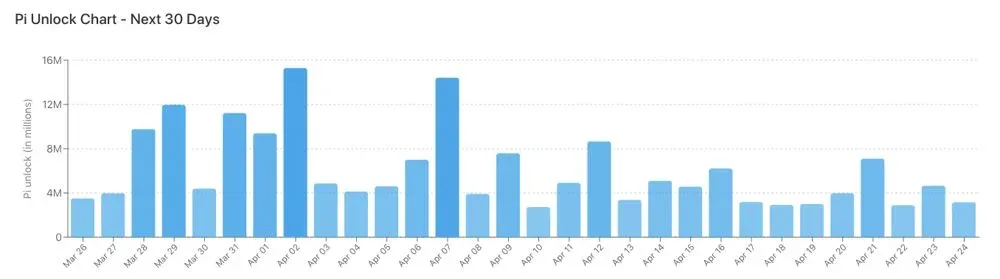
Current circulating supply stands at 5.08 billion, while 5.86 billion tokens remain locked. Upcoming unlock schedules will gradually increase supply; if demand does not keep pace, downward price pressure may arise.
---
2026 Price Forecast (Short‑Term)
2026 is a pivotal year as Pi transitions from concept to market. Analyst opinions generally fall into three categories:
- Optimistic Range: Based on community size and upcoming feature rollouts, some forecasts see year‑end prices reaching $0.25–$0.30 USD, with extreme scenarios touching $0.35 USD. These projections assume smooth mainnet implementation, additional exchange listings, and a broadly bullish crypto market.
- Neutral Expectation: The majority of analysts place the end‑of‑year price around $0.22 USD, representing a 20%–25% increase from current levels, reflecting a balance between project progress and market sentiment.
- Conservative Estimate: Considering gradual supply unlocks, potential regulatory risks, and possible technical delays, certain viewpoints expect the price to hover between $0.15–$0.22 USD for the full year, with a risk of dipping below $0.15 USD if the broader market corrects.
Synthesizing these views, a reasonable end‑2026 range can be viewed as $0.20–$0.25 USD, contingent on community holding behavior, exchange listing progress, and macro‑crypto market trends.
---
2030 Price Forecast (Long‑Term)
Five years from now, Pi’s price will be shaped by multiple factors. Below are three scenario outlines:
1. Optimistic Scenario
If Pi achieves widespread commercial acceptance by 2030—hundreds of enterprises integrating it as a payment channel, an active DApp ecosystem, and tens of millions of daily active users—demand could grow exponentially. Some institutions project PI breaking the double‑digit USD barrier, ranging between $10–$20 USD, with extreme cases approaching $20–$22 USD.
2. Conservative Scenario
Should the project encounter bottlenecks in technology, governance, or regulation, and user activity stalls, Pi may linger in the low‑single‑digit range. A cautious estimate caps the price at $2–$5 USD, still above 2026 levels but without breakthrough growth.
3. Middle‑Ground Scenario
Accounting for uncertainty, a balanced forecast places Pi’s 2030 price in the $5–$10 USD band. This suggests the ecosystem would have attained a moderate scale and utility, yet not reached full mainstream adoption.
Regardless of the outcome, the 2026–2030 window is critical for Pi to transition from a “social currency” to a “functional platform.”
---
Technical Outlook and Key Price Levels
- Upside Resistance: $0.195–$0.200 USD; a break may lead to observations at $0.215 and $0.235, with strong momentum potentially targeting $0.260 USD.
- Downside Support: $0.180 USD as the primary floor; a breach could test the $0.170–$0.165 range, and further decline would focus on $0.150 USD.
- Indicator Profile: Narrowing Bollinger Bands and converging DMI indicate a compression phase, often preceding heightened volatility.
Chart patterns show Pi currently forming a sideways range near a key support level. Holding above $0.18 USD and breaking the resistance could trigger a new rally, whereas a slip below the support may invite short‑term selling pressure.
---
Potential Impact of Token Unlocks on Price
Data indicates that 5.86 billion PI remain locked, representing roughly $1 billion USD of value. In the next 30 days, about 182 million tokens are scheduled to unlock—approximately 3% of the locked supply—averaging 6 million PI entering circulation each day. A large influx during periods of weak demand could amplify sell pressure, especially since traders often close positions ahead of unlock events, causing short‑term price fluctuations.
---
Major Events and Market Sentiment
Pi Network will host the Consensus 2026 conference in Miami from May 5‑7, featuring an AI‑focused main hall. The event’s visibility is expected to raise project awareness among developers and investors, but actual price movement will still depend on subsequent technical delivery and regulatory conditions.
---
Comprehensive Conclusion
Pi has evolved from a zero‑value experimental project into a cryptocurrency listed on public exchanges, a journey that in itself marks a milestone. The current price reflects an initial market acknowledgment of its potential, yet liquidity constraints, token unlocks, and ecosystem maturity continue to limit upside. In the short term, breaching the $0.20 USD resistance will serve as a litmus test for community holding intent; over the longer horizon, achieving commercial deployment and a robust user economy by 2030 will be decisive for breaking the double‑digit USD threshold.
Investors should monitor project developments, regulatory updates, and overall crypto‑market cycles, avoiding impulsive decisions driven by short‑term volatility. Regardless of Pi’s ultimate trajectory, its exploration of mobile mining and community‑driven models provides valuable experimental insight for the broader blockchain industry.
Reference Data Table (USD‑based)
| Year | Low Price (USD) | High Price (USD) | Average Price (USD) | YoY Change |
|------|-----------------|------------------|---------------------|------------|
| 2026 | 0.13 | 0.22 | 0.18 | — |
| 2027 | 0.16 | 0.23 | 0.20 | +7.0% |
| 2028 | 0.12 | 0.27 | 0.22 | +14.0% |
| 2029 | 0.15 | 0.34 | 0.24 | +27.0% |
| 2030 | 0.22 | 0.33 | 0.29 | +51.0% |
| 2031 | 0.18 | 0.34 | 0.31 | +61.0% |
*(Data are for reference only and do not constitute investment advice.)*
For the latest updates and in‑depth analysis on Pi, please visit Bitaigen (比特根) or continue reading related articles below. Thank you for reading, and we look forward to exploring the blockchain frontier together.
💡 Register on Binance with referral code B2345 for the maximum trading fee discount. See Binance complete guide.
⚠️ Risk Disclaimer: Crypto prices are highly volatile. This is not investment advice.



