
 Bitaigen Research
 From both technical and regulatory perspectives, we systematically outline the operating principles, storage methods, and security characteristics of card‑type digital RMB soft wallets and hard wallets, helping users pinpoint the key differences in offline payments, data synchronization, and risk mitigation. The full text will reveal practical references for choosing the appropriate card and is worth a careful read.
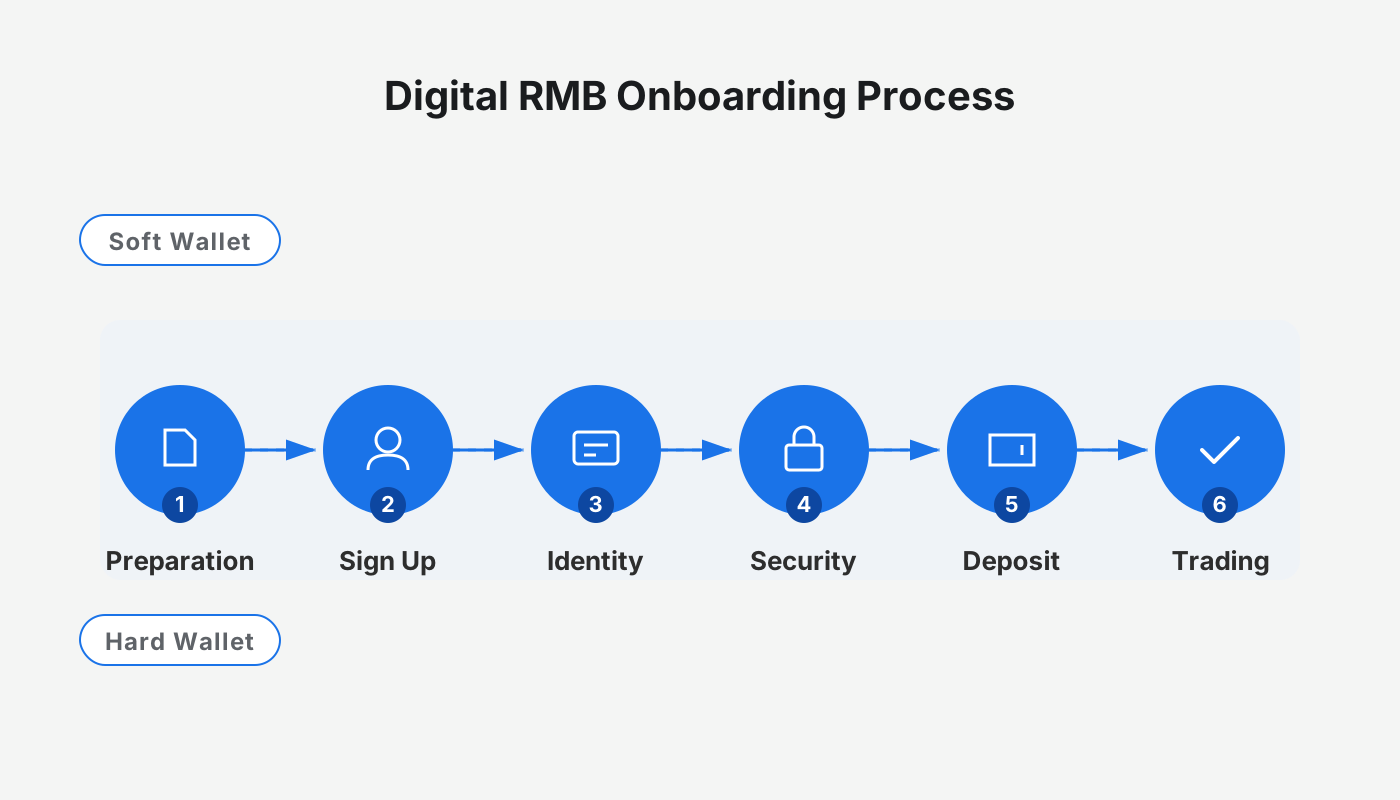
The value of a card‑type digital RMB soft wallet is stored on a server and synchronized with a mobile phone through the account bound to the card; a card‑type hard wallet, on the other hand, stores digital RMB directly inside a secure element embedded in the card, enabling truly offline payments.
Card “Hard Wallet” vs. Card “Soft Wallet”
The *Digital RMB Development Research Report 2020* states that a digital RMB wallet is a legal‑currency carrier opened by a service provider for a user, identified by a unique serial number, and it comes in two forms: an App wallet and a hardware wallet.
- App wallet: Provides services through a smart application that supports digital RMB. It is a software wallet that exists as an app, for example the bank‑issued wallets inside the official Digital RMB application.
- Hardware wallet: An实体 (physical) medium created via a counter or electronic channel, equipped with a Hardware Security Module (HSM). It supports functions such as cash‑in, cash‑out, circular deposit, circular withdrawal, consumption, transfer, and balance inquiry. Common embodiments include phones with SE (Secure Element) chips, NFC‑SIM cards, bank cards, and wearable devices.
The essence of a hardware wallet is a physical carrier that contains a secure element. Typical card formats are visual cards, fingerprint‑enabled cards, and similar variants.
A soft wallet represents a different implementation: the card itself does not hold any digital RMB. Instead, it is linked to a wallet account that lives on a remote server. The card communicates with a smartphone via Bluetooth or NFC, syncs the account information, and then completes a payment. This type of card shares the same underlying account as the digital RMB account inside the app; when a transaction occurs, the card can upload the necessary data to the merchant terminal, allowing balance display and transaction records to stay in sync.
Why is a card‑type “soft wallet” Still Needed?
Compared with a card‑type hard wallet, a soft wallet offers several advantages:
- No need for pre‑loading
A hard wallet resembles a transit card: you must top it up in advance and write the value into the secure element. A soft wallet draws directly from the mobile‑side account; once synchronization is complete, you can spend immediately, eliminating the top‑up step.
- Reduced loss risk
If a hard wallet is issued as an anonymous (non‑named) card, the value stored locally on the card is difficult to recover after loss. With a soft wallet, the value remains on the server, so losing the physical card only affects convenience, not the actual assets.
A soft wallet still needs to sync with the backend periodically to obtain a quota of offline transactions. After synchronization, a limited number of offline payments can be performed; once the quota is exhausted, another sync is required.
From a technical standpoint, the soft wallet relies on communication modules such as Bluetooth and NFC, thereby avoiding the cost of a secure element. Whether this translates into a lower overall cost remains to be proven by the market. Because a soft wallet essentially supplements a mobile phone wallet, its payment limits may be capped, making it suitable for wearables and other scenarios that require frequent interaction with a phone.
Diverse Technical Paths – Market Determines Product Form
Mobile‑payment network interviews with industry insiders reveal mixed views on soft wallets:
- Cao Changjing, a banking professional: “We have not yet seen any soft‑wallet products on the market. Smart cards tend to adopt hard‑wallet solutions, and the practicality of soft wallets is limited.”
- Shi Qianfeng, terminal manufacturer: “Smart cards, wearables, and similar products are designed for specific user groups and market demands. In the early stage of digital RMB promotion, multiple technical routes coexist, and collective brainstorming is needed. Ultimately, the market will select the most viable solutions.”
Cao also disclosed plans to develop a ‘dual‑core hard wallet’: a single piece of hardware that hosts two wallets—one for digital RMB and another for industry‑specific tokens—realizing a “one‑card‑multiple‑applications” model. He explained that the rollout of digital RMB still faces high merchant‑side integration costs and challenges in hardware/software upgrades; the dual‑wallet approach is more of an interim bridge.
Digital RMB is still in its infancy of adoption, and various card‑type wallet solutions continue to evolve. As industry voices agree, market demand will ultimately decide which technical path and product form prevail.
The above provides a detailed analysis of the differences between card‑type soft wallets and hard wallets for digital RMB. For more articles related to card‑type digital RMB, please follow Bitaigen (比特根).
*Note for global readers*: When dealing with fiat transactions related to digital assets, the usual settlement channels are USD transfers via SWIFT or SEPA, depending on the region. Users in the United States should use Binance.US rather than the global Binance platform. Crypto‑related gains may be subject to taxation under local jurisdiction; please consult a tax professional for guidance.
Related Reading
- Secure Blockchain Games: Multi‑Signature Wallets & ZK Proofs
- Decentralized Networks: Security, Cost & Governance
- Top Crypto Trading Platforms: Security, Fees & UX
💡 Register on Binance with referral code B2345 for the maximum trading fee discount. See Binance complete guide.



