
 Bitaigen Research
 In this article we systematically examine the nature of wallet addresses, passwords, private keys, mnemonic phrases, and keystores, using a bank‑card analogy to help newcomers quickly develop a security mindset. We then delve deeper into their interrelationships and optimal storage methods, offering practical recommendations that are worth a careful read.
A Deeper Explanation
In blockchain use‑cases, the various credentials of a wallet are often compared to elements of a traditional bank account. Below, using the “card number + PIN” model as a framework, we explain the address, password, private key, mnemonic phrase, and keystore one by one.
1. Address
The address is analogous to a bank card number.
- How it is generated: After creating a wallet the system automatically provides a hexadecimal string that starts with `0x` and is 42 characters long. This string is the wallet’s unique receiving address. Each wallet corresponds to a single address, and it cannot be changed.
- Use cases: The address can be given to others for sending funds, and it also serves as proof of a transaction. Note that all tokens held in a decentralized wallet (e.g., ETH, EOS) share the same address, which differs from centralized exchanges that often allocate a separate receiving address for each token type.
2. Password
The password is comparable to a bank card PIN and is primarily used for local operations.
- Setting requirements: When the wallet is created for the first time, a password must be set; it must be at least 8 characters long, and a complex combination is recommended to improve security.
- Functions: ① Acts as a payment PIN for sensitive actions such as transfers; ② Serves as the unlock password when importing a keystore file.
- How to change: If you remember the original password, you can modify it directly within the wallet; if you forget it, you must re‑import the wallet using the private key or mnemonic phrase and set a new password.
- Cross‑device characteristic: The same wallet on different phones can have different local passwords, which do not affect each other, reflecting the software‑level independence.
3. Private Key
The private key is analogous to “card number + PIN”. Possessing the private key gives you full control over the assets in the corresponding wallet.
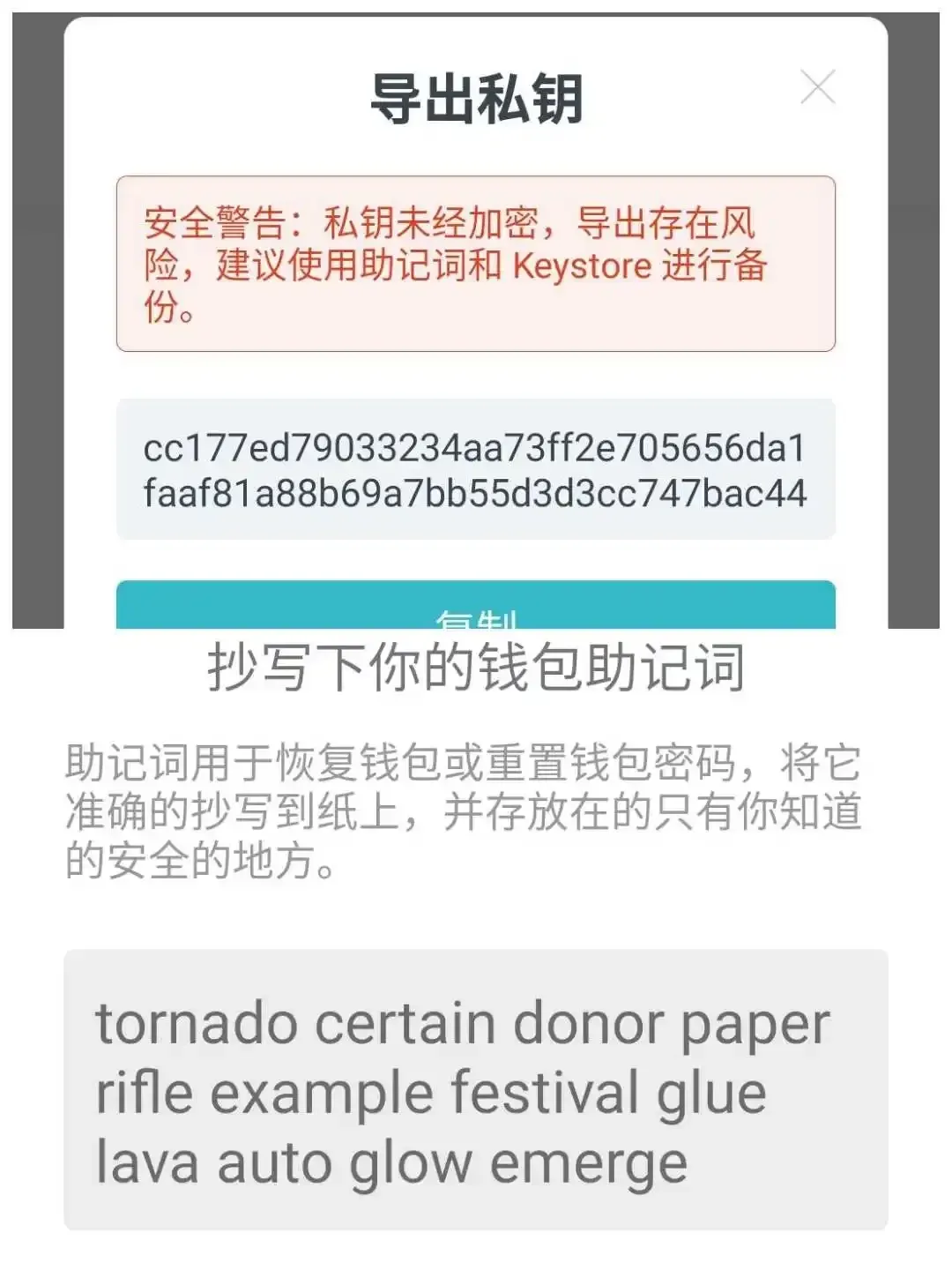
- Structure: A plain‑text string composed of 64 hexadecimal characters. Each wallet has a single, immutable private key.
- Export method: After entering the password you have set, you can export the private key from within the wallet.
- Purpose: By importing the private key into any supported client and setting a new local password, you can restore the wallet and transfer the assets it holds.
4. Mnemonic Phrase
A mnemonic phrase is another representation of the private key, designed for easier memorisation and manual recording.
- Composition: 12 English words separated by spaces.
- Generation and backup: When the wallet is created, the system prompts you to back up the phrase; once you confirm, the phrase disappears and must be handwritten and stored in a secure environment.
- Functionally equivalent to the private key: Importing the phrase and setting a new password restores the wallet with full control.
- Uniqueness: Each wallet corresponds to a single set of mnemonic words, which cannot be altered after generation.
5. Keystore
A keystore file is essentially the private key encrypted with the wallet password.
- Backup method: In the wallet, choose “Backup keystore”, enter the current password, and you will receive a long string of characters—that is the keystore.
- Import process: When using the official client, provide the keystore together with the password you used at creation to unlock the wallet. Note that this password must be the original one used for the backup; subsequent changes to the local password do not affect the keystore.
- Security feature: The keystore is bound to the password, so when the password is changed the keystore content is updated accordingly.
6. Summary
In a centralized financial system, losing a bank card or forgetting the PIN can be remedied through the bank’s recovery services. In the decentralized world of blockchain, all credentials (private key, mnemonic phrase, keystore + password) are managed solely by the user. If any piece of information is lost, only the user can attempt recovery; no third party can retrieve it. Therefore, proper backup and strict protection against leakage are the only guarantees of security.
---
A Simpler Recap
Below is a more straightforward review of the concepts to help beginners build quick recognition.
Private Key
- A string of 64 hexadecimal characters.
- After creating a wallet, you can export it by entering the local password.
- The private key maps to a unique public key, which through an algorithm generates the address; the process is irreversible.
Mnemonic Phrase
- Created to solve the memorisation problem of private keys; it consists of 12 English words.
- Functions identically to the private key—enter the phrase and set a new password to recover the wallet.
Wallet Password
- Must be set when the wallet is created; length ≥ 8 characters.
- Used for payment verification during transfers and for unlocking a keystore during import.
- Can be changed at will, or reset via the private key/mnemonic phrase if forgotten.
Analogy:
- Private Key = Card number + Card PIN
- Mnemonic Phrase = Same as above, just a different representation
- Password = Card PIN alone
---
Common Risks and Countermeasures
1. Forgetting Information
| Situation | Viable Recovery Method |
|---|---|
| Address forgotten | Re‑import using the private key, mnemonic phrase, or keystore + password to retrieve it |
| Password forgotten | Import with the private key or mnemonic phrase and set a new password |
| Neither private key nor mnemonic phrase backed up **and** password forgotten | Control of the wallet is lost; transfers become impossible |
| Keystore lost but password remembered | You can still export a new keystore using the private key or mnemonic phrase |
| Mnemonic phrase forgotten | Re‑import via private key or keystore + password, then generate a new mnemonic phrase |
As long as at least one element of the “three‑piece set” (private key, mnemonic phrase, or keystore + password) remains in your possession, the wallet can be restored.
2. Information Leakage
- Address only: No impact on asset security.
- Password only: Still safe, because the private key or mnemonic phrase is required for access.
- Keystore + password or private key/mnemonic phrase: If exposed, anyone can fully control the wallet and transfer assets out.
If you suspect any of these combinations may have been exposed, immediately move the assets to a newly generated address.
3. Backup Recommendations
- Private key & mnemonic phrase: Write them on paper, create multiple copies, and store them in separate, secure locations.
- Verification: After backing up, try importing on another device to confirm correctness.
- Avoid network distribution: Never send backup data via email, social media, or other internet‑connected channels.
- Family awareness: While maintaining security, let trusted relatives know where the backups are stored to handle emergencies.
---
Related Reading
- MetaMask Wallet Security: 5,000 ETH Theft Rumor & Probe
- Beginner’s Step‑by‑Step Guide to Using Huobi Wallet Safely
- Secure Your Blockchain Wallet: Private Keys & Seed Phrases
💡 Register on Binance with referral code B2345 for the maximum trading fee discount. See Binance complete guide.



