
 Bitaigen Research
Standing at a new starting point following the 2024 halving, we are entering a critical period where historical patterns and macroeconomic shifts intertwine. As a vital "coordinate" within the cycle, 2026 not only carries the residual effects of the halving but also faces a deep interplay between global monetary policies and the ongoing process of regulatory compliance. This article aims to look past short-term volatility, reconstructing the underlying logic of market evolution by reviewing historical cycles and integrating three major macro dimensions. We hope this in-depth analysis will help readers establish a global perspective amidst complex trends and rationally perceive the long-term value of crypto assets.
2026: The Historical Coordinate of the Bitcoin Four-Year Halving Cycle
The Bitcoin market in 2026 is expected to enter the "adjustment year" of its four-year halving cycle. Historical data indicates that the second year following a halving is typically accompanied by price pullbacks and market shakeouts. Influenced by Federal Reserve interest rate policies, global inflation trends, and the progress of regulatory compliance in hubs like Hong Kong, the 2026 market may exhibit a trend of range-bound bottoming after a retreat from previous highs. Due to increased institutional participation, volatility may be lower compared to previous cycles.
Reviewing the 2024 Halving: Repetition and Variation of Historical Patterns
The Bitcoin "Halving" mechanism is the core of its decentralized financial design. Set by Satoshi Nakamoto within the genesis code, the block reward granted to miners is reduced by 50% approximately every four years (or every 210,000 blocks). This design is intended to mimic the scarcity of gold, combating inflation by gradually reducing the rate of new supply.
A Review of the Three Historical Halvings:
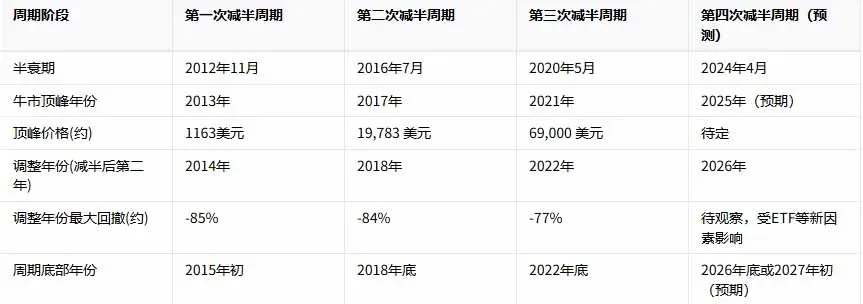
- First Halving (November 2012): The reward dropped from 50 BTC to 25 BTC. Within the following year, the price surged from approximately $12 to over $1,100.
- Second Halving (July 2016): The reward decreased to 12.5 BTC. Within 18 months post-halving, the price rose from $650 to nearly $20,000.
- Third Halving (May 2020): The reward fell to 6.25 BTC. Despite a turbulent macroeconomic environment, Bitcoin reached a peak of approximately $69,000 in November 2021.
The fourth halving in April 2024 reduced the reward to 3.125 BTC. Judging by historical patterns, the halving itself is not an immediate trigger for a price explosion, but rather a "seeding" process. The Supply Shock it induces typically manifests most intensely in the following year (i.e., 2025).
However, significant variations have appeared in the current cycle. In early 2024, the U.S. Securities and Exchange Commission (SEC) approved several Spot Bitcoin ETFs, opening a compliant channel for traditional financial capital. This means that market performance in 2026 will not only be influenced by the halving but will also be deeply reshaped by ETF capital flows and the behavior of institutional investors. For global investors, it is important to note that while the global market uses platforms like Binance, users in the United States must utilize Binance.US to comply with local regulations.
The Second Year Post-Halving: The Typical Path from Mania to Rationality
The second year after a halving is usually the "year of adjustment" where the crypto market returns from mania to rationality. If 2025 witnesses a bull market peak as expected, then 2026 (corresponding to 2014, 2018, and 2022 in history) will likely undergo a significant revaluation of assets.
Historical data reveals the similarities in these cycles:
- 2014: After peaking in 2013, Bitcoin remained in a downward channel throughout the year, with a decline exceeding 80%.
- 2018: Following the bursting of the ICO bubble, Bitcoin retreated from its $20,000 high and endured a year-long "crypto winter."
- 2022: Hit by global central bank interest rate hikes and the collapse of institutions like FTX, the price saw a major drawdown from $69,000, falling by more than 75%.
The logic behind this pattern is that the late stages of a bull market often accumulate excessive leverage and irrational valuations. When upward momentum is exhausted, selling by early profit-takers triggers a chain reaction of liquidations. Therefore, the Bitcoin market in 2026 will likely be in a phase of cyclical consolidation or bottoming. Market characteristics may include decreased volatility and shrinking trading volumes. For long-term investors, this is often viewed as a window for re-evaluating entry points or performing Dollar Cost Averaging (DCA).
Diminishing Supply Shock Effect: Math and Psychology in the New Cycle
The marginal effect of the Bitcoin supply shock is weakening year by year. While each halving cuts the new supply in half, the actual impact on the total supply structure is decreasing because the total circulating supply is already very large.
- 2012: The annual inflation rate dropped from 25% to 12%, creating a massive supply shock.
- 2024: After the halving, the annual inflation rate dropped from approximately 1.7% to 0.85%, which is already lower than the extraction rate of gold.
By 2026, Bitcoin's circulating supply will account for more than 95% of the total supply. This means that demand-side factors will completely dominate the price discovery mechanism. Institutional adoption rates, macroeconomic policies, and technical breakthroughs in the Layer 2 ecosystem will carry more weight than the simple "halving narrative." As market maturity increases, the adjustment period in 2026 may manifest as a longer period of sideways movement rather than the sharp, vertical crashes seen in the early days.
Three Major Macroeconomic Variables: Reshaping the 2026 Bitcoin Valuation Framework
The correlation between Bitcoin and the global macroeconomy has strengthened significantly in recent years. By 2026, Bitcoin's price fluctuations will more closely reflect global liquidity, interest rate expectations, and geopolitical risks.
Shifts in Interest Rate Policy: The Anticipatory Game Between Tightening and Easing
The US Federal Funds Rate is the core of global asset pricing. When interest rates rise, the valuation of risk assets like Bitcoin often comes under pressure; conversely, rate cuts release liquidity and push up asset prices.
Looking toward 2026, the market's core focus lies in the Federal Reserve's monetary policy path:
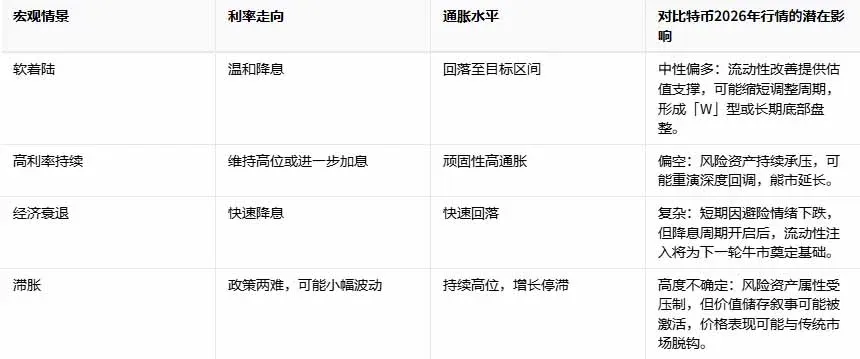
- Mild Easing Scenario: If inflation is controlled and the economy slows, the Fed may initiate a rate-cut cycle. This would provide strong valuation support for Bitcoin in 2026, resulting in a "shallow bear" or "sideways bottoming" market structure.
- Higher for Longer: If inflation proves sticky and the tightening environment persists, 2026 may face deeper adjustment pressures.
- Stagflation Environment: The coexistence of economic stagnation and high inflation might highlight Bitcoin's attributes as a "digital gold" and a store of value.
The Evolution of the Inflation Narrative: From Hedge to Risk Asset
In market practice, Bitcoin is increasingly viewed as a long-duration risk asset. Despite its fixed total supply, its price sensitivity is extremely high when dealing with sudden interest rate hikes aimed at curbing inflation.
In 2026, investors should pay close attention to the Real Yield. When real yields decrease, the attractiveness of holding non-yielding assets (like Bitcoin) increases. If a sovereign debt crisis or a systemic shakeup of confidence in fiat currencies occurs in 2026, the narrative of Bitcoin as a "non-sovereign store of value" could be reignited, attracting safe-haven capital inflows.
Global Geopolitics and Recession Risks: Safe-Haven Demand Amidst Uncertainty
The impact of geopolitical turmoil on Bitcoin is dual-natured. During regional credit crises, Bitcoin is often seen as a "digital lifeboat"; however, during global systemic liquidity crises (such as in March 2020), investors tend to prefer "cash is king," leading to a synchronized decline in all risk assets. In 2026, investors must be alert to the short-term liquidity shocks that a systemic recession could cause to the crypto market. When moving funds internationally, users typically rely on SWIFT for USD transactions or SEPA for Euro-based transfers to move capital into compliant exchanges.
The Hong Kong Compliance Process: A Catalyst for Institutional Capital and Retail Participation
Hong Kong's virtual asset compliance process is reshaping the local market structure. By 2026, as the regulatory framework matures, Hong Kong is expected to become an important gateway for institutional capital entering the crypto market.
Maturity of the SFC Regulatory Framework: Value and Credibility of Licensed Exchanges
The Virtual Asset Trading Platform (VATP) licensing system implemented by the Hong Kong Securities and Futures Commission (SFC) provides the market with transparent and rigorous operational standards.
- Investor Protection: Licensed platforms are strictly required to segregate assets and provide insurance coverage for assets held in cold wallets.
- Traditional Financial Connectivity: Compliance has smoothed the channels for fiat (HKD/USD) deposits and withdrawals, enhancing the convenience of fund flows.
By 2026, licensed exchanges will become the first choice for mainstream capital. This trust endorsement, driven by regulation, will effectively mitigate market panic during adjustment periods and accumulate compliant funds for the next cycle of growth.
Comprehensive Analysis: Building Your 2026 Bitcoin Investment Strategy
Scenario Analysis: Probabilities and Responses for Bull, Bear, and Sideways Markets
- Moderate Adjustment Scenario (High Probability): Prices retreat 30%-50% from the 2025 highs, entering a wide range of sideways bottoming. It is recommended to adopt a Dollar Cost Averaging (DCA) strategy, buying in batches within pre-set valuation ranges to average out costs.
- Deep Bear Market Scenario (Medium Probability): In the event of a global financial crisis, the price drawdown could exceed 70%. In this case, risk management is paramount; high leverage should be avoided, and assets should be stored in regulated platforms (such as HashKey Exchange) to ensure safety.
- Super Cycle Continuation (Low Probability): If macroeconomic tailwinds exceed expectations, the bull market may be extended. The strategy should focus on "gradual profit-taking," avoiding blind chasing of highs during periods of extreme market euphoria.
Risk Management: Key Principles for Protecting Capital Amidst Volatility
- Rational Asset Allocation: It is suggested to keep Bitcoin within 1% to 10% of your overall investment portfolio.
- Reject High Leverage: During adjustment cycles, leverage acts as an accelerator for losses; spot trading is significantly more robust.
- Choose Compliant Channels: Ensure that assets are stored with licensed institutions that are protected by law and maintain high transparency.
- Tax Considerations: Investors should be aware that cryptocurrency gains are generally taxable. Depending on your local jurisdiction (e.g., IRS in the US or HMRC in the UK), you may be required to report and pay capital gains tax on your profits.
FAQ: Frequently Asked Questions Regarding the 2026 Bitcoin Market
1. Will Bitcoin experience another major bear market in 2026 like it did in 2022?
According to the four-year cycle rule, 2026 is likely to be an adjustment year. However, whether a decline of more than 75% occurs depends on the macroeconomy. The existence of spot ETFs may provide stronger downside buying support than in previous years.
2. What specific impact does Hong Kong's regulatory policy have on ordinary investors?
The core impacts are "safety" and "convenience." Investors can enjoy asset segregation protection through licensed platforms and have access to compliant fiat deposit and withdrawal channels, reducing the risk of platform defaults.
3. Will institutional capital enter the market on a large scale in 2026?
As regulatory frameworks (such as those in Hong Kong and the US) improve, more pension funds and insurance companies may include Bitcoin in their allocations. Institutional "buy the dip" behavior will serve as an important stabilizer for the market in 2026.
Conclusion
Looking ahead to 2026, the Bitcoin market is no longer an isolated field of speculation but a complex ecosystem deeply intertwined with the global macroeconomy. While the four-year cycle suggests the possibility of an adjustment, the compliance process in Hong Kong and the involvement of global institutions are injecting new resilience into the market. A successful investment strategy should not rely on precise price predictions but should be based on respect for cyclical patterns, insight into macro variables, and strict execution of risk management.
---
*The content of this article is for informational purposes only and does not constitute any investment advice. Investors should fully understand the risks and consult with professional advisors before making any decisions. For more outlooks on Bitcoin in 2026, please search for previous articles by Bitaigen or continue browsing related content.*
Related Reading
- Pi Coin Consensus Price: Community Views vs Market Reality
- Solana Network Decline & Flash Indicator Impact on Price
- Ethereum Pullback: Macro, Technical & Sentiment Outlook
💡 Register on Binance with referral code B2345 for the maximum trading fee discount. See Binance complete guide.



