
 Bitaigen Research
 You’re new to Binance and want to try grid trading but don’t know where to start?
On Binance, beginners should first choose a spot‑grid or futures‑grid based on their capital size and risk tolerance, then match the market condition (sideways, slowly rising, slowly falling) and grid parameters (price range, number of grids, investment amount) to compare options and pick the most suitable grid strategy.

In this article we systematically outline the grid‑trading selection logic for Binance newcomers, tying together capital size, risk appetite, and market characteristics. We walk through the differences between spot and futures grids and the key parameter settings. With case‑by‑case demonstrations, you’ll be able to get started quickly, avoid common pitfalls, and boost your trading confidence.
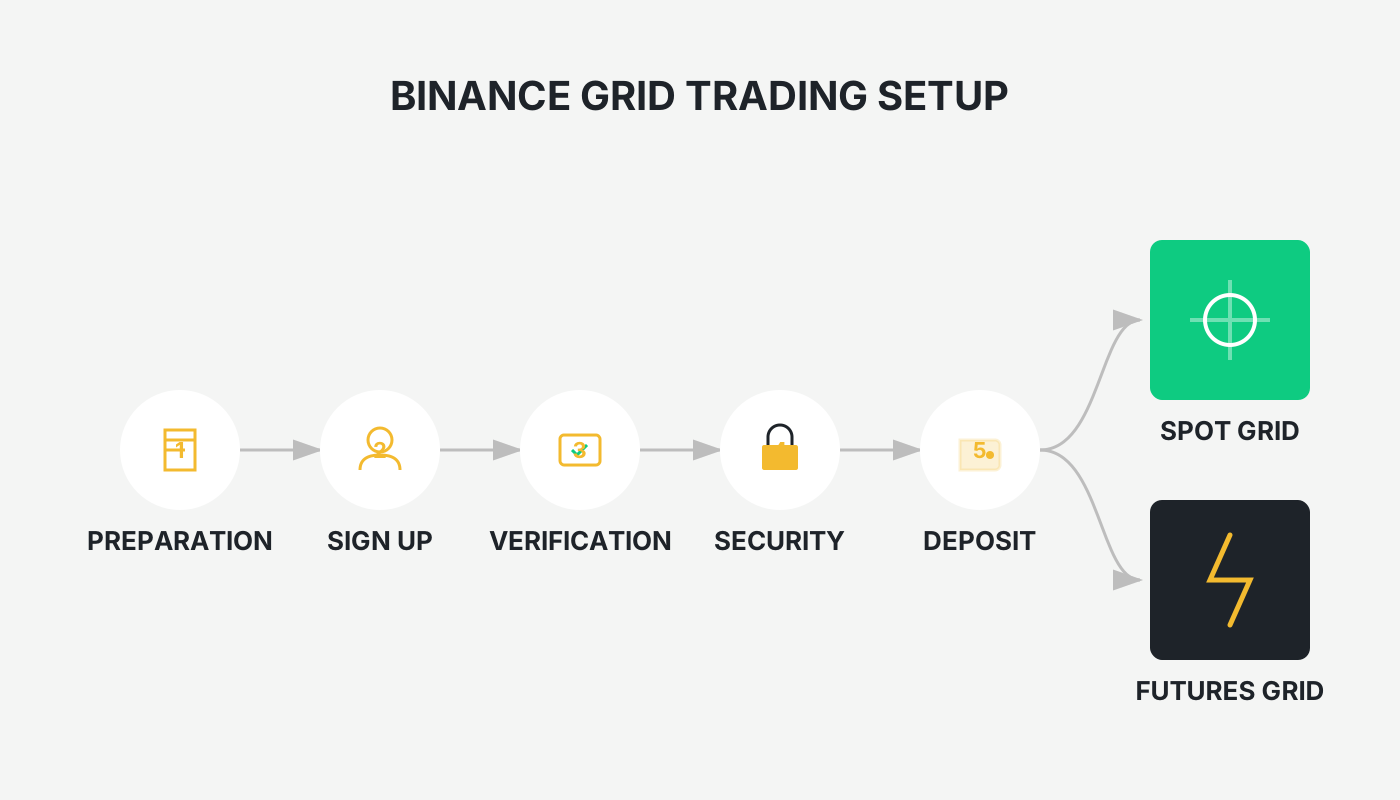
Why use grid trading on Binance?
Newcomers often worry that picking the wrong strategy will cause early setbacks. Grid trading is an automated, low‑entry‑barrier investment tool that helps investors reduce the need to constantly watch the market, mitigate FOMO (fear of missing out) emotions, and participate in price swings through interval‑based positioning. Using Binance as an example, this guide explains the principle of grid trading, the different types available, and the complete process for creating a grid on Binance, helping you get up to speed fast and increase confidence.
Full Introduction to Grid Trading
What is grid trading?
Grid trading employs an automated bot that automatically executes “buy low, sell high” within a predefined price interval. Different grid types (long, short, or neutral) determine the direction of buying and selling as well as the detailed strategy. The most common long‑grid works best in relatively stable price ranges, allowing you to enter and exit in batches and continuously accumulate profit.
How it works: automatically buying low and selling high
Below we use a spot long grid as an example to break down the key parameters and execution logic.
| Parameter | Meaning |
|---|---|
| **Price range** | Upper and lower limits where the grid operates (e.g., 100,000 ~ 150,000) |
| **Number of grids** | How many sub‑intervals the range is divided into; more grids mean smaller price gaps and finer granularity |
| **Investment amount** | Total capital allocated to run the grid |
Operation example
Assume you trade Bitcoin (price ≈ 116,684 USD) and set the range to 100,000 ~ 150,000 USD, split into 20 grids (price gap = 2,500 USD per grid):
- In the 100,000 ~ 115,000 USD segment place 7 buy orders (one per grid)
- In the 115,000 ~ 150,000 USD segment place 13 sell orders (one per grid)
When the price drops to 115,000 USD, the bot automatically buys. If the price later rises to 117,500 USD, the bot automatically sells, capturing the interval spread. Once the parameters are set, the bot runs continuously, helping beginners reduce emotional interference.
Situations where grid strategies fit and their pros & cons
| Market condition | Recommended grid type | Explanation |
|---|---|---|
| Sideways market | Long / Short / Neutral grid | Prices bounce within a range, suitable for harvesting small fluctuations |
| Slowly rising market | Long grid | Overall upward trend with oscillations, allows phased entry and exit |
| Slowly falling market | Short grid | Overall downward trend with oscillations, also allows phased entry and exit |
Advantages
- Automated operation, no need to watch the market constantly
- Reduces emotional interference (FOMO)
- Capital is entered in batches, spreading single‑trade risk
- Low dependence on market direction; profit can be earned as long as price moves within the interval
- Particularly suitable for ranging markets
Disadvantages
- In high‑volatility environments the price may break out of the interval, causing the grid to stop
- In strong trending markets, returns may be lower than a full‑position hold
- Continuous decline leads to repeated buying; without a stop‑loss the risk grows
- Requires relatively large capital to support a higher number of grids
Complete Overview of Binance’s Grid Trading Feature
Binance offers two major categories of grid trading: Spot Grid and Futures (Contract) Grid, each of which includes AI‑generated strategies, popular templates, and manual custom‑creation modes.
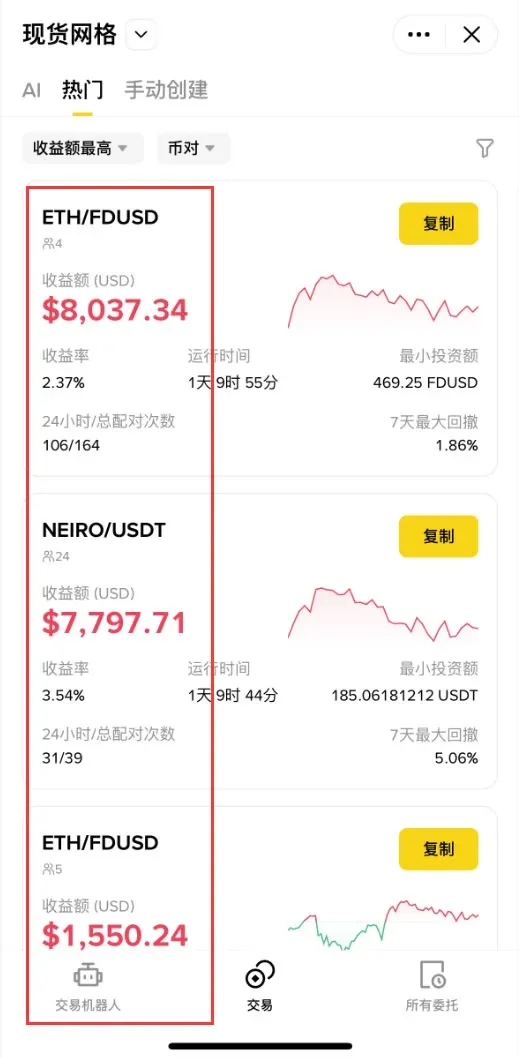
Comparison of Grid Trading Types
| Item | **Spot Grid** | **Futures Grid** |
|---|---|---|
| Trade direction | Long only | Long, Short, Neutral |
| AI‑strategy applicable horizon | Short‑medium, Long term | Short‑medium, Long term |
| Capital requirement | Uses spot balance directly | Requires margin; leverage can be applied |
| Risk level | Lower | Higher (inherent leverage risk of futures) |
Spot grids support more flexible short‑term operations and are ideal for beginners to get in quickly; futures grids provide directional diversity and larger leverage opportunities, but require careful risk assessment and the use of stop‑losses.
Fee comparison table
| Item | **Spot Grid** | **Futures Grid** |
|---|---|---|
| Opening/closing fee | 0.1 % | 0.05 % |
| Trading fee (buy/sell) | 0.1 % | 0.02 % |
| Funding rate | Varies by asset | Varies by contract |
The table helps you quickly compare the cost structures of the two grid types, allowing you to decide based on capital size and fee sensitivity.
How should beginners choose a grid?
1. Pick a strategy based on capital size and risk tolerance
| Capital size | Recommended grid | Explanation |
|---|---|---|
| ≥ 1,000 USD (USDT) | **Spot Grid** | Sufficient funds to invest directly in a spot grid |
| < 1,000 USD (USDT) | **Futures Grid (leveraged)** | Leverage amplifies the capital, but risk is comparatively higher |
| Risk tolerance | Recommended approach |
|---|---|
| High | May try higher leverage or denser grids, but always set a stop‑loss |
| Low | Start with spot grids, get comfortable with range trading before moving to futures |
Note for U.S. users: Binance’s global platform is not available in the United States. You should use Binance.US for any spot or futures activities, and the fee structure may differ slightly.
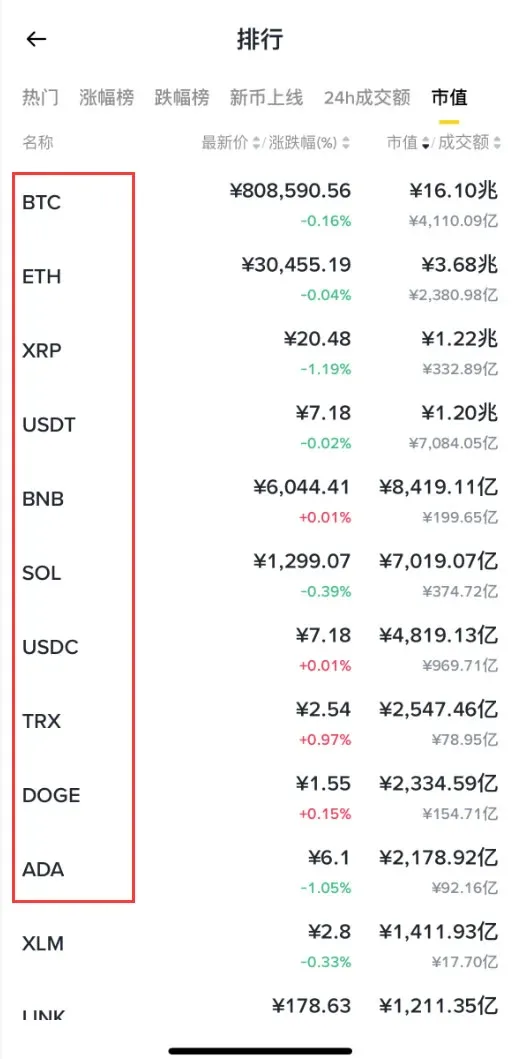
2. Coin selection guide
- Top‑10 market‑cap assets (e.g., BTC, ETH, BNB, SOL) – high liquidity, relatively controllable volatility
- Projects with ongoing development (tokens with strong on‑chain activity)
- Hot‑topic coins (be aware of higher volatility, especially many altcoins)
3. Technical patterns and interval setting
| Technical tool | Usage |
|---|---|
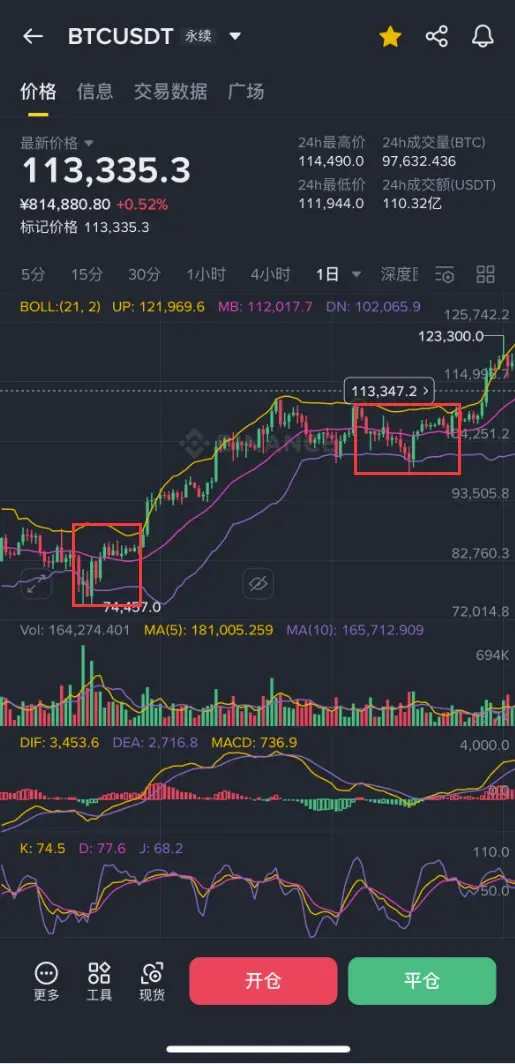
| **Bollinger Bands** | Build upper and lower bands using standard deviations to identify overbought/oversold zones |
| **Moving Averages (MA)** | Observe different period averages (5, 20, 60‑day) to spot support and resistance |
Apply the chosen time frame (weekly, monthly, or quarterly) to the tools above to derive a reasonable price‑range upper and lower bounds.
Step‑by‑Step Tutorial for Binance Grid Trading
1. Create a grid strategy
- Open the Binance APP (registration link) → More → Trade → Trading Bot.
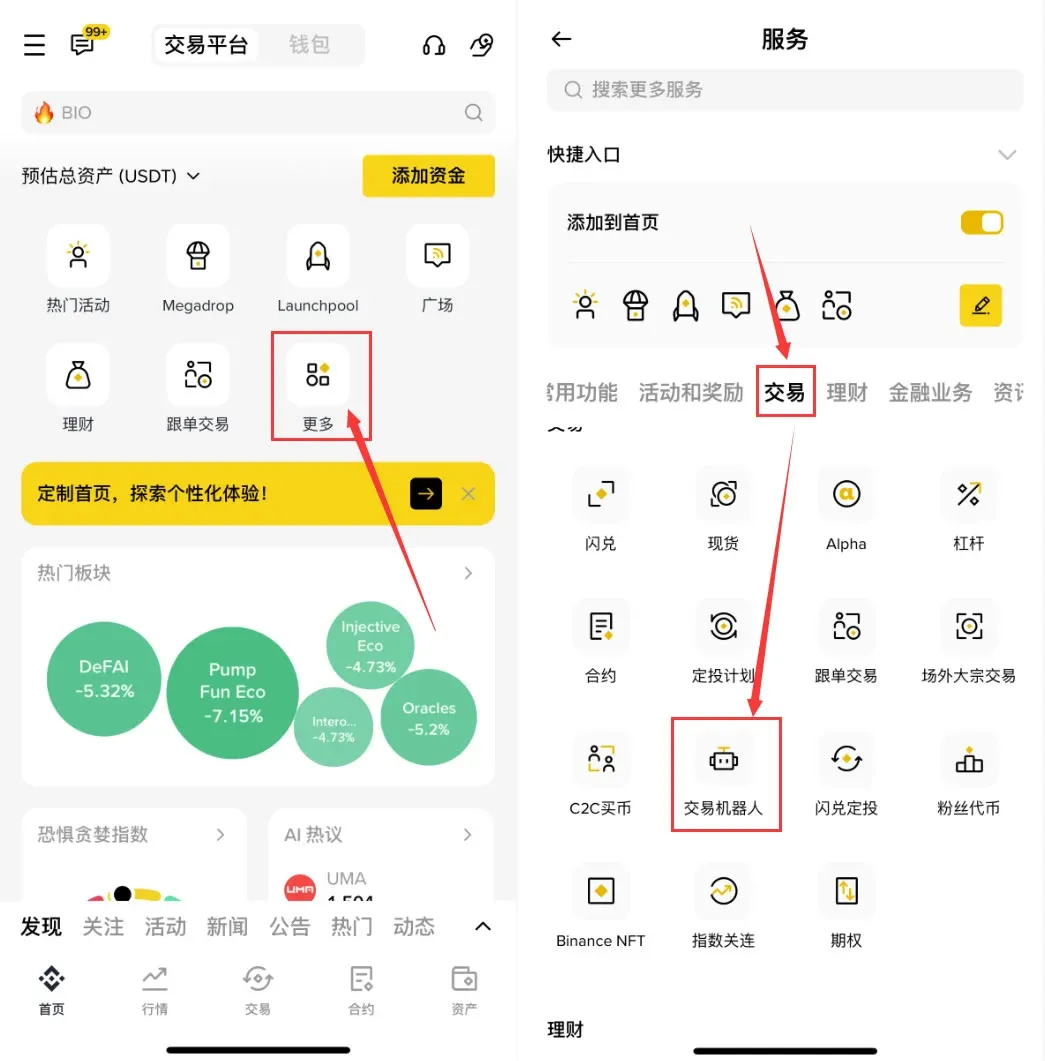
- On the page, select Spot Grid or Futures Grid.
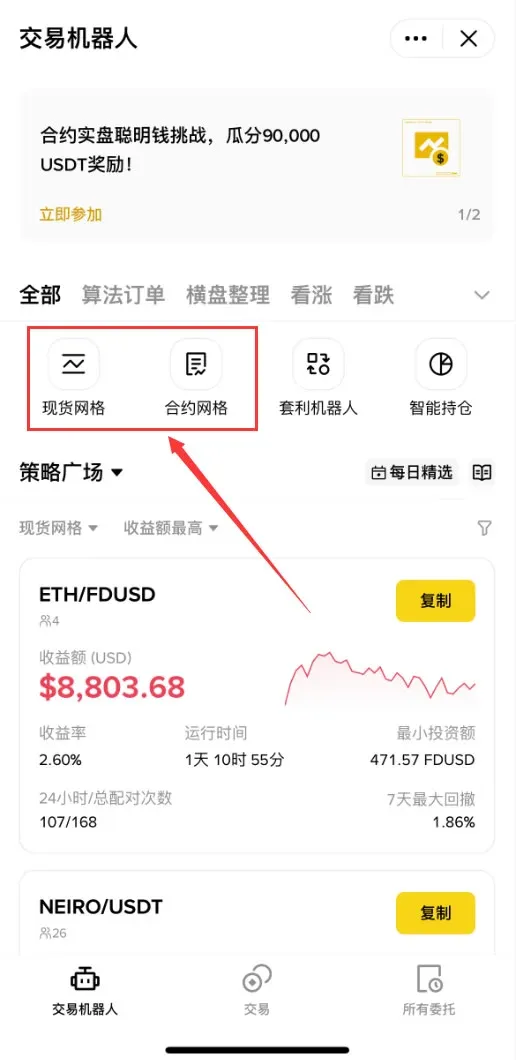
- Choose one of the three creation modes:
- AI: One‑click copy of an existing strategy (spot defaults to long; futures allow long, short, or neutral)
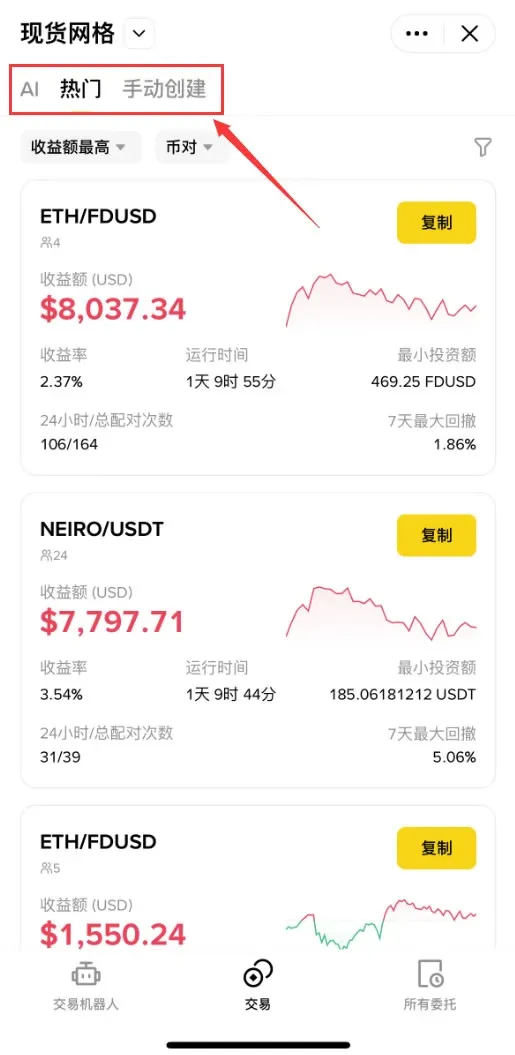
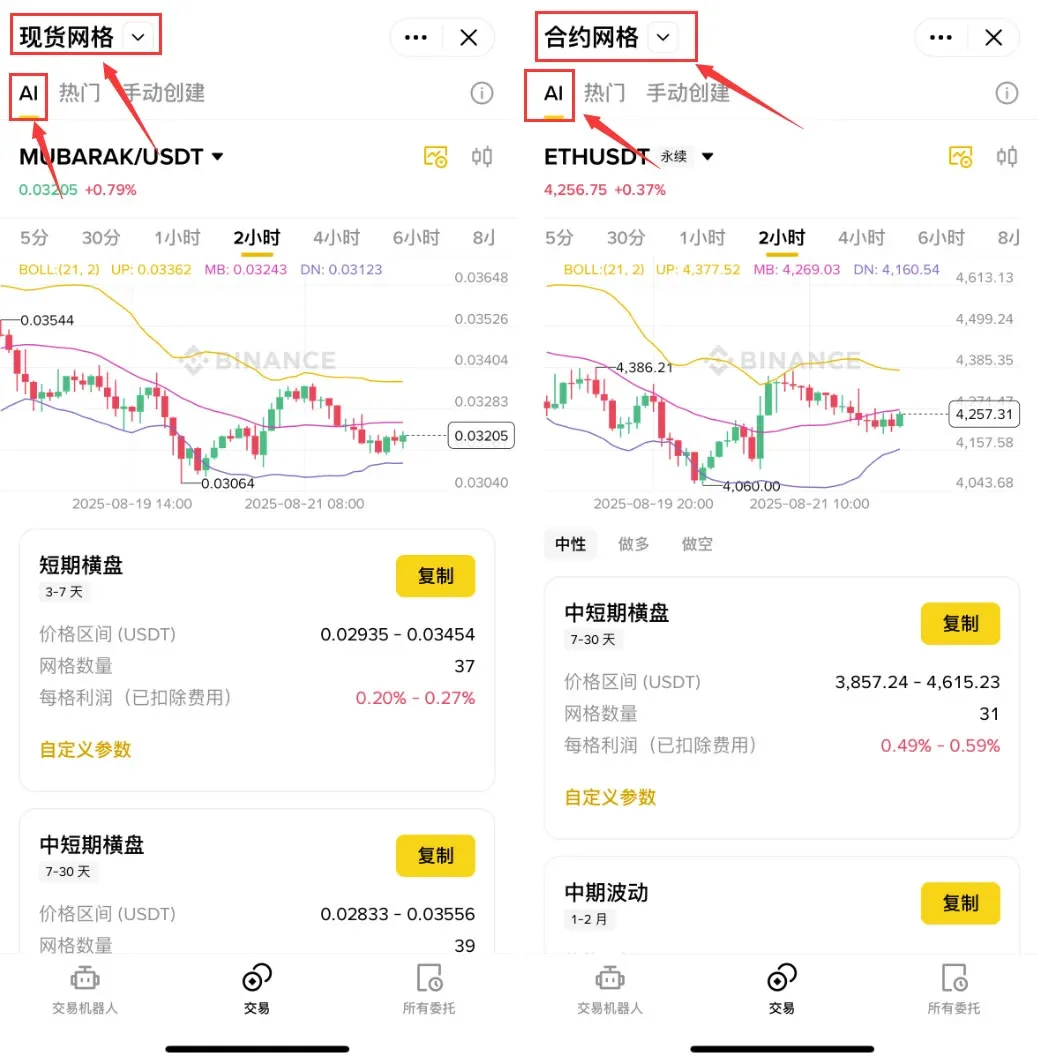
- Popular: Pick from templates recommended by the platform
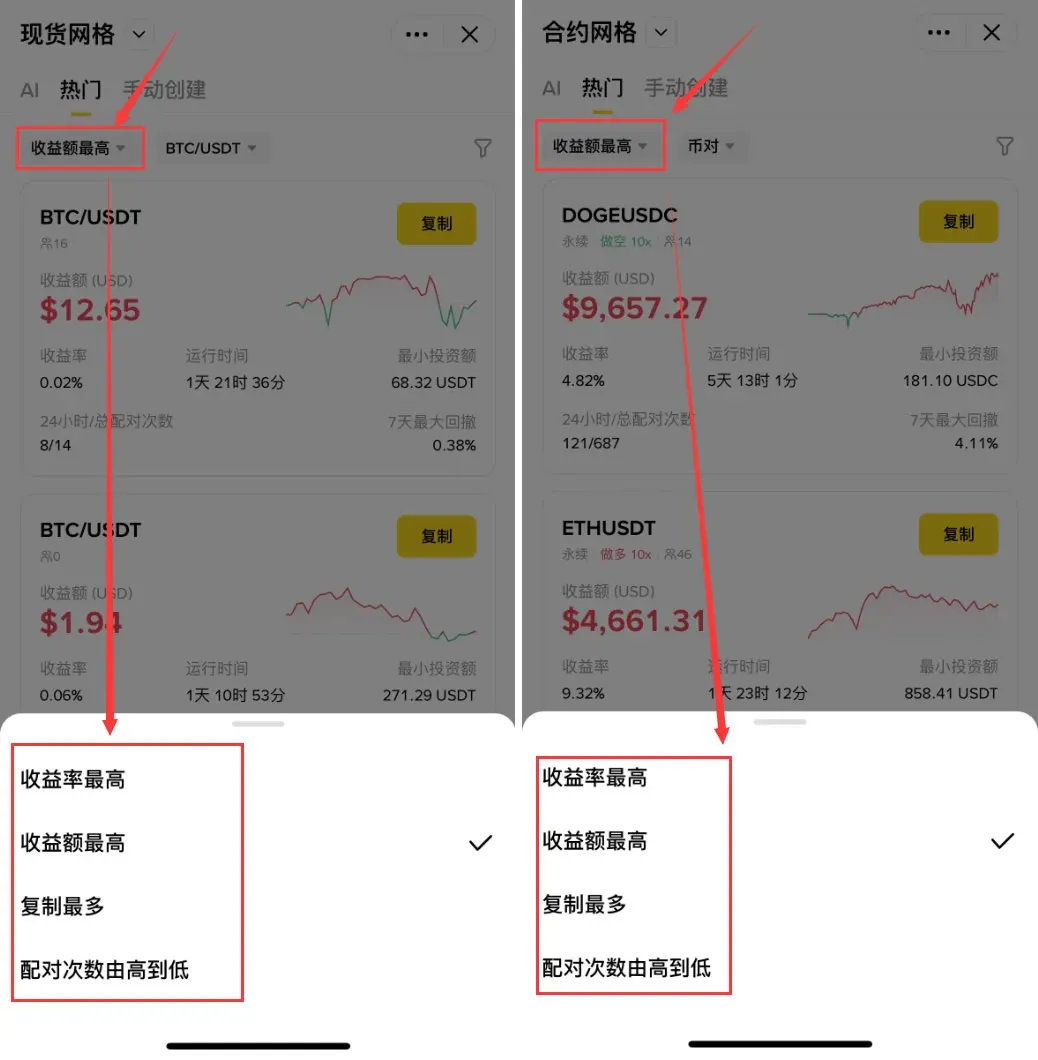
- Manual: Define all parameters yourself (explained below)
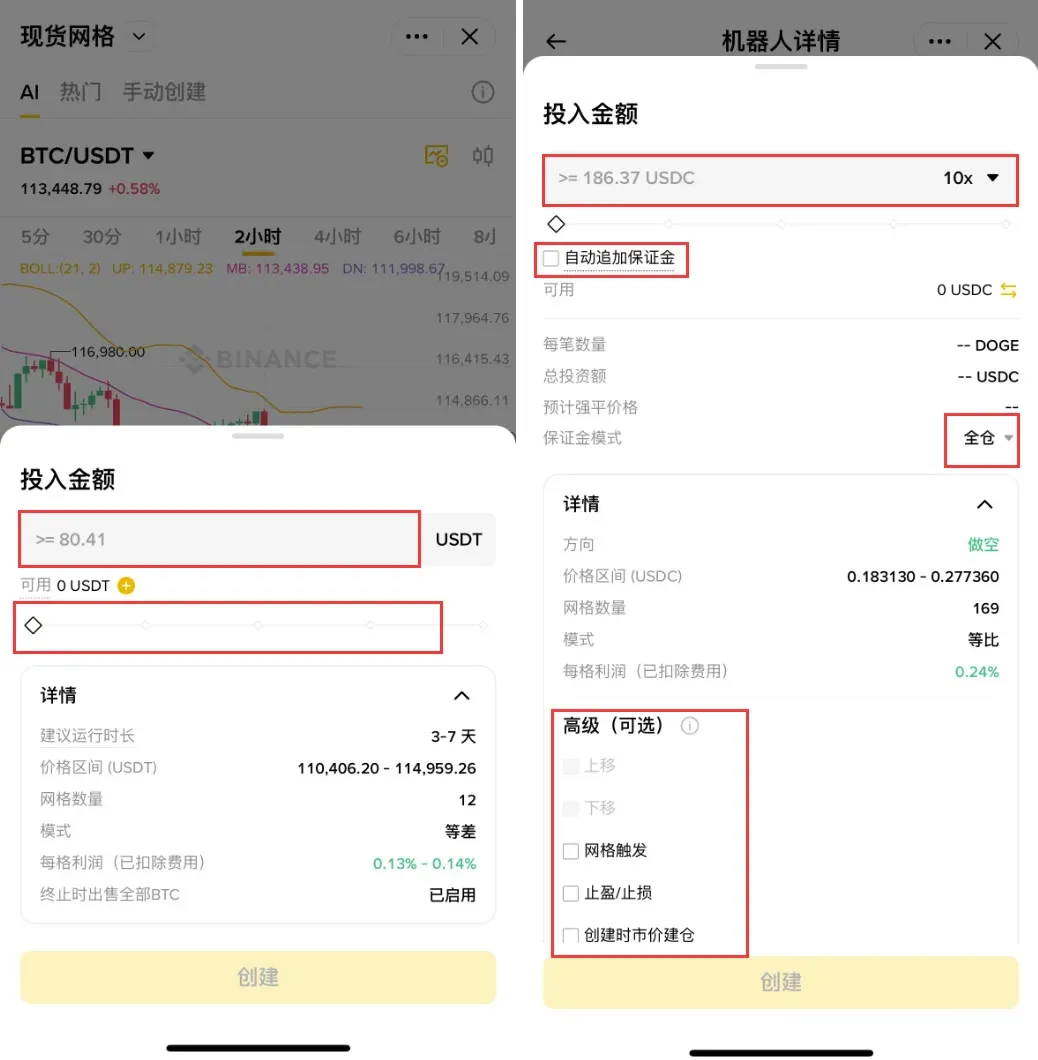
2. Manual creation – parameter explanation
Required fields for Spot Grid
| Parameter | Description |
|---|---|
| **Price range** | Desired upper and lower limits for buying and selling |
| **Number of grids** | How many price steps the interval is divided into |
| **Investment amount** | Minimum capital automatically calculated by the system |
| **Advanced settings** | Includes upward/downward trailing, grid trigger, take‑profit/stop‑loss, etc. |
- Upward trailing: If price breaks the upper limit, the whole range shifts upward automatically (e.g., 1‑5 → 1.5‑5.5), and TP/SL move accordingly.
- Grid trigger: Set a start price; the grid only begins once that price is reached.
- Take‑profit / Stop‑loss: Define profit‑taking and loss‑cutting price levels separately.
Differences for Futures Grid
| Mode | Common required fields | Unique aspects |
|---|---|---|
| Long grid | Price range, number of grids, margin | Long‑only direction |
| Short grid | Same as above | Short‑only direction |
| Neutral grid | Same as above | Simultaneously long and short, suited for ranging markets |
All modes support upward trailing, downward trailing, grid trigger, take‑profit/stop‑loss, and auto‑close functionalities.
3. Common mistakes and solutions
| Common pitfall | Impact | Remedy |
|---|---|---|
| Too many grids | Accumulated fees erode profit | Choose a grid count that matches volatility (high volatility → fewer grids, ranging → more grids) |
| Too few grids | Lack of entry points in trending markets | Use moving averages to gauge trend; pause the grid when needed |
| Misusing high leverage | Amplifies loss risk | Set explicit stop‑losses and cap leverage ratios |
Risk Management and Capital Allocation
1. Sample capital allocation (using 2,000 USD as an example)
- Spot Grid: 80 % ~ 90 % (1,600‑1,800 USD)
- Mid‑to‑long‑term interval (wide range)
- Short‑term interval (flexible adjustments)
- Futures Grid: 10 % ~ 20 % (200‑400 USD)
- Primarily for capturing short‑term volatility
Prioritize top‑10 market‑cap coins for mid‑to‑long‑term spot grids.
2. Take‑profit and stop‑loss setting tips
- Take‑profit: Place near the upper edge of the price range or the upper Bollinger Band.
- Stop‑loss: Reference a level 10 %‑20 % below a moving average, helping guard against short‑term pullbacks.
3. Dealing with extreme volatility and black‑swans
- Use a wider price range together with a moderate number of grids to improve the chance of profit over a larger cycle.
- When a sudden event (e.g., regulatory announcement) occurs, trigger the stop‑loss immediately or manually pause the grid, then resume once market sentiment stabilizes.
Frequently Asked Questions (Q&A)
Does grid trading guarantee profit?
Grid trading aims to reduce emotional interference; it does not guarantee absolute profit.
What risks does grid trading involve?
If you ignore the strategy for an extended period, you may miss market moves or suffer losses when price breaks out of the predefined interval.
How do I select a suitable grid strategy?
Consider your capital size, risk tolerance, and the volatility profile of the chosen cryptocurrency, then combine technical patterns to set a reasonable price range.
What’s the key to improving grid success rate?
Familiarize yourself with support and resistance levels, set sensible take‑profit and stop‑loss points, and continuously monitor market dynamics.
Am I a good fit for grid trading?
For beginners, grid trading can be an effective tool to escape FOMO and achieve disciplined entry.
Summary
This article systematically explained the concept, mechanics, suitable scenarios, and fee structures of grid trading on the Binance platform. By jointly evaluating capital size, risk preference, coin selection, and technical patterns, you can quickly assemble a grid strategy that matches your personal needs. While grids are not a cure‑all, thoughtful parameter tuning and diligent risk control—combined with ongoing learning and practice—will help you accumulate assets more steadily in the crypto space.
For more beginner‑focused Binance grid‑trading guides, follow Bitaigen and stay tuned for our upcoming deep‑dive articles!
Tax reminder: Crypto gains may be taxable in your jurisdiction. Consult a local tax professional to ensure compliance with SEPA/SWIFT‑related fiat conversions or other reporting obligations.
Related Reading
- 2026 Top Crypto Exchanges: Binance, OKX, Bitget, Bybit, Gate
- Binance Funding vs Spot Wallet: Complete Guide
- OKX vs Binance: Beginner Guide to Register, Fund & Trade
💡 Register on Binance with referral code B2345 for the maximum trading fee discount. See Binance complete guide.



