
 Bitaigen Research
 When you first open a cryptocurrency trading platform and begin the registration process, you will typically be asked to upload identification documents, perform facial verification, and complete a series of similar steps. This is what is commonly referred to as KYC (Know Your Customer) verification. Although the procedure can feel somewhat cumbersome, it is a crucial component of the global financial system designed to protect the safety of transactions.
In this article we outline the origins of KYC, its core mechanisms, and why it has become indispensable on crypto exchanges. By dissecting the link between identity verification and anti‑money‑laundering (AML) measures, we help newcomers quickly grasp the compliance essentials and reduce the risks associated with using a platform. To understand the institutional logic and practical details behind it, keep reading.
Definition and Historical Background of KYC
KYC, short for “Know Your Customer,” is a set of identity‑verification and risk‑assessment procedures that financial institutions must perform before providing services to a client. By collecting basic user information, reviewing financial background, and continuously monitoring transaction behavior, institutions can confirm that the source of funds is legitimate and help prevent money laundering, fraud, terrorist financing, and other illicit activities.
The mechanism did not originate in the crypto space. Its roots trace back to the December 1998 Basel Committee on Banking Supervision declaration titled *“Statement on Preventing the Use of the Banking System for the Purpose of Money Laundering.”* The declaration explicitly required financial institutions to collect and verify user information when delivering services, laying the groundwork for today’s KYC framework.
KYC is tightly coupled with AML (Anti‑Money‑Laundering) regulations. AML’s primary goal is to stop illegal money from entering the regulated financial network, while KYC supplies the most basic identity‑verification tools through Customer Identification Programs (CIP), Customer Due Diligence (CDD), and Enhanced Due Diligence (EDD).
Why the Crypto Industry Must Adopt KYC
Cryptocurrency trading is technically capable of supporting anonymous or pseudonymous operations, which also creates an opening for malicious actors. To mitigate the risks of money laundering, fraud, and other financial crimes, exchanges widely employ KYC to verify user identities, thereby boosting platform credibility and easing regulatory pressure.
- Reduced compliance risk – Centralised exchanges that enforce strict KYC can operate within legal frameworks and avoid penalties that stem from regulatory gaps.
- Enhanced market trust – Verified users enjoy higher withdrawal limits and additional features, which in turn improves the exchange’s reputation.
- Protection of funds – Identity verification helps prevent account takeover, reducing the likelihood of fraud and identity theft.
For the average user, although KYC demands time and effort, it plays a pivotal role in safeguarding assets.
Practical Steps of KYC Execution
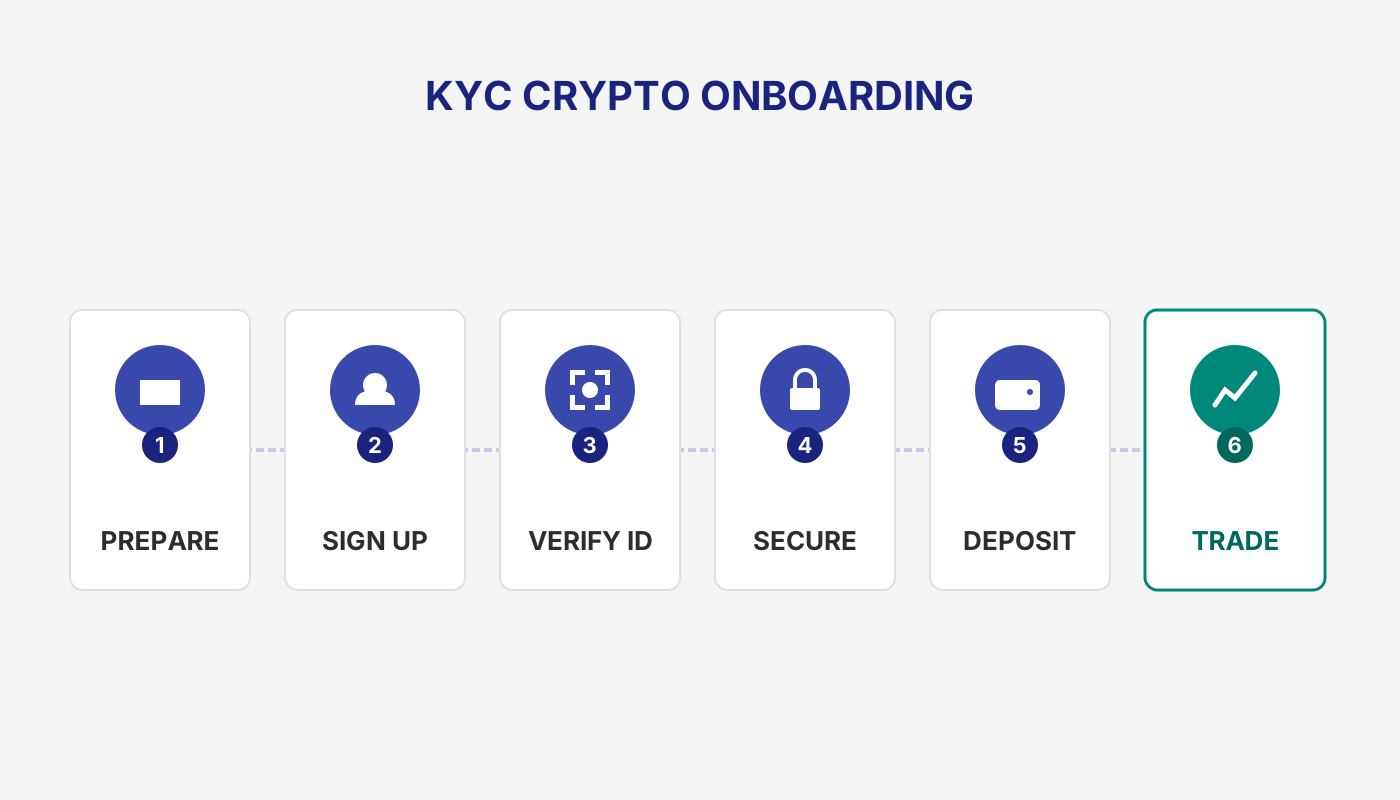
On most crypto exchanges, the KYC workflow can be broken down into the following stages:
1. Basic Information Collection
Users are required to fill in name, residential address, date of birth, and other fundamental details. This forms the starting point for identity verification.
2. Upload of Identification Documents
The platform asks for an official ID (such as a national ID card, driver’s licence, or passport) together with a selfie, in order to confirm the authenticity of the person behind the account.
3. Proof of Address (optional on some platforms)
To further validate residency, certain exchanges request utility bills (water, electricity, gas) or similar documents that display the user’s address.
4. Ongoing Monitoring
KYC is not a one‑off task. Exchanges continuously analyse users’ transaction patterns, flagging anomalous or high‑risk activity to ensure ongoing compliance.
Benefits for Users and Potential Pain Points
After completing KYC, users unlock higher daily withdrawal limits and gain access to the full suite of platform functionalities. Different verification tiers correspond to distinct limits, for example:
- Basic verification – Provide name, ID number, etc.; maximum withdrawal of 100,000 USDT.
- Advanced verification – Includes facial recognition; maximum withdrawal of 2,000,000 USDT and access to the Benefits Center, Rewards Center, and similar features.
- Address verification – Submit proof of address; maximum withdrawal rises to 8,000,000 USDT, granting even higher privileges.
At the same time, KYC generates debate. Some crypto enthusiasts champion anonymity and view mandatory identity checks as an intrusion on personal privacy. Others find themselves unable to complete verification because they lack formal identification documents, which can effectively lock them out of the market.
Case Study of a Leading Exchange: Gate’s KYC System
Gate, a globally recognised digital‑asset exchange, exemplifies industry‑best practices in KYC. The platform has built a risk‑based AML/CTF (Counter‑Terrorist Financing)/Sanctions framework, requiring every user to finish identity verification before executing the first trade.
Gate structures KYC into three layers:
| Tier | Required Materials | Daily Withdrawal Limit | Available Features |
|---|---|---|---|
| Basic verification | Name, ID number and other basic data | 100,000 USDT | Buy, deposit, trade |
| Advanced verification | ID document + facial recognition | 2,000,000 USDT | Benefits Center, Rewards Center |
| Address verification | Proof‑of‑address document | 8,000,000 USDT | Higher‑level permissions |
On Gate, completing the entire verification process typically takes about 3 minutes. Users simply input nationality, residence, and name, then choose to upload either a national ID, driver’s licence, or passport.
Technological Evolution and Future Trends of KYC
As the crypto sector expands rapidly, the industry is exploring ways to protect user privacy while staying compliant. Cutting‑edge technologies such as Zero‑Knowledge Proofs (ZKP) and Decentralised Identity are being trialled to let users verify themselves without exposing unnecessary personal data. For instance, blockchain‑based identity credentials can be stored securely on‑chain and disclosed only in a minimal, purpose‑specific manner when a platform requests verification.
These innovations aim to preserve the core decentralised ethos while enhancing security. Future KYC solutions may become lighter, privacy‑friendly, and seamlessly integrated across a wide range of crypto services.
Conclusion and Outlook
Regulatory frameworks are becoming clearer, and major exchanges—including Gate, Binance (US users should use Binance.US), and others—have adopted KYC as a standard procedure. Completing identity verification not only unlocks higher trading limits and full functionality, but also represents an essential step toward building a safe, transparent crypto ecosystem.
With the maturation of technologies like zero‑knowledge proofs, it is expected that KYC will evolve from a rigid entry barrier into an unobtrusive, automated security layer that protects users without compromising the decentralised spirit.

This article is intended to help readers quickly understand the role and implementation details of KYC in the crypto space. For more related content, you can search for previous articles by Bitaigen or continue reading the recommended articles below. Thank you for supporting Bitaigen!
Related Reading
- How to Verify the Real Bitcoin Official Website in 2026
- Binance Registration & Verification Guide for Non-China Users
- Sell USDT Safely on Binance & OKX: KYC, Payouts & AML Guide
💡 Register on Binance with referral code B2345 for the maximum trading fee discount. See Binance complete guide.



