
 Bitaigen Research
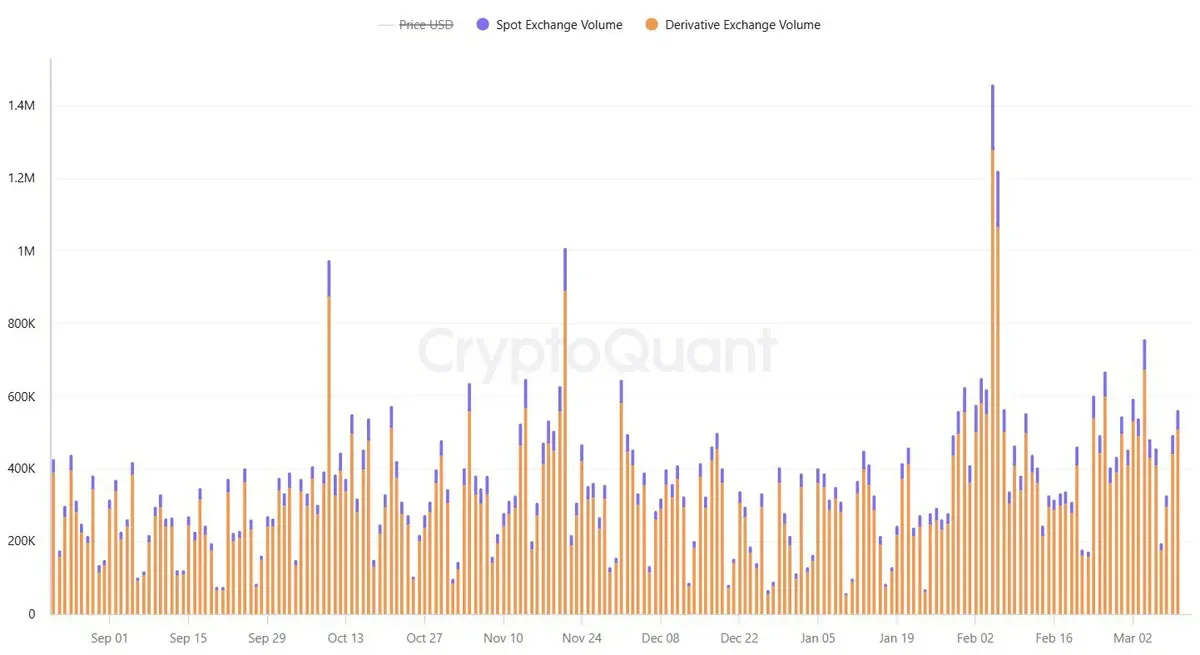
In the crypto space, the trading volume of perpetual contracts has already eclipsed that of spot markets. Data from CryptoQuant shows that a single day’s Bitcoin spot turnover is roughly 55,230 BTC, while derivatives turnover surpasses 506,600 BTC, with the latter consistently dominating the market.
The sheer scale of these derivatives trades has prompted multiple blockchain ecosystems to race in building perpetual decentralized exchanges (perp DEXs) in order to attract more market makers, institutional players, and everyday traders. BNB Chain’s Growth Executive Director Nina Rong told *Cointelegraph* that active on‑chain participants bring liquidity, hedging, and arbitrage activity, which in turn significantly boosts overall on‑chain transaction volume and improves the trading environment of the ecosystem.
---
In this article we outline the rapid rise of perpetual contracts within blockchain ecosystems and analyze how major chains are positioning perpetual DEXs to capture trading flow. By revealing the strategic approaches of platforms such as BNB Chain, Ethereum and others, readers can grasp the latest trends in the derivatives market and understand the key factors driving ecosystem competition.
Blockchains Begin Building or Incubating Their Own Perp DEX
From a business‑logic perspective, derivatives account for the lion’s share of crypto trading, making a successful perp DEX a critical lever for a chain to fight for transaction volume. Nina Rong elaborates: “Chains that host a larger number of successful derivatives platforms tend to sustain higher trading activity within their own ecosystems.”
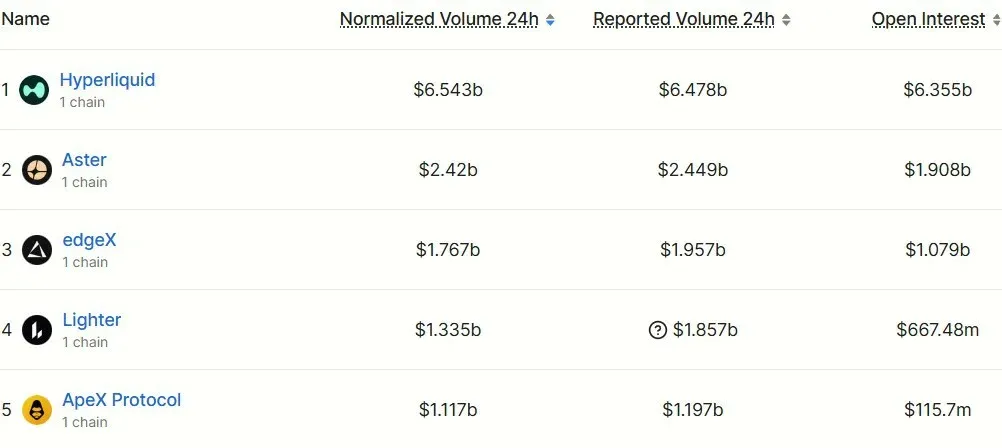
On BNB Chain, Aster has already become the chain’s flagship perp DEX. Data from DefiLlama indicates that Aster ranks second only to Hyperliquid in terms of the number of contracts opened across all chains, helping BNB Chain retain a meaningful market share.
Similarly, Aptos recently launched a perp DEX through the Decibel project. Decibel Foundation head Brylee Whatley disclosed that Aptos has been incubating Decibel for almost a year—earlier than platforms such as Hyperliquid, Aster and Lighter entered the market. Whatley added: “Different L1s are pondering which services truly deserve on‑chain resources, and Decibel was built from a deep understanding of our native chain mechanics.”

---
Liquidity Tends to Concentrate in Dominant Venues
Even though on‑chain DEXs have mushroomed like mushrooms after rain, liquidity does not automatically disperse. Former BitMEX CEO Stephan Lutz observes that the derivatives market has historically gravitated toward a handful of platforms: “All markets—spot and derivatives alike—are heavily dependent on market makers and mature risk‑management frameworks. Those participants naturally gravitate toward exchanges that already boast deep liquidity and solid performance records.”
He further notes that cross‑chain and multi‑asset traders prefer a unified entry point, a demand that drives liquidity to concentrate organically. A similar pattern is evident in traditional finance. Since the rise of electronic trading in the 1990s, liquidity has progressively moved toward venues with deeper order books, tighter spreads, and more reliable infrastructure—such as CME, ICE and Eurex, which dominate U.S. futures, energy derivatives and European index futures respectively.
In the crypto realm, perpetual contracts for Bitcoin and Ethereum are likewise concentrated on platforms like Binance, OKX, Bybit and Deribit. (U.S. residents must use Binance.US rather than the global Binance platform.) In recent years, decentralized projects such as Hyperliquid have also begun carving out a niche in the perpetual futures space.
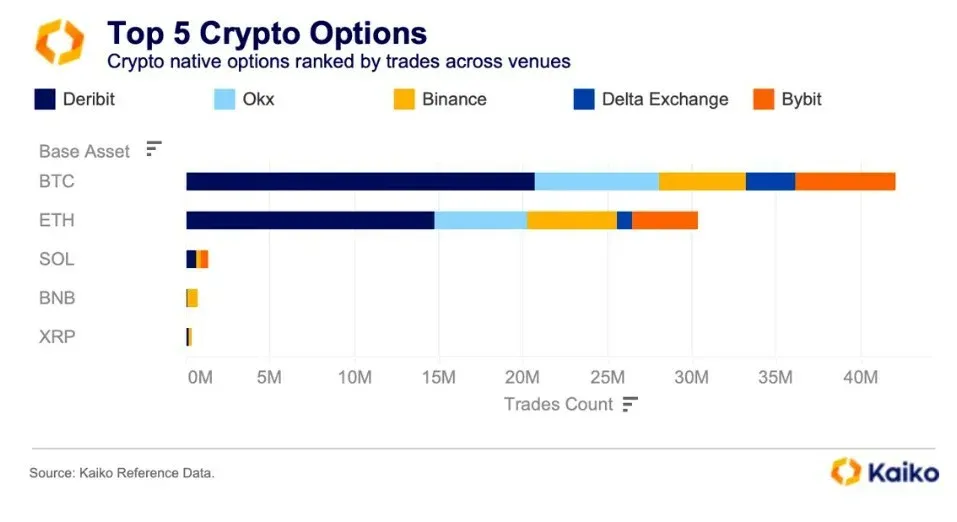
Deribit’s Retail Head Sidrah Fariq explains that centralized exchanges can provide more comprehensive order handling, risk controls and liquidity support, while also offering lower latency and reduced slippage. “Centralized platforms also deliver higher privacy protection, which is especially important for institutional users,” she adds.
Conversely, proponents of on‑chain exchanges stress that the composability inherent to decentralization allows derivatives liquidity to be embedded directly within a specific ecosystem. Whatley clarifies: “The order book is verifiable on‑chain, and matching rules follow the blockchain’s native price‑time priority. Traders can see exactly how orders are matched, ensuring fairness.”
---
A “U‑Shaped” Trajectory for the Derivatives Market
Looking ahead, the outlook for perp DEXs hinges on whether individual chains can deliver differentiated products and services. Nina Rong believes that chains with unique yield models or exclusive trading venues are more likely to stand out. She warns: “If every chain merely replicates homogeneous products, liquidity will be scattered across numerous ecosystems, making it difficult for any single hub to dominate.”
BitMEX’s Lutz cautions that market makers and professional traders tend to allocate capital where liquidity is concentrated, thereby minimizing cross‑platform deployment costs and improving risk‑management efficiency. He warns: “Over‑fragmented liquidity leads to wider bid‑ask spreads and more volatile price swings.”
This cyclical dynamic is what Lutz describes as a “U‑shaped” development curve: new platforms attract a burst of activity at launch, then experience a dip as liquidity re‑aggregates around larger, more established exchanges. As inter‑chain competition intensifies, the perpetual contract market will continue shaping where liquidity pools, how traders hedge, and which platforms emerge as the dominant players.
---
Perpetual futures have become an essential layer of infrastructure for blockchain ecosystems. Whether it’s a centralized heavyweight or an emerging decentralized perp DEX, each is vying for a slice of this high‑value “cake.” To stay abreast of the latest developments in perp DEXs and to understand the competitive landscape of blockchain derivatives, keep following Bitaigen’s ongoing coverage.
Note: Crypto gains may be subject to tax in your local jurisdiction. Participants should consult a tax professional and be aware that fiat settlements are typically processed via USD transfers, SEPA, or SWIFT, depending on regional banking networks.
💡 Register on Binance with referral code B2345 for the maximum trading fee discount. See Binance complete guide.
⚠️ Risk Disclaimer: Crypto prices are highly volatile. This is not investment advice.



