
 Bitaigen Research
 In this article we outline the core functions and events of the ERC‑20 specification, explain its ubiquity within the Ethereum ecosystem, and describe why it dramatically lowers the barrier to issuing tokens. With diagrams and official documentation links, readers can quickly grasp the implementation essentials; later chapters will dive into common pitfalls and best practices in real‑world development, making this a worthwhile read.
What is the ERC‑20 token standard in blockchain?
Smart contracts that follow the ERC‑20 specification must implement several mandatory functions and optional attributes. The indispensable functions include `balanceOf`, `transfer`, `transferFrom`, `approve`, and `allowance`; optional ones are `name`, `symbol`, and `decimals`. In addition, the contract should emit two standard events: `Transfer` and `Approval` (see Figure 1).
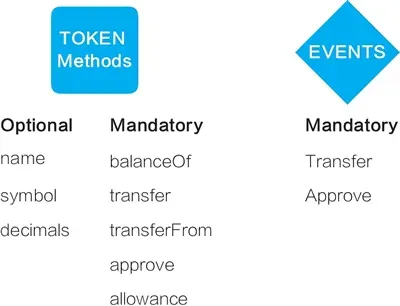
Figure 1: Core methods and events of an ERC‑20 contract
The complete technical documentation for ERC‑20 can be consulted on GitHub:
https://github.com/ethereum/EIPs/blob/master/EIPS/eip-20.md
Tokens that implement this standard enjoy a high degree of interoperability across the Ethereum ecosystem—almost every major wallet, exchange, and decentralized application can recognize and interact with them directly. Because ERC‑20 provides a unified interface for tokens, the technical hurdle for issuing a new token is greatly reduced; developers only need to follow a template to write the contract and can swiftly create and launch a token.
---
What is ERC‑20?
ERC‑20 is the most widely used token contract standard on the Ethereum network. It can be thought of as “a set of token protocols” on Ethereum, with all contracts built on this protocol adhering to the same rule set. Since the standard defines a token’s name, symbol, total supply, and basic transfer functions, tokens issued by different projects are interchangeable on the same network—i.e., a user holding 100 ERC‑20 tokens and another user holding the same quantity of a different ERC‑20 token are considered equivalent at the protocol level.
The standard was first proposed by developer Fabian Vogelsteller in the open‑source community, after which Ethereum founder Vitalik “V” Buterin authored the initial document titled *Standardized_Contract_APIs*. Since then, ERC‑20 has become synonymous with “standardized token,” prized for its compatibility and ease of implementation, making it the go‑to solution for many projects seeking token‑based fundraising.
The earliest discussion can be found here: https://github.com/ethereum/EIPs/issues/20
---
What does ERC stand for?
ERC stands for Ethereum Request for Comment; the number that follows identifies the proposal’s sequence. The concept mirrors the Internet Engineering Task Force’s (IETF) RFC (Request for Comment) series, which records and debates technical specifications and protocols. Ethereum adopted Bitcoin’s naming convention for improvement proposals: Bitcoin uses BIP (Bitcoin Improvement Proposals), while Ethereum groups all proposals under EIP (Ethereum Improvement Proposals). The EIP series includes Core upgrades, Networking improvements, Interface changes, and application‑level ERC proposals.
Official portal for Ethereum Improvement Proposals: https://eips.ethereum.org
---
Differences between ERC‑20 and other token standards
Beyond ERC‑20, the industry also pays close attention to the ERC‑721 standard. The core distinction lies in token fungibility:
| Feature | ERC‑20 | ERC‑721 |
|---------|--------|----------|
| Interchangeability | Homogeneous, interchangeable | Non‑fungible, unique |
| Divisibility | Infinitely divisible | Smallest unit is 1, cannot be further divided |
| Typical use‑case | General‑purpose tokens, fundraising | NFTs (e.g., CryptoKitties) |
ERC‑721 was formally adopted by the Ethereum community in June 2018 and quickly became the preferred standard for non‑fungible tokens (NFTs). Compared with ERC‑20’s generic, divisible nature, ERC‑721 is better suited for representing unique assets or digital collectibles.
---
This concludes a systematic overview of the ERC‑20 token standard in blockchain. For deeper material on ERC‑20, feel free to follow the upcoming specialist articles from Bitaigen (比特根).
*Note: Cryptocurrency gains may be taxable under the regulations of your local jurisdiction. U.S. users should access Binance.US rather than the global Binance platform, and fiat transactions are typically processed via USD, SEPA, or SWIFT channels.*
💡 Register on Binance with referral code B2345 for the maximum trading fee discount. See Binance complete guide.



