
 Bitaigen Research
 What Is a Blockchain Wallet? Understanding Its Role, Types, and Security
In the world of blockchain, assets are not stored in a so‑called “wallet.” The core function of a wallet is to safeguard the private key—the sole credential that can control assets on‑chain. Depending on how the private key is stored, wallets fall into three major categories: cold wallets, hot wallets, and exchange wallets. Below we will unpack each category from concept and technical principle to real‑world use cases.
In this article we systematically explore the essence of blockchain wallets, reveal the pivotal role of private keys in asset control, and deeply compare the security characteristics and use‑case scenarios of cold, hot, and exchange wallets. Our goal is to help readers build a safe and convenient asset‑management mindset. Later sections also provide practical tips for reference.
My Bitcoin Isn’t “In” My Wallet—What Exactly Is a Blockchain Wallet?
A blockchain is a public, transparent distributed ledger where every cryptocurrency transaction is recorded on‑chain. To move those recorded funds you must possess the corresponding private key, the only key capable of initiating a transfer or signing a transaction. A wallet is the tool that generates, manages, and protects these private keys.
In traditional finance, withdrawing cash requires identity verification such as a government ID, fingerprint, or password—essentially proving *who* you are. In a decentralized blockchain network, the verification target is the private key itself—anyone who holds the private key automatically owns all assets associated with that address, without needing to report to any institution.
Beyond storing and accessing assets, a wallet also serves as a digital identity on the blockchain. Much like a Google, Facebook, or LINE account on social platforms, a user can “link” their wallet to decentralized finance (DeFi) protocols, blockchain games (GameFi), or other dApps to log in, trade, chat, and interact.
How Does a Wallet Work? What Are Private Keys, Public Keys, and Addresses?
A blockchain wallet is built around three fundamental components:
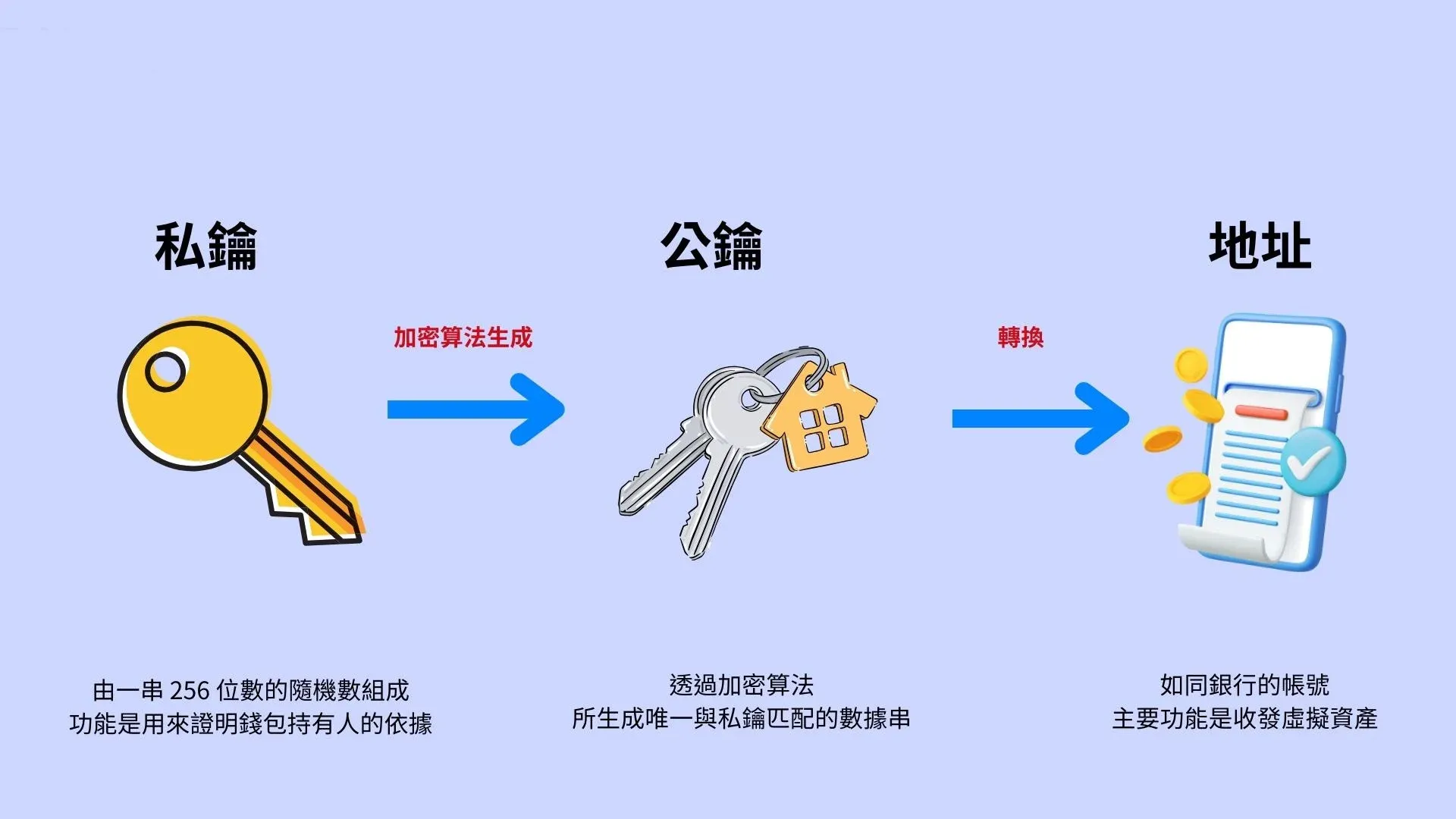
- Private Key – a 256‑bit random number visible only to its owner. It functions like the login password for a banking app, determining who can spend the associated assets. Because memorizing such a number is impractical, it is usually represented by a recovery phrase (mnemonic) composed of 12 or 24 English words; knowing the phrase lets you reconstruct the private key.
- Public Key – derived from the private key via an elliptic‑curve cryptographic algorithm. It can be shared publicly. The public key’s main jobs are to help generate the wallet address and to verify transaction signatures. Deriving a public key from a private key is easy; the reverse is computationally infeasible.
- Address – analogous to a bank account number, created by applying multiple hash functions to the public key. An address is a public identifier used for receiving and sending funds. Observers can see the address but cannot reverse‑engineer the private or public key from it.
These three elements form a one‑way, irreversible relationship: possessing an address lets you receive funds, but you cannot infer the private key; only the holder of the private key can sign transactions and control the assets.
Whenever a user initiates a transfer, the wallet uses the private key to cryptographically sign the transaction data, proving that the initiator is indeed the private‑key holder. After signing, the transaction is broadcast to the blockchain network, where nodes validate it and eventually embed it in a block.
Three Broad Categories: Cold Wallets, Hot Wallets, and Exchange Wallets
Cold Wallet
A cold wallet stores the private key completely offline. Common forms include hardware devices (e.g., Ledger, CoolWallet) or paper‑backed recovery phrases. Because they never interact directly with the internet, the attack surface is minimal, making them ideal for long‑term holding of large sums. The trade‑off is that each usage requires connecting the hardware and performing extra steps, which demands a higher technical comfort level.
- Pros: Offline storage, very high security, extremely difficult for hackers to steal.
- Cons: Users must manage the private key themselves; operation can be cumbersome.
- Best For: Long‑term holders and investors with sizable asset portfolios.
- Typical Products: Ledger, CoolWallet, etc.
Hot Wallet
A hot wallet stays constantly connected to the internet, with the private key stored in a software application on a computer or mobile device. Typical implementations are browser extensions (e.g., MetaMask) and mobile apps (e.g., Trust Wallet, Phantom). As long as the device has network access, users can send/receive funds, connect to decentralized applications (DApps), and perform other actions instantly. Convenience comes at the cost of a larger exposure to online attacks.
- Pros: Immediate availability, user‑friendly interface, suited for everyday small‑value transactions.
- Cons: Online storage makes it more vulnerable to hacking, phishing, and malware.
- Best For: Frequent traders, DeFi participants, gamers, and anyone needing rapid interaction.
- Typical Products: MetaMask (often called the “little fox” wallet), Phantom, Trust Wallet.
Exchange Wallet
When you create an account on a centralized exchange, the platform automatically generates an exchange wallet for you, and the exchange retains custody of the private key. Users simply log into the web or mobile interface to buy, sell, or transfer assets—no key management is required. The biggest advantage is ease of use, but asset security is entirely dependent on the exchange’s operational health.
- Pros: Low entry barrier, no need to understand blockchain mechanics to start trading.
- Cons: Assets are custodial; if the exchange suffers a security breach, insolvency, or regulatory action, users may lose access to their funds.
- Best For: Beginners and those conducting small‑scale, routine trades.
- Typical Products: Wallets automatically created by major exchanges such as Binance, Coinbase, etc. *(U.S. users should use Binance.US or another regulated U.S. platform instead of the global Binance.)*
| Category | Advantages | Disadvantages | Ideal Scenarios | Common Wallets |
|---|---|---|---|---|
| Cold Wallet | Very high security, offline | User manages keys, can be cumbersome | Long‑term holding of large amounts | Ledger, CoolWallet |
| Hot Wallet | Ready whenever online, easy to use | Connected to internet, higher attack risk | Daily small‑value or frequent trades | MetaMask, Phantom, Trust Wallet |
| Exchange Wallet | Simple onboarding, no key handling | Custodial, platform risk | Newcomers, everyday small trades | Wallets auto‑generated by major exchanges |
How to Choose the Right Wallet for You?
Based on the characteristics above, consider the following guidelines:
- For absolute beginners: If you are unfamiliar with blockchain technology, start with an exchange wallet to avoid the hassle of key management.
- For experienced active traders: After gaining confidence, migrate to a hot wallet (e.g., MetaMask or Trust Wallet) and enable two‑factor authentication (2FA) for added security.
- For long‑term holders: If you plan to keep assets for months or years without frequent transfers, a cold wallet (Ledger, CoolWallet) offers the safest storage.
- For multi‑chain portfolios: When you need to manage tokens across several blockchains, look for a multi‑asset wallet with cross‑chain support, such as Exodus.
Security Reminder
Even when the wallet’s ownership resides with the user, attacks still occur. In October 2024, NFT artist DeeKay stored a photo of a handwritten recovery phrase on Google Drive; the file was later accessed by a hacker who drained all assets. This incident underscores that offline storage of the recovery phrase is just as crucial as protecting it from network exposure.
Whether you use an exchange wallet, a hot wallet, or a cold wallet, each option has its own strengths and limitations. Understanding how private keys, public keys, and addresses function—and aligning that knowledge with your transaction frequency and risk tolerance—will enable you to select the most suitable wallet and keep your digital assets safe and efficiently managed.
Note on taxes: Crypto gains may be taxable in your jurisdiction. Be sure to consult local tax regulations and consider reporting requirements when you realize profits, whether in USD, EUR (via SEPA), or other fiat currencies.
That concludes the article “What Is a Blockchain Wallet? How It Works, and the Differences Between Cold, Hot, and Exchange Wallets.” For deeper analyses of crypto wallets, you can search for past Bitaigen (比特根) articles or continue reading the related content below. Thank you for following Bitaigen, and we look forward to your continued support!
Related Reading
- KeepKey Hardware Wallet Review: Secure Multi-Chain Crypto Storage
- Block.io Multi-Chain Web Wallet for Bitcoin, Litecoin & Dogecoin
- Cold vs Hot Wallets: Private/Public Keys & Mobile Setup
💡 Register on Binance with referral code B2345 for the maximum trading fee discount. See Binance complete guide.



