
 Bitaigen Research
 Bitcoin (BTC) has been around for more than a decade, evolving from an experimental token into a global asset with a market capitalization measured in trillions of USD. With the full activation of Taproot and the ongoing iteration of the network protocol, everyday users inevitably encounter Bitcoin addresses when sending or receiving funds. Understanding how an address is generated, the characteristics of the different encoding formats, and the steps for creating an address securely is essential knowledge for anyone who wants to use Bitcoin safely.
In this article we systematically review the principles behind Bitcoin address generation, the traits of the various encoding formats, and the safest creation procedures. The goal is to help newcomers quickly master the core points of sending and receiving, while avoiding common pitfalls. If you want to learn the cryptographic logic behind addresses and practical tips, keep reading.
What Is a Bitcoin Address?
In the Bitcoin network an address is a string of letters and numbers, typically 26 – 35 characters long. It is not arbitrarily chosen; it is derived through a series of cryptographic operations from a private key. An address’s sole purpose is to act as a receiving identifier for funds. Ownership transfers are recorded on the blockchain using the address as an index, while the user’s real‑world identity remains off‑chain, providing what is often called “pseudonymity”.
The concept of an address, introduced in the Bitcoin whitepaper, was meant to mitigate the centralisation risk and privacy leakage associated with traditional finance. By 2026 the total number of Bitcoin addresses worldwide has surpassed one billion, with roughly one million active addresses each day supporting a range of use‑cases such as DeFi, NFTs, and more. Important: an address does not hold Bitcoin itself; the actual value resides in unspent transaction outputs (UTXOs). The address is merely an indexing tool. Therefore, losing an address does not mean losing assets – what must be protected is the corresponding private key.
Generation Process and How It Works
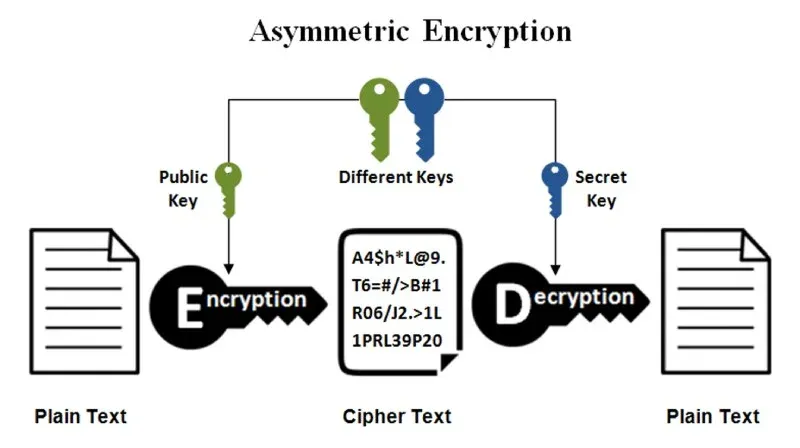
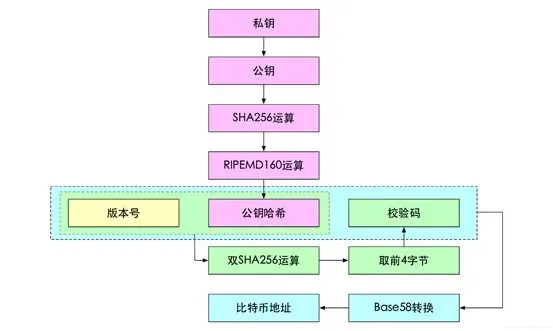
Creating a Bitcoin address relies on the Elliptic Curve Digital Signature Algorithm (ECDSA) and multiple hash functions. The whole pipeline can be summarised as follows:
- Private key – a 256‑bit random number, for example
`E9873D79C6D87DC0FB6A5778633389F4453213303DA61F20BD67FC233AA33262`.
The private key is the sole credential that controls the funds; if it is exposed, the assets are permanently lost.
- Public key – derived from the private key using ECDSA, yielding an (x, y) point that can be compressed to 33 bytes or left uncompressed at 65 bytes. The public key is public information used for signature verification and cannot be reversed to obtain the private key.
- Hashing – the public key is first hashed with SHA‑256 and then with RIPEMD‑160, producing a 160‑bit hash.
- Version byte and checksum – a network identifier (e.g., `0x00` for P2PKH) is prepended to the hash, after which a double SHA‑256 is performed and the first four bytes are taken as a checksum.
- Base58 encoding – the resulting byte sequence is encoded using Base58, giving the human‑readable address we normally see.
These one‑way, irreversible operations guarantee uniqueness and tamper‑resistance; even the tiniest alteration yields a completely different address. When a transaction is created, the sender writes the recipient’s address into the output script, the network validates the signature, and the corresponding UTXO set is updated. The receiver later spends the funds by signing with the matching private key.
The diagram above clearly shows the chain private key → public key → SHA‑256 → RIPEMD‑160 → version + checksum → Base58. The probability of a collision is effectively negligible.
Differences Between the Main Address Formats
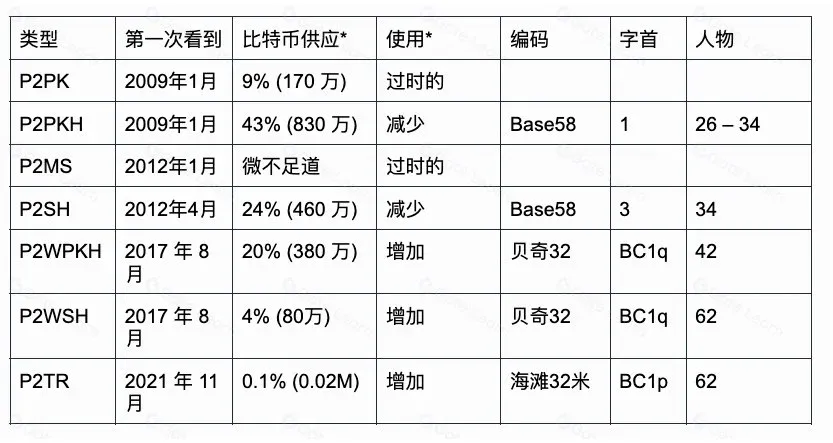
Throughout its evolution Bitcoin has introduced several address encodings to reduce fees, improve privacy, or support new features. Today four formats dominate the ecosystem:
| Format | Prefix | Length | Encoding | Year Introduced | Main Advantages |
|---|---|---|---|---|---|
| **Legacy (P2PKH)** | `1` | 26‑34 chars | Base58 | 2009 | Highest compatibility – supported by every wallet |
| **P2SH** | `3` | 34 chars | Base58 | 2012 (BIP16) | Enables multisignature and complex scripts |
| **Bech32 (P2WPKH / P2WSH)** | `bc1q` | 42‑62 chars | Bech32 (BIP173) | 2017 (SegWit) | ~20‑30 % lower fees, 4‑bit error‑detecting code |
| **Taproot (P2TR)** | `bc1p` | 62 chars | Bech32 (BIP341) | 2021 | Higher privacy, better efficiency via Schnorr signatures |
- Legacy (P2PKH) – Starts with `1`, 26‑34 characters, Base58‑encoded. It was the first format, introduced in 2009, and remains the most compatible. Because its script is relatively large, transaction fees are higher. As of 2026 it still accounts for roughly 43 % of active addresses.
- P2SH – Starts with `3`, always 34 characters, also Base58‑encoded. Brought in by BIP16 in 2012, it enables advanced capabilities such as multisignature wallets and custom scripts. Compatibility is slightly lower than Legacy, with about 24 % of active addresses in 2026.
- Bech32 (SegWit) – Begins with `bc1q`, length varies between 42 and 62 characters, and uses the newer Bech32 alphabet. Launched with the SegWit upgrade in 2017, it separates witness data, cutting fees by roughly 20‑30 % and providing built‑in error detection. By 2026 it represents about 20 % of active addresses, and most new wallets default to this format.
- Taproot – Begins with `bc1p`, a fixed 62 characters, also Bech32‑encoded. Activated in 2021, Taproot combines Schnorr signatures with Merkle‑tree scripts, delivering better privacy (multisig looks like single‑sig) and further fee reductions. Adoption is still modest—around 0.1 % in 2026—but forecasts expect growth toward 5 % as tooling matures.
When selecting an address type, consider your specific needs: beginners or fee‑conscious users should default to Bech32; enterprises that require multisignature setups may opt for P2SH or Taproot. Most modern wallets support all four formats, but always verify that the counterparty’s wallet can accept the chosen type to avoid “stuck” funds.
How Beginners Can Safely Generate a Bitcoin Address
1. Choose the Right Wallet
| Wallet type | Typical cost (USD) | Security level | Typical use case |
|---|---|---|---|
| **Hardware wallet** (e.g., Ledger, Trezor) | $100 – $200 | Highest – private keys stay offline | Long‑term storage, large balances |
| **Software wallet** (Electrum, Exodus, etc.) | Free | Medium – keys stored on the device, vulnerable to malware | Daily transactions, moderate balances |
| **Mobile wallet** (Trust Wallet, etc.) | Free | Variable – depends on phone security | On‑the‑go payments, multi‑chain support |
Tip: Never rely on an unaudited online address generator; such services can capture your private key.
2. Install the Wallet and Create a New Account
Download the application from the official website or app store. Follow the onboarding flow to generate a fresh wallet. The software will present a seed phrase of 12 – 24 words (for example `abandon ability able about above absent absorb abstract absurd abuse access accident`). This phrase is a human‑readable representation of the master private key. Write the seed phrase on paper, store it in a fire‑, water‑, and theft‑resistant location, and never keep a digital copy online.
3. Generate and Retrieve Your Address
In the wallet UI, navigate to the Receive tab. The app will automatically display a newly derived address. Most wallets allow you to switch the encoding format in the settings—new users are encouraged to select Bech32 to benefit from lower transaction fees. Copy the address (or scan the QR code) when you need to receive BTC.
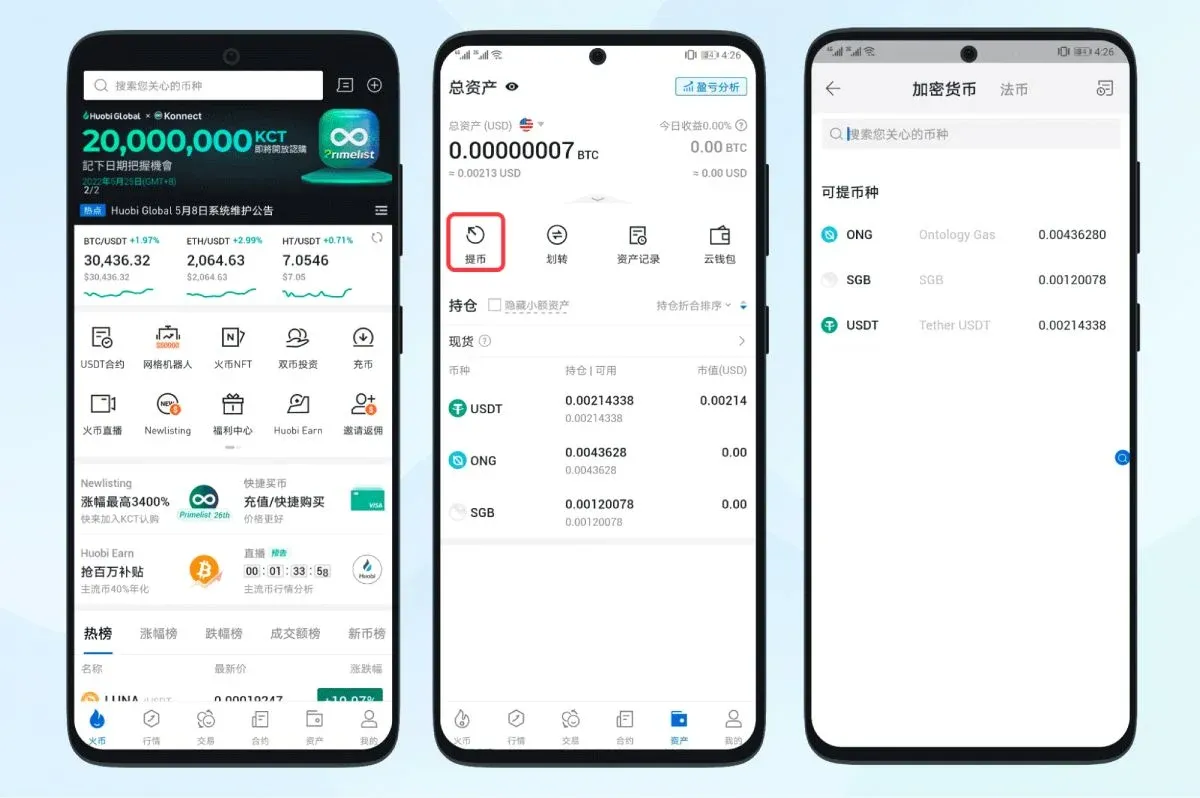
The screenshot shows the address, its QR code, and the steps for withdrawing funds, making the process straightforward.
4. Backup and Verify
After securely storing the seed phrase, send a small test transaction (e.g., $5 USD worth of BTC via a SEPA or SWIFT‑compatible exchange) to the newly generated address to confirm that it can receive funds. Once the test succeeds, you can start using the address for larger amounts.
Advanced Option: Programmatic Generation
For developers, the Python library `bitcoinlib` can be used:
```python
from bitcoinlib.keys import Key
k = Key()
print(k.address())
```
The code prints an address that conforms to the current network rules. However, users without programming experience should stick to wallet software to avoid mistakes that could lead to loss of funds.
Privacy note: It is recommended to use a one‑time address for each incoming transaction. Hierarchical Deterministic (HD) wallets automatically generate a fresh address for every receipt, improving privacy.
Security Best Practices When Using Addresses
- Protect the private key – Treat it as the sole key to your assets. Store it offline (cold storage) using hardware wallets or encrypted paper backups.
- Beware of phishing – Only download wallets from official channels. In 2026, global losses due to phishing exceeded $5 billion USD.
- Avoid address reuse – Re‑using the same address makes transaction tracing easier and reduces anonymity. Tools such as Wasabi Wallet can help mix coins for enhanced privacy.
- Regulatory compliance – In jurisdictions like Hong Kong, exchanges must follow FATF KYC/AML rules and may request address verification. Personal, non‑custodial wallets are generally not subject to mandatory reporting, but you should still be aware of local tax obligations. Crypto gains may be taxable in your jurisdiction; consult a tax professional for guidance.
- Fiat conversion – When you need to move money between BTC and fiat, use reputable services that support USD via SEPA or SWIFT. U.S. residents should use Binance.US or another U.S.-registered exchange to stay compliant with local regulations.
Looking ahead, wider adoption of Taproot will enable new smart‑contract‑like capabilities (e.g., Ordinals inscriptions and Layer‑2 solutions) that will further extend what a Bitcoin address can represent.
Conclusion
A Bitcoin address is the first gateway into the decentralized finance world. Understanding the complete generation pipeline—from private key to the final human‑readable string—knowing the strengths and limitations of each encoding format, and consistently applying security best practices will allow you to manage assets confidently within the 2026 Bitcoin ecosystem. We hope this guide helps you get started and use Bitcoin addresses safely. Wishing you smooth sailing on your digital‑asset journey.
---
For deeper dives into Bitcoin address mechanics, you can search for past articles by Bitaigen or continue exploring the recommended content below. Thank you for reading!
*Translation by AI*
Related Reading
- Bitcoin Address Types Explained: A Guide to All 4 Formats
- Bitcoin Mining 2026: Capture Gains in Trillion‑Dollar Market
- BlackRock Owns 3% of Bitcoin: Strategic Institutional Analysis
💡 Register on Binance with referral code B2345 for the maximum trading fee discount. See Binance complete guide.



