
 Bitaigen Research
 Bitcoin, as one of the earliest cryptocurrencies, continues to see its value and influence rise. A large number of investors and enthusiasts are exploring how to get a slice of the pie through Bitcoin mining. So, how does Bitcoin mining actually generate profit? This article provides an in‑depth dissection of the profit‑making mechanism behind Bitcoin mining.
Bitcoin mining can still be profitable, but the net return depends on hardware costs, electricity expenses, and the price of Bitcoin. A typical miner contributing about 1 % of the total network hash‑rate could theoretically earn roughly 18 BTC per day, though actual profit must subtract electricity, facility and other operating costs.
The Bitaigen editorial team presents a panoramic analysis of Bitcoin mining, diving into the composition of earnings, cost elements, and key tactics for boosting profitability. We will dissect hardware selection, energy‑management, and the latest developments in block‑reward mechanics to help readers objectively assess whether an investment makes sense. If you want to understand the economics behind mining, keep reading.
1. The Basic Principle of Bitcoin Mining
Bitcoin mining refers to the process of solving complex mathematical puzzles to validate and record Bitcoin transactions. Miners on the network employ specialised hardware (such as ASIC miners) to perform high‑speed calculations in order to compete for the right to write new blocks. A miner who successfully records a new block receives a block reward plus transaction fees, both of which constitute the direct revenue from mining.
2. Mining Costs and Equipment
- Hardware investment: The mainstream equipment is the ASIC miner, which offers a high energy‑efficiency ratio and strong hash power, but it is expensive and becomes obsolete quickly.
- Electricity consumption: ASICs draw a lot of power, making electricity the dominant operating expense.
- Cooling and networking: Adequate cooling systems, a stable internet connection, and venue rent are additional supporting costs.
3. Mining Revenue Analysis
- Block reward: Each time a block is successfully mined, the protocol issues a fixed number of newly minted Bitcoins to the miner. This reward halves roughly every four years until the total supply is exhausted.
- Transaction fees: Miners collect a small amount of Bitcoin from each transaction they include. As on‑chain transaction volume grows, fee income gradually takes up a larger share of total revenue.
4. Strategies to Increase Mining Profitability
- Optimise hardware configuration: Choose ASIC models with the best hash‑per‑watt ratio, arrange cooling efficiently, and ensure stable long‑term operation.
- Control operating costs: Reduce expenses by sourcing low‑cost electricity, optimising facility layout, and negotiating favourable lease terms.
- Join a mining pool: Pooling hash power raises the probability of earning block rewards and fees, resulting in smoother, more predictable income.
- Monitor market dynamics: Bitcoin price swings directly affect profitability; adjust mining strategies promptly to align with market conditions.
5. Risks and Challenges
- Intense hash‑rate competition: As more miners join, the network difficulty rises, making it harder for small‑scale operators to achieve noticeable earnings.
- Electricity price volatility: Increases in power costs compress profit margins.
- Regulatory and policy risk: Countries differ widely in how they regulate mining, so compliance risk must be monitored.
- Rapid technology turnover: Hardware becomes outdated quickly; investors should carefully evaluate the pay‑back horizon before committing capital.
Is Mining Bitcoin Still Profitable? How Much Can You Actually Earn?
Up until the end of March 2023, BTC miners were still setting new revenue records, with cumulative earnings surpassing $1.5 billion. Since the November 2020 halving, miner profits fluctuated but later recovered, reaching a fresh peak of $1.36 billion in February 2021. Unlike Ethereum, Bitcoin’s earnings are driven primarily by the block reward (currently 6.25 BTC) rather than fee growth. In March 2023, block rewards generated roughly $1.36 billion in revenue, while transaction fees contributed about $148 million. Fees have risen month‑by‑month with on‑chain activity, yet they remain far below Ethereum’s roughly 40 % fee‑growth rate.
Large‑scale BTC mining firms can double or even triple earnings thanks to economies of scale and rising asset prices; publicly listed miners see their share prices move in tandem. Institutional investors in North America had deployed about $500 million into Bitcoin mining by Q4 2020, providing a steady flow of capital to the sector.

How Much Can a Bitcoin Miner Earn in a Day?
To gauge whether Bitcoin mining is profitable, one must first understand the block‑generation mechanism. The Bitcoin network creates a new block on average every 10 minutes, and miners receive two types of compensation:
| Reward Type | Description |
|---|---|
| **Coinbase reward** | The protocol‑issued mining reward, originally 50 BTC and halved every 210,000 blocks. It is currently 6.25 BTC (the article’s text mentions 12.5 BTC; adjust according to the latest halving). |
| **Transaction fees** | Fees collected for including transactions in the block, which fluctuate with network activity. |
At present, the average total reward per block is about 12.6 BTC (roughly 99 % from the Coinbase reward and 0.1 BTC from fees). The network produces 144 blocks per day, delivering roughly 1,800 BTC (plus fees, about 1,814.4 BTC) into circulation each day.
Key Variables for Calculating Individual Earnings
- Hash‑rate share: A miner’s earnings are proportional to the share of their hash power relative to the total network hash rate. The global hash rate now exceeds 39 EH/s (39 × 10¹⁸ hashes per second).
- Hash‑rate example: A typical home computer might deliver around 1,000 H/s. If a miner’s equipment represented 1 % of the total network hash rate, the daily output would be about 18 BTC. Using a Bitcoin price of roughly $3,500 USD per BTC (≈ 25,000 CNY), that translates to a daily gross revenue of about $63,000 USD.
- Cost accounting: Real profit must subtract the purchase price of the ASICs, electricity bills, venue rent, personnel costs and other operational expenses. Variations in regional electricity rates, equipment efficiency and local taxes can cause wide profit disparities.
For a more precise projection, you can employ an online mining profitability calculator (e.g., http://www.51bishuo.xyz/?cate=7) to simulate different scenarios.
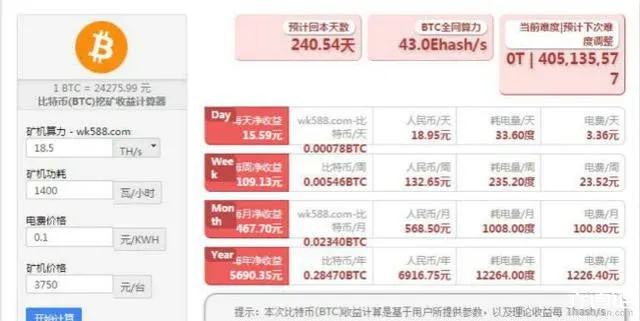
Note: Bitcoin mining is not a guaranteed‑profit venture. Profitability depends on hardware costs, energy expenses, the price trajectory of Bitcoin, and the level of competition. Before committing capital, conduct a thorough cost‑benefit analysis and consider that crypto gains may be taxable in your jurisdiction.
This concludes the detailed breakdown of “Is mining Bitcoin profitable now? How much can you earn from Bitcoin mining?” For more Bitcoin‑mining‑related articles, stay tuned to Bitaigen (比特根).
Additional global‑market considerations:
- When converting fiat to cryptocurrency, users in the United States should use Binance.US (the U.S.‑compliant platform) rather than the global Binance site.
- Transfers from banks to crypto exchanges typically use SWIFT or SEPA networks, depending on the region, and fees may vary.
---
Related Reading
- How to Mine Bitcoin on Poolin: Step‑by‑Step Guide 2024
- Bitcoin Mining Evolution: GPUs as Early Crypto Powerhouses
- How Bitcoin Mining Works and China’s Legal Risks
💡 Register on Binance with referral code B2345 for the maximum trading fee discount. See Binance complete guide.



