
 Bitaigen Research
 In this article we systematically outline Ethereum’s latest long‑term upgrade roadmap, decode the core significance of each critical fork, and explore its potential impact on throughput, finality, privacy, and quantum security. By providing an accessible explanation, readers can grasp the overall evolution narrative; subsequent sections will delve into the details, making a careful read worthwhile.
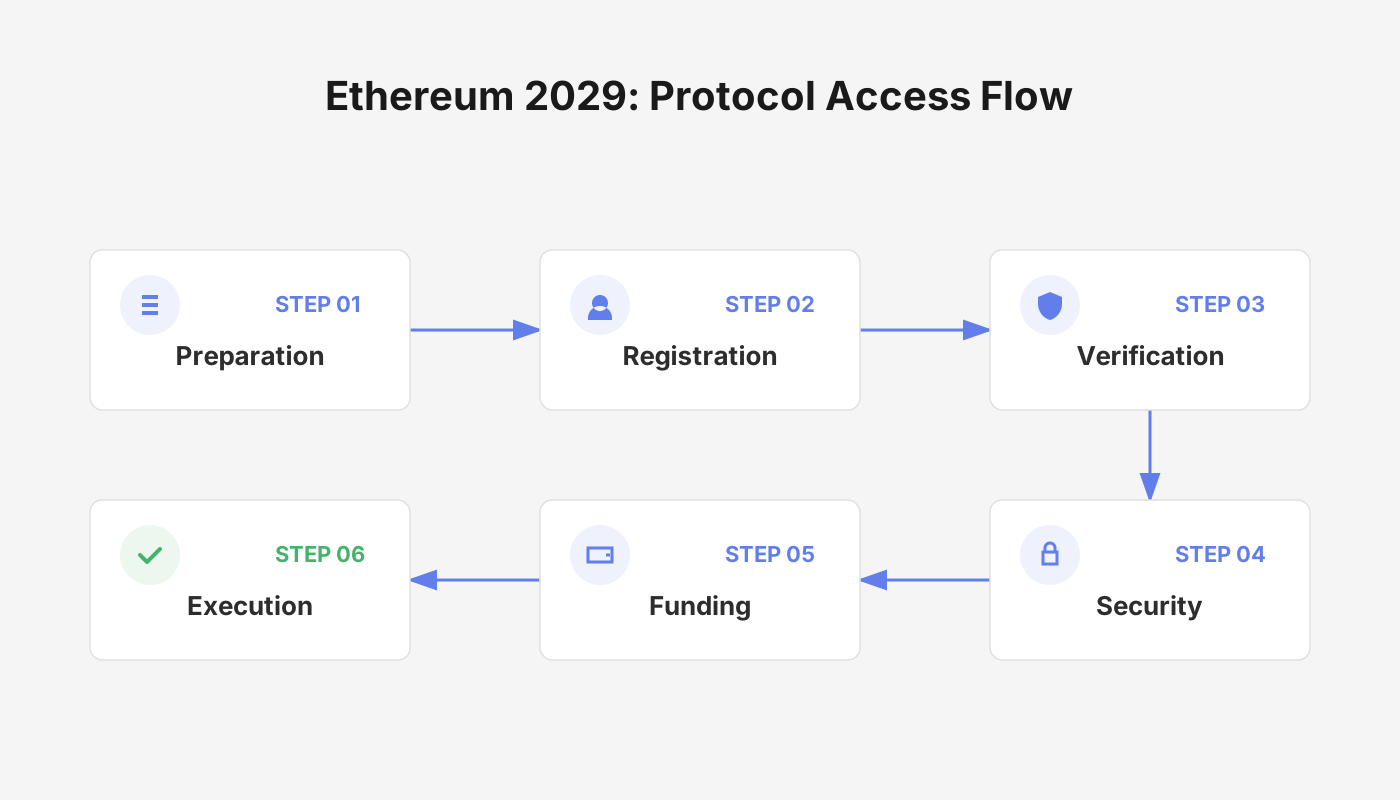
Ethereum 2029 Strawmap Beginner’s Guide
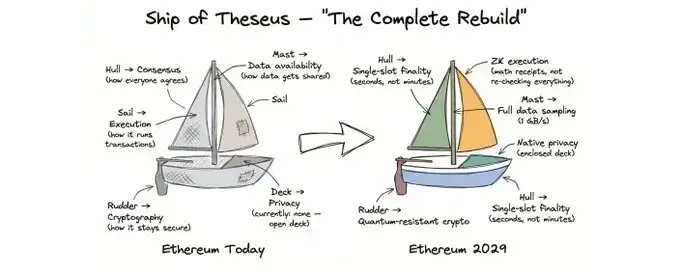
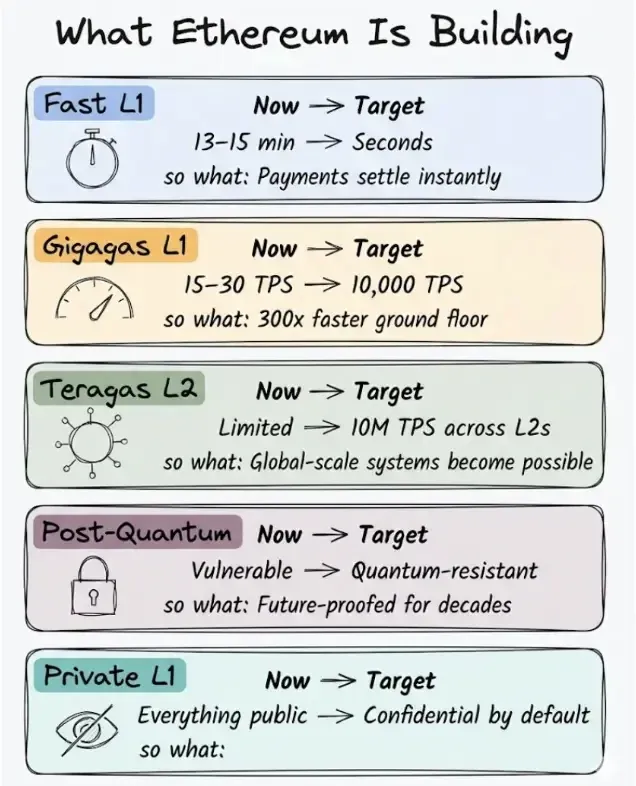
Ethereum recently released the most detailed upgrade blueprint to date—Strawmap. The plan consists of seven hard forks and aims to achieve five major technical objectives before 2029: faster L1 finality, a substantial increase in L1 throughput, massive TPS via L2, quantum‑resistance, and protocol‑level privacy. The entire process is likened to the Ship of Theseus, meaning that the system’s critical components will be replaced piece by piece without ever stopping the chain.
---
Overview of the Seven Forks
Strawmap proposes to roll out seven upgrades at roughly six‑month intervals, starting with Glamsterdam. Each fork focuses on one or two core changes so that, if an anomaly occurs, the root cause can be identified quickly. The already‑deployed Fusaka laid the groundwork for the forthcoming PeerDAS and data‑calibration upgrades; it was followed by Glamsterdam, which re‑organized the way transaction blocks are assembled.
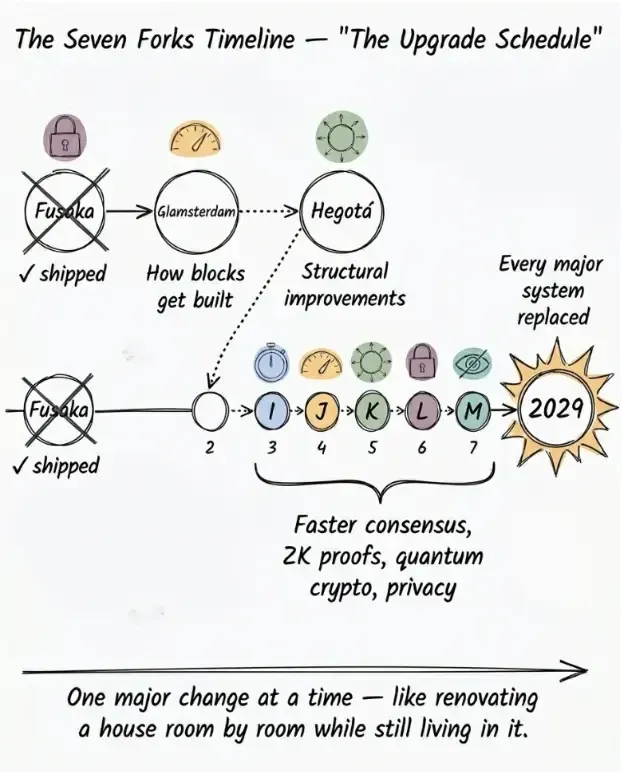
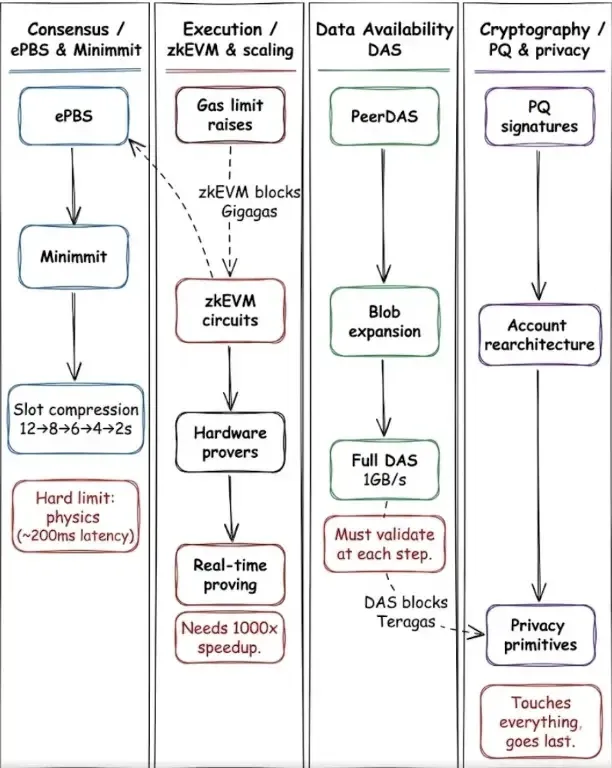
Next comes Hegotá, which further refines the architecture. The remaining forks (I* through M*) will be delivered before 2029, introducing a faster consensus protocol, ZK proofs, scalable data availability, post‑quantum cryptography, and native privacy features. The extended timeline is required mainly because:
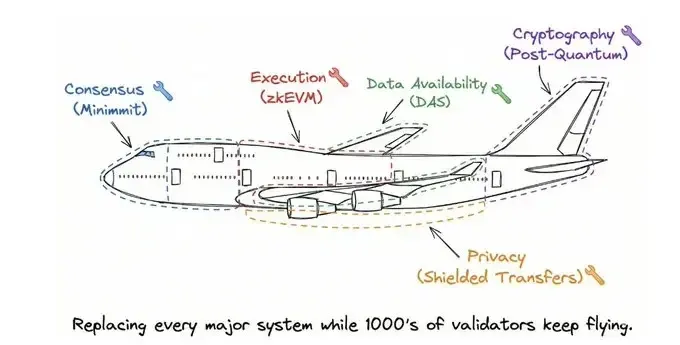
- Replacing the consensus mechanism is the most technically demanding step, akin to swapping an aircraft’s engines while it’s in flight; thousands of validators worldwide must reach a synchronized agreement.
- The generation speed of ZK proofs still needs to move from “minute‑level” to “second‑level,” demanding both mathematical breakthroughs and dedicated hardware.
- Scalable data availability already has theoretical backing, but securely deploying it on a real‑time network worth tens of billions of USD remains challenging.
- Post‑quantum migration will increase signature sizes, affecting block size, bandwidth, and storage economics.
- Native privacy must satisfy regulatory compliance while retaining quantum‑resistance, creating simultaneous technical and political hurdles.
---
Ethereum’s Current Operating Model (60‑Second Snapshot)
Before diving into the future roadmap, let’s review the basic structure of the existing network. Ethereum is a shared computer maintained by thousands of independent nodes worldwide. Nodes validate transactions among themselves; a subset of them are called validators, who must stake ETH as collateral and stand to lose that stake if they act maliciously.
- Every 12 seconds a slot is created, and validators reach consensus on transaction ordering within that window.
- 32 slots (≈ 6.4 minutes) are grouped into an epoch.
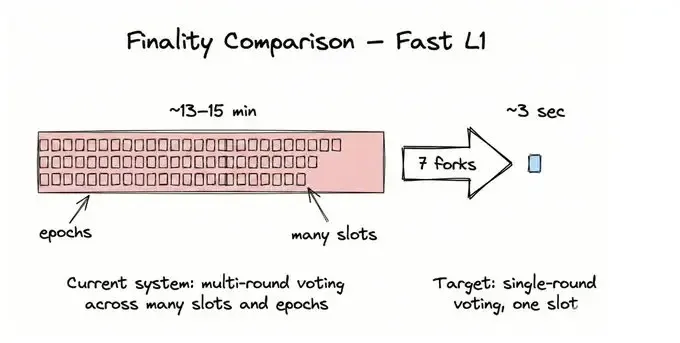
- True irreversibility—finality—generally occurs about 13 – 15 minutes after a transaction lands, depending on its position in the epoch.
Today, Ethereum processes roughly 15 – 30 transactions per second (TPS), far below Visa’s capacity of about 65,000 TPS. This limitation drives most dApps to rely on Layer‑2 (L2) networks: L2 aggregates a large number of transactions and posts a succinct summary back to L1, inheriting L1’s security guarantees. The current consensus mechanism has been battle‑tested for years, but it was originally designed for an early‑stage network and now strains under modern scaling demands.
Strawmap’s entire effort is centered on these bottlenecks, delivering incremental upgrades to achieve higher performance and stronger security.
---
The Five Core Objectives of Strawmap
The objectives are presented in sequential order; each corresponds to one or more fork‑specific implementation paths.
1. Faster L1: Second‑Level Finality
At present, on‑chain final confirmation takes about 13 – 15 minutes, which is unacceptable for high‑value payments or settlement use‑cases (e.g., USD‑denominated transfers). Strawmap proposes to replace the existing consensus engine with a design that achieves finality within a single slot (12 seconds). The team is researching a protocol tentatively named Minimmit, aimed at ultra‑fast consensus. While details are still evolving, the primary goal is to complete finality within one slot, after which the slot duration will be gradually compressed to 8 → 6 → 4 → 3 → 2 seconds.
Finality is not just about speed; it’s about certainty. Shrinking the settlement window from several minutes to a few seconds is comparable to turning a traditional wire transfer—where “sent” and “settled” are separated by a vague lag—into an almost instantaneous transaction. This shift could fundamentally broaden blockchain applicability in finance, real estate, and other high‑value domains.
2. Gigagas: Around 10,000 TPS
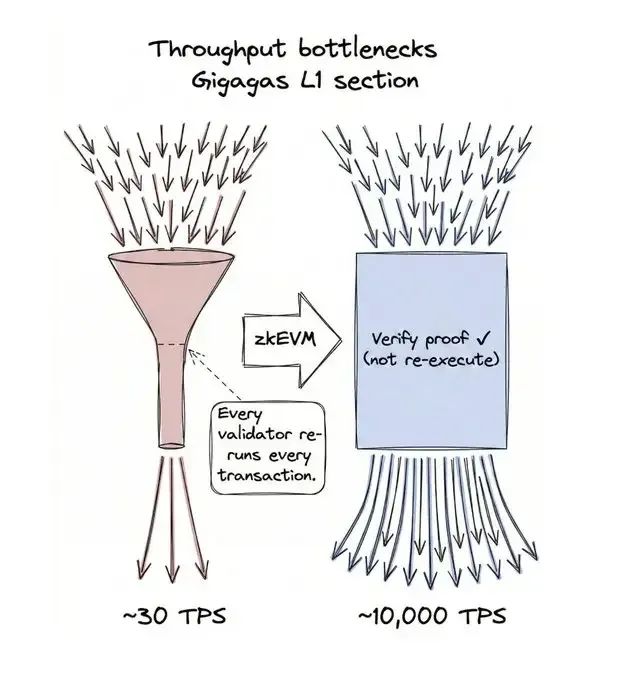
Ethereum’s mainnet currently caps at 15 – 30 TPS, a clear choke point. Strawmap plans to leverage zero‑knowledge (ZK) proof technology to raise the network’s execution capacity to 1 Gigagas, roughly 10,000 TPS (the exact figure varies with transaction complexity). In a traditional full‑node setup, every node re‑executes each transaction—similar to every employee independently re‑calculating every colleague’s spreadsheet entry, which guarantees security but is highly inefficient. ZK proofs allow nodes to verify a compact mathematical attest‑ation instead, dramatically reducing computational load while preserving trust.
Generating ZK proofs today still takes minutes or even hours. Research groups such as RISC Zero and Succinct are racing to compress this process to the second‑level, targeting ≈ 1,000× performance gains. Achieving a 10,000 TPS mainnet would simplify the system architecture and lower error rates.
3. Teragas L2: 10 Million TPS via Data‑Availability Sampling
Even with a 10,000 TPS base layer, truly massive applications will still need L2 scaling. Current L2 throughput is limited by the bandwidth L1 can provide. Strawmap introduces Data‑Availability Sampling (DAS), whereby validators no longer download the entire data set; instead they randomly sample a small subset and mathematically prove that the whole data set is available. Think of flipping through 20 pages of a 500‑page book and, through statistical reasoning, confirming that the entire book resides on the shelf.
PeerDAS was launched with the Fusaka upgrade, laying the foundation for later expansion. As data capacity and network stability grow, the L2 ecosystem could eventually sustain 10 million transactions per second, unlocking use cases such as global supply‑chain tokenization, massive IoT data on‑chain, and micro‑payments at unprecedented scale.
4. Post‑Quantum L1: Guarding Against Quantum Threats
Ethereum’s security model currently relies on mathematical problems that are infeasible for classical computers, including user signatures and validator consensus signatures. If sufficiently powerful quantum computers emerge, these signatures could be broken, enabling forged transactions or asset theft. Strawmap’s mitigation strategy is a migration to hash‑based post‑quantum cryptography, which, in theory, resists quantum attacks. Because the new signatures are larger (on the order of kilobytes), the migration will impact block size, network bandwidth, and storage cost—a key focus of later‑stage upgrades.
5. Private L1: Protocol‑Level Transaction Confidentiality
At present, unless users employ dedicated privacy layers (e.g., Railgun, ZKsync, Aztec), all Ethereum transaction details are publicly visible. Strawmap intends to embed zero‑knowledge privacy directly into the core protocol, allowing the network to verify fund sufficiency and computational correctness without revealing transaction specifics. In other words, a user could prove “this is a legitimate USD 50,000 transfer” without disclosing the sender, receiver, or exact amount.
In February 2026, EY and StarkWare launched Nightfall on Starknet, moving privacy transactions to Layer 2. However, that workaround still requires extra middleware, adding cost and complexity. By baking privacy into L1, those overheads disappear, and the solution aligns with the post‑quantum requirements discussed earlier.
---
Timeline and Technological Outlook
Strawmap explicitly states that the current draft assumes a manually driven schedule; however, introducing AI‑assisted development and formal verification could compress the timeline dramatically. In February 2026, a developer codenamed YQ bet Vitalik that an AI‑driven agent could deliver a complete Ethereum implementation (dubbed ETH2030) within weeks, and subsequently submitted roughly 713,000 lines of code to a testnet. Vitalik’s response was that, while the implementation would likely contain many bugs, “the trend is worth watching,” and he urged the community to stay open to faster, more secure versions.
Concurrently, the Lean Ethereum project is advancing machine‑checkable formal verification of cryptographic and proof stacks, aiming for “bug‑free code.” If successful, the baseline for code quality would shift from “ideal” to “guaranteed,” providing a sturdier foundation for future upgrades.
---
Closing Thoughts
Strawmap is a collaborative planning document rather than a binding contract. Its ambitious goals and aggressive schedule rely on the sustained contributions of hundreds of independent developers. The crucial question is not whether every single technology will be delivered exactly on schedule, but whether you are willing to build on an ecosystem that continuously evolves and offers long‑term growth potential—rather than seeking an alternative platform.
It is worth noting that all research, breakthroughs, and cryptographic migrations are conducted in a public, free, and globally accessible manner, a fact that arguably outweighs the media hype surrounding any single project.
*Note: Cryptocurrency gains may be taxable in your jurisdiction; consult local tax regulations.*
*For fiat on‑ramps, users typically employ USD transfers via SEPA or SWIFT, and U.S. residents should use Binance.US rather than the global Binance platform.*
The above constitutes the complete exposition of the Ethereum 2029 Strawmap Beginner’s Guide. For further details, follow Bitaigen (比特根) and its upcoming special reports.
Related Reading
- Ethereum Smart Contracts: Benefits, Risks, and Challenges
- What Is a Smart Contract? Definition, How It Works & Benefits
- Ethereum PoS vs PoW: Why the Shift Matters
💡 Register on Binance with referral code B2345 for the maximum trading fee discount. See Binance complete guide.



