
 Bitaigen Research
 Rollup is a Layer 2 scaling solution that batches transactions off‑chain and then posts a summary or a zero‑knowledge proof to the main chain, achieving higher throughput and lower fees.
In this article we lay out the core principles and operating mechanisms of Rollup, and we look ahead to its role in blockchain scaling throughout 2025. By dissecting the technology layer by layer, readers can quickly grasp its advantages and typical use‑cases. Subsequent sections also provide practical how‑to guidance, making the piece worth a thorough read.
What Is a Rollup?
Rollup is an advanced scalability solution. It first processes transactions off‑chain, then submits a batch‑level summary or cryptographic proof back to the base blockchain. You can think of a Rollup as a fast lane on a highway: it aggregates a large number of scattered transactions and reports the result to the main chain. This class of Layer 2 protocols boosts transaction speed and cuts costs while still relying on the security of underlying networks such as Ethereum.
As of 2025, Rollups have become the centerpiece of blockchain scaling, with total value locked (TVL) exceeding US $31 billion and hundreds of active networks. Users who wish to participate in the Rollup ecosystem can access the major Rollup tokens and projects through platforms like Bitget.
How Does a Rollup Actually Work?
- User initiates a transaction – The transaction is first sent to the Rollup network’s entry point (a sequencer or validator).
- Off‑chain batch processing – The received transactions are aggregated, ordered, and executed off‑chain.
- Generate a summary/proof – Depending on the Rollup type, a batch summary or a zero‑knowledge proof is produced.
- Submit to the main chain – The batch, together with its data or proof, is posted to Ethereum or another base chain.
- Main‑chain verification – The base chain validates the summary or proof, providing security and finality.
This workflow allows thousands of transactions to be settled off‑chain, requiring only a single on‑chain submission for secure confirmation. The result is dramatically lower gas fees and much faster confirmation times.
Two Main Types of Rollups
| **Rollup Type** | **How It Works** | **Key Advantages** |
|---|---|---|
| **Optimistic Rollup** | Assumes transactions are valid by default; only if a fraud proof is submitted during a challenge period is verification performed. | Fast processing, full EVM compatibility |
| **ZK‑Rollup** | Uses zero‑knowledge proofs to verify every transaction before it is submitted. | Immediate finality, enhanced privacy |
Optimistic Rollup
- Operates on a “trust‑but‑verify” model, treating all transactions as valid unless proven otherwise.
- After a batch is posted, it enters a challenge window (typically 7 days); anyone can submit a fraud proof during this period.
- Representative projects: Arbitrum, Optimism, Base. These are highly compatible with Ethereum smart contracts, although withdrawals must wait until the challenge period ends.
ZK‑Rollup
- Performs off‑chain transaction validation using zero‑knowledge proofs, then posts the proof to the main chain.
- Once the proof is verified, finality is achieved instantly, and transaction details can remain hidden.
- Representative projects: zkSync Era, StarkNet, Polygon zkEVM, Linea. Some of these still have limitations regarding smart‑contract compatibility.
Which Rollups Are Expected to Lead the Market in 2025?
Most Watched Optimistic Rollups
- Arbitrum One – Highest TVL, robust DeFi ecosystem, proven security.
- Optimism – Built on the modular OP Stack framework, powers the Superchain multi‑chain ecosystem.
- Base – Developed by Coinbase, offers seamless fiat‑to‑crypto integration and rapid user growth.
Leading ZK‑Rollups
- zkSync Era – EVM‑compatible, targeting 10,000+ TPS, high developer adoption.
- StarkNet – Utilises zk‑STARKs for faster throughput and supports the Cairo programming language.
- Polygon zkEVM – Provides Ethereum‑equivalent security while being compatible with existing dApps.
- Linea – Developer‑friendly, low cost, and fast settlement.
Bitget offers spot trading for the tokens of these projects, and has recently added Caldera (ERA) and BSquared Network (B2) to its listings.
What Core Problems Do Rollups Solve?
- Scalability – Enables thousands of transactions per second without sacrificing security or decentralisation, breaking through Ethereum’s ~15 TPS ceiling.
- Fee reduction – By batching transactions, gas costs drop 90 %‑99 % compared with Layer 1.
- Network congestion – Relieves pressure on the main chain, reducing competition for block space and smoothing overall network performance.
- Security inheritance – Continues to rely on the security model of the underlying chain while adding its own innovative mechanisms.
Note for U.S. users: When converting fiat to crypto for Rollup‑related activities, you must use Binance.US (or another U.S.-compliant exchange) rather than the global Binance platform. International users can typically use SEPA, SWIFT, or local bank transfers.
Tax reminder: Crypto gains—including any profits realized from trading Rollup tokens—may be taxable in your jurisdiction. Consult a tax professional for guidance specific to your country or state.
Practical Benefits and Potential Risks of Using Rollups
Main Benefits
- High scalability – Capable of processing 10,000+ transactions per second.
- Significant fee savings – Costs are reduced by 90 %‑99 % relative to the mainnet.
- Fast finality – ZK‑Rollups settle instantly; Optimistic Rollups also achieve rapid confirmations once the challenge window closes.
- Security inheritance – Leverages Ethereum’s robust security model.
- Rich ecosystem – Supports DeFi, NFTs, gaming, and enterprise‑grade applications.
Key Limitations
- Withdrawal delays – Optimistic Rollups require an approximate 7‑day challenge period before funds can be withdrawn.
- Bridge complexity – Moving assets across layers can be confusing for newcomers.
- Centralisation risk – Early‑stage Rollups may depend on centralized sequencers or validators.
- Ecosystem fragmentation – Liquidity and users are spread across multiple Rollup networks.
- Contract compatibility – Some ZK‑Rollups impose restrictions on smart‑contract functionality.
Bitget’s wallet now supports several Layer 2 networks, helping users connect seamlessly with the Rollup ecosystem.
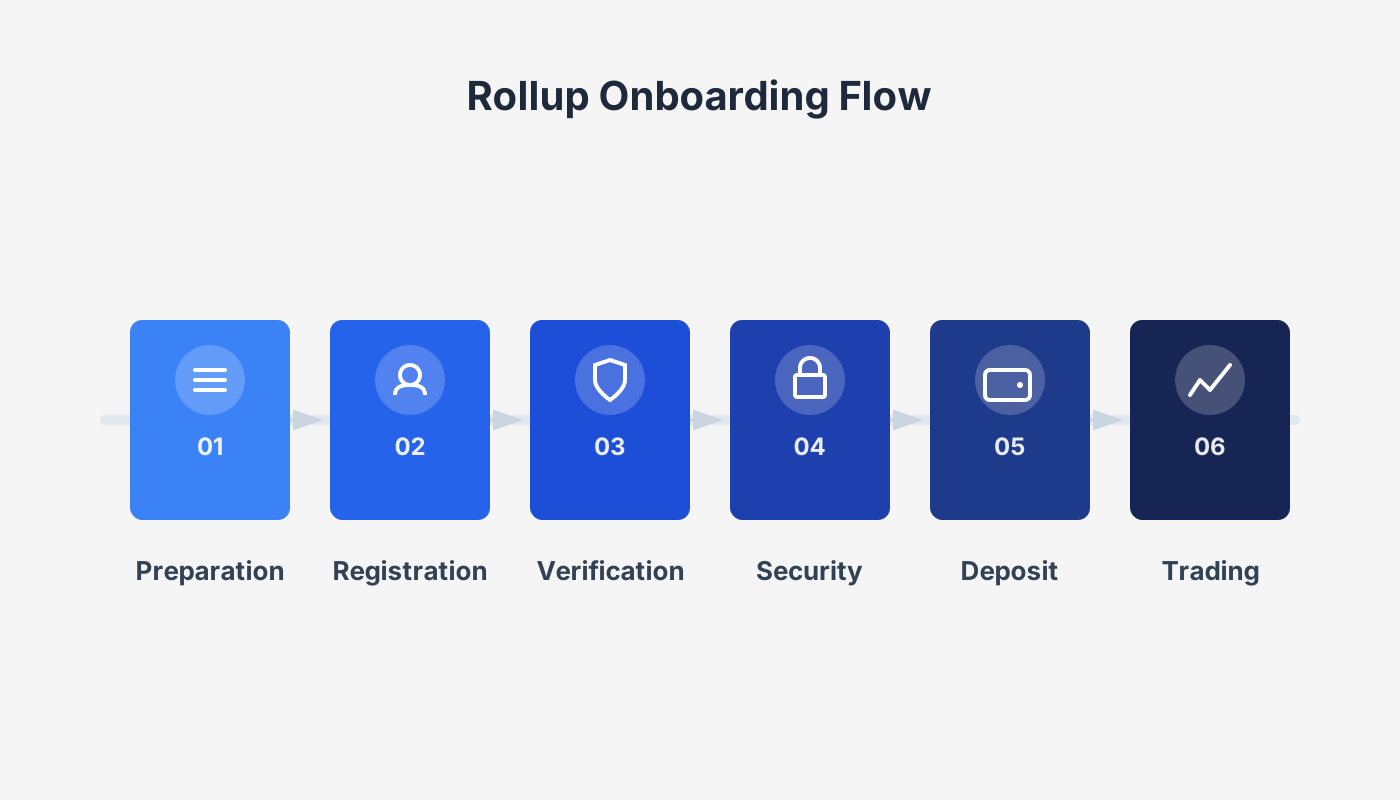
How to Get Started with a Rollup
- Prepare a wallet – Use a wallet that supports Layer 2 (e.g., MetaMask, Bitget Wallet).
- Bridge assets – Transfer a modest amount of ETH or a stablecoin to the target Rollup network for testing.
- Explore dApps – Most major dApps are already compatible with multiple Rollups; you can compare speed, fees, and user experience directly.
If you wish to deepen your involvement, you can trade the native tokens of the respective Rollups on the Bitget platform, join launch‑pool events, or hold tokens such as Arbitrum (ARB) and Optimism (OP).
Is Rollup the Future of Blockchain Scaling?
Current trends indicate that Rollups will remain a cornerstone of blockchain infrastructure. The technology has matured from an experimental concept to a production‑grade platform handling billions of transactions. Frameworks like OP Stack, Arbitrum Orbit, Polygon CDK, and zkSync Hyperchain enable customizable Rollup deployments, signalling continuous ecosystem expansion.
The rivalry between Optimistic Rollups and ZK‑Rollups fuels rapid innovation: the former is improving withdrawal mechanisms and modular design, while the latter advances contract compatibility and proof efficiency. This healthy competition drives down costs, raises security standards, and enhances the overall user experience.
Key Takeaways About Rollups
- Rollups are currently the most mature blockchain scaling solution, delivering substantial speed gains and fee reductions while preserving security.
- Optimistic Rollups excel in ecosystem compatibility; ZK‑Rollups lead in instant finality and privacy.
- The technology is still evolving quickly, with new frameworks and better interoperability emerging regularly.
- For newcomers, starting with well‑established Rollups before exploring newer projects can help balance risk and reward.
This concludes the guide. For a more comprehensive collection of Rollup resources, search for previous articles from Bitaigen (比特根) or continue reading the related links below. Thank you for your continued interest and support!
Related Reading
- Ethereum Layer 2 Solutions: Boosting Scalability & Reducing Fees
- Ethereum Layer 2 Explained: Scalability, Low Fees & Speed
- MegaETH (MEGA) Token Review: Ultra‑Fast Layer 2 Scaling on Ethereum
💡 Register on Binance with referral code B2345 for the maximum trading fee discount. See Binance complete guide.



