
 Bitaigen Research
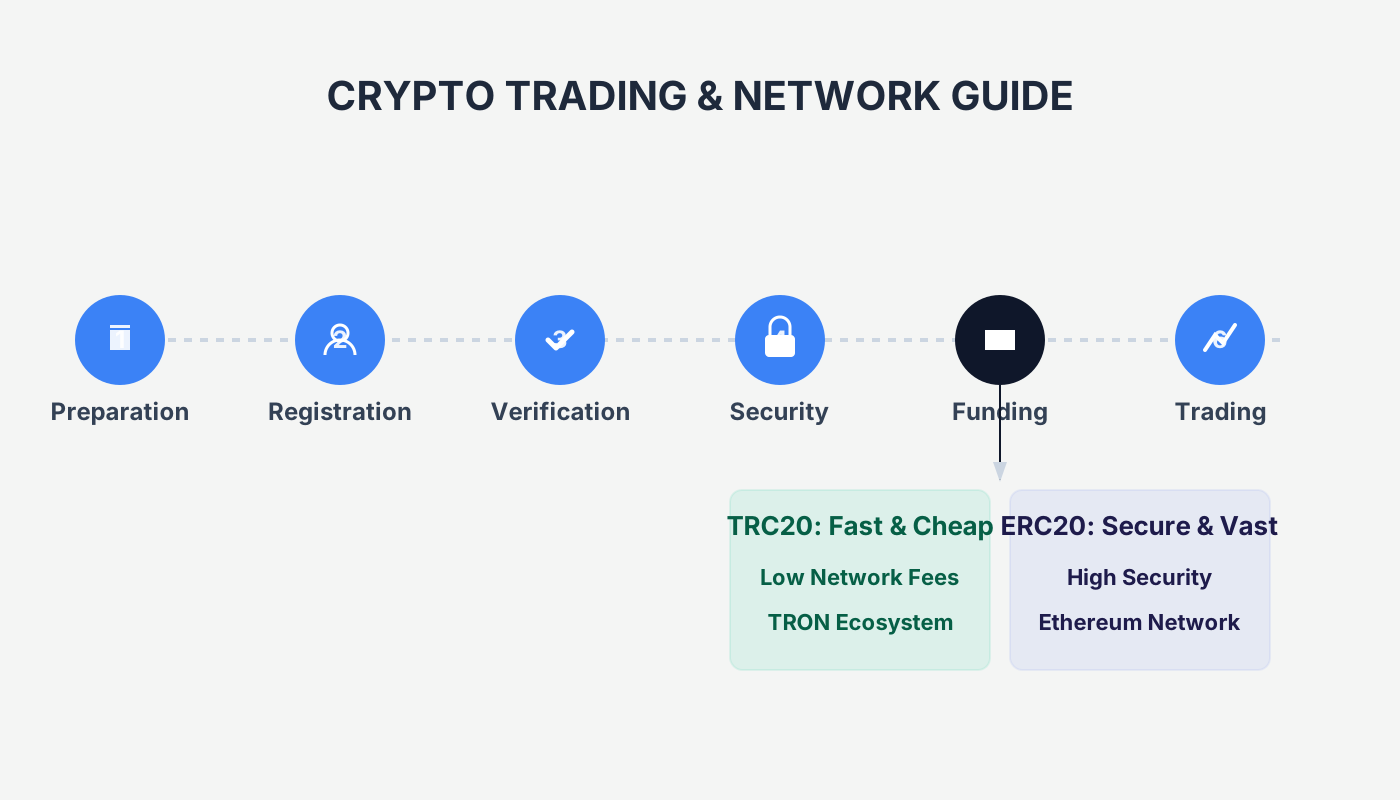
 TRC20 is suitable for transfer and payment scenarios that require high speed and low fees, while ERC20 is better suited for DeFi, NFT, and composable smart‑contract applications that demand strong security and a rich ecosystem.
Key Points
- TRC20 is the token standard on the Tron blockchain, known for low fees and fast transactions.
- ERC20 is a widely used Ethereum standard that offers robust security and compatibility within Ethereum’s massive ecosystem.
- ERC20 transactions require ETH to pay gas, whereas TRC20 transactions usually cost less and use TRX to pay gas.
- TRC20 is optimal for rapid, low‑cost token transfers and dApps on the high‑throughput Tron network.
- ERC20 is optimal for secure, widely supported Ethereum tokens and is the ideal choice for DeFi, NFT, and interoperable smart‑contract applications.
From both technical and ecosystem perspectives, we compare the core characteristics of TRC20 and ERC20 to help developers and investors determine the best choice for different business scenarios. The article delves into the principles of each token standard, fee structures, and typical use cases, enabling you to quickly assess which on‑chain solution aligns with your needs. It is well worth a read.
What Is a Token Standard?
A token standard is a set of predefined rules and protocols for creating and managing tokens on a blockchain. It provides developers with a unified framework, ensuring that tokens can interact seamlessly with wallets, exchanges, and smart contracts.
Examples
- ERC20 on Ethereum: One of the earliest and most widely adopted standards, defining a suite of functions for creating fungible tokens and supporting a massive token ecosystem and decentralized finance (DeFi) applications.
- TRC20 on Tron: Inspired by ERC20, it implements fungible tokens on the Tron blockchain with an emphasis on fast transactions and low fees.
Overview of TRC20 and ERC20
Both TRC20 and ERC20 are used to create fungible tokens. TRC20 focuses on speed and cost efficiency, while ERC20 benefits from Ethereum’s extensive ecosystem and mature security model. The following sections provide a detailed comparison.
TRC20 on the Tron Blockchain
TRC20 is supported by the Tron Virtual Machine (TVM) and defines the rules for creating and managing homogeneous tokens, ensuring compatibility within the Tron ecosystem. Its goal is to provide a faster, more cost‑effective alternative to Ethereum tokens.
ERC20 on the Ethereum Blockchain
ERC20 runs on the Ethereum Virtual Machine (EVM) and leverages a full dApp ecosystem, developer tools, and community support. Since its introduction in 2015, the standard has been widely used, offering high security and near‑universal compatibility with wallets, exchanges, and blockchain applications.
Main Differences Between TRC20 and ERC20
| Aspect | **TRC20** | **ERC20** |
|---|---|---|
| Blockchain Platform & Technology | Tron blockchain, using TVM | Ethereum blockchain, using EVM |
| Transaction Speed | ~120 TPS, finality ~57 seconds | ~12 TPS, finality ~960 seconds |
| Transaction Fees | $0.20‑$3.40 (average ≈ $0.12) | Gas‑price dependent, up to $50 |
| Network Compatibility & Ecosystem | Smaller ecosystem, focused on efficient transfers | Massive ecosystem, supports DeFi, NFT, DEX, etc. |
| Security & Decentralization | DPoS consensus, 27 Super Representatives, lower decentralization | PoS consensus, large validator set, high security |
Blockchain Platform & Technology
- TRC20 operates on the Tron blockchain, leveraging an efficient and inexpensive infrastructure to achieve low fees and rapid confirmations.
- ERC20 operates on Ethereum, benefiting from a mature security model and broad compatibility, making it suitable for scenarios that require extensive audits and multi‑chain interoperability.
Transaction Speed
- TRC20 can peak at 272 TPS, with an average block time of about 57 seconds.
- ERC20 processes roughly 62 transactions per second, with an average confirmation time of about 960 seconds (one block every 12 seconds).
Transaction Fees
- TRC20 fees can be as low as a few tenths of a cent, though transfers to empty wallets may rise to 27.25 TRX (≈ $6.54 as of 2025‑04‑25).
- ERC20 fees are heavily influenced by gas prices; during periods of network congestion a single transaction can exceed $50.
Network Compatibility & Ecosystem
- TRC20 ecosystem is relatively concentrated, primarily used for high‑speed transfers and payment use cases.
- ERC20 is compatible with almost every wallet, exchange, and DeFi protocol, making it the mainstream platform for innovation and interoperability.
Security & Stability
- ERC20 benefits from years of audited smart contracts and a large validator network, offering high decentralization.
- TRC20 achieves high throughput via DPoS but relies on only 27 Super Representatives, resulting in comparatively lower decentralization.
In short, ERC20 offers greater decentralization and security, while TRC20 prioritizes throughput and cost efficiency. The choice depends on the specific use case.
Use‑Case Comparison: When to Choose TRC20 vs. ERC20
- Choose TRC20 for scenarios that demand high speed, low cost, and large transaction volumes, such as stablecoin transfers, payment applications, and remittance services. Over 50 % of USDT trading volume occurs on Tron, with fees measured in fractions of a cent and confirmation times of a few seconds.
- Choose ERC20 for building DeFi protocols, DAOs, NFT platforms, or projects that need extensive toolchain support (MetaMask, Chainlink, Etherscan, Layer‑2 solutions). Ethereum’s security model and rich composability are key advantages, even though gas costs can spike during peak periods.
Brief Comparison
- TRC20: Low fees + high speed + suitable for payments, stablecoins, retail applications.
- ERC20: High security + rich ecosystem + suitable for DeFi, NFT, complex smart contracts.
Some projects issue both TRC20 and ERC20 versions, leveraging the fast transfer capability of the former and the ecosystem access of the latter, creating a complementary rather than exclusive approach.
How to Identify TRC20 vs. ERC20 Tokens
- Check Address Format
- ERC20 uses Ethereum addresses that start with `0x` (e.g., `0xabc123…`).
- TRC20 uses Tron addresses that start with `T` (e.g., `TXYZabc…`).
- Use a Block Explorer
- Queries on Etherscan pertain to ERC20.
- Queries on Tronscan pertain to TRC20.
- Wallet Support
- MetaMask natively supports ERC20 and does not recognize TRC20.
- TronLink supports TRC20 and does not support ERC20.
- Gas‑Fee Currency
- ERC20 requires ETH to pay gas.
- TRC20 requires TRX (or Energy) to pay gas.
- Exchange Labeling
- Deposit/withdrawal pages typically indicate the chain a token belongs to; always verify before proceeding to avoid cross‑chain mistakes that could lead to loss of assets.
- Contract Address Verification
- Search the contract address on both Etherscan and Tronscan; only one will return valid information, confirming the token’s standard.
Final Thoughts
Both TRC20 and ERC20 have distinct strengths. If a project emphasizes high‑speed, low‑cost transfers—especially for stablecoins or high‑frequency payment scenarios—TRC20 is the more appropriate choice. If the focus is on security and ecosystem depth, and you wish to tap into the extensive resources of DeFi and NFT platforms, ERC20 holds the advantage. Understanding the differences helps avoid unnecessary costs and technical risks, enabling developers, traders, and blockchain enthusiasts to make decisions that best match their requirements.
Note: Crypto gains may be taxable in your jurisdiction. Be sure to consult local tax regulations and consider using SEPA or SWIFT for fiat withdrawals where applicable. U.S. residents should use Binance.US rather than the global Binance platform.
The above constitutes the full text of “TRC20 vs. ERC20: Which Is Better? Main Differences and Use Cases.” For more related material, follow Bitaigen (比特根) and its other articles!
Related Reading
- On‑Chain Transfer: Match Networks (TRC20, ERC20, BEP20)
- Transfer TokenPocket Funds to OKX (OKEx) Safely
- BRC20 vs ERC20: Differences in Bitcoin & Ethereum Tokens
💡 Register on Binance with referral code B2345 for the maximum trading fee discount. See Binance complete guide.



