
 Bitaigen Research
In this article we walk you through the core mechanisms of Aster, a cross‑chain perpetual‑contract DEX, the multiple functions of its governance token ASTER, and the platform’s security and liquidity design, helping newcomers quickly assess its investment value. We will then dive into its technical roadmap, community incentives, and potential risks. Keep reading.
Quick Overview
- Aster is a cross‑chain decentralized perpetual‑contract trading platform (Perp DEX) that emphasizes CEX‑level smoothness and high‑leverage trading while keeping assets under users’ self‑custody.
- ASTER is the ecosystem’s core token, capped at 8 billion units, with functions that include governance voting, fee discounts, margin collateral, staking mining, and reward programs, backed by a large‑scale fee‑buy‑back and burn mechanism.
Project Snapshot
Chinese name: Aster
English name: Aster / Aster DEX
Category: Multi‑chain decentralized perpetual‑contract exchange (also supports spot and stock‑perpetual derivatives)
Official launch: 31 March 2025, under the Aster brand; predecessor was the merger of Astherus + APX Finance
Backing capital: YZi Labs (a family office spun out from the former Binance Labs team), closely linked with Binance founder CZ and He Yi.
Supported chains: BNB Chain, Ethereum, Arbitrum, Solana, etc.
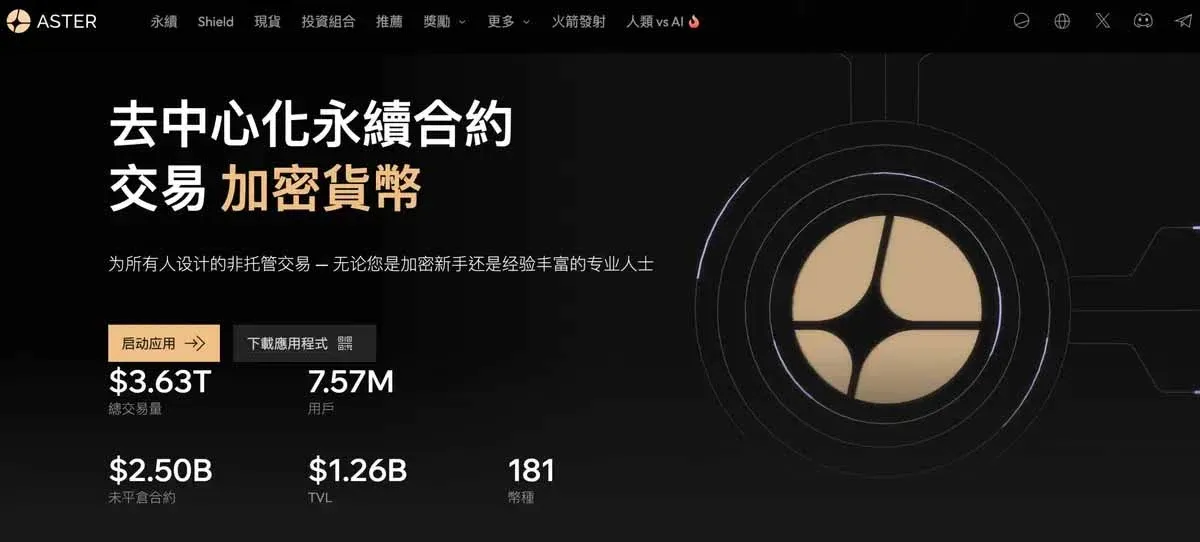
Core products: Simple mode, Pro mode (on‑chain order‑book CLOB), 1001× ultra‑high leverage, stock perpetuals, Spot market, ALP liquidity pools, USDF stablecoin, and more.
Functional Modules Overview
- Spot trading: Executes low‑slippage buys and sells via a decentralized order book (CLOB), covering early‑stage tokens and mainstream blue‑chip assets.
- Perpetual contracts: Offers a full suite of leverage tools and supports dark‑pool trading to protect privacy, prevent front‑running, and avoid malicious liquidations.
- 1001× mode: An extreme‑leverage option aimed at high‑risk speculators.
- Prediction trading: Allows users to forecast price movements over short windows such as 1 hour or 30 minutes, useful around macro data releases (e.g., Federal Reserve rate decisions, employment reports).
- ALP liquidity vault: Users can deposit idle assets into the vault, contribute liquidity, and earn a share of fees and liquidation proceeds.
- Yield‑bearing assets: Inherits Astherus functionality, offering tokens like asUSDF, asBNB, asCAKE that can be staked for yield.
- Other tools: Grid Trading, Rocket Launch, etc., designed to replicate the user experience of centralized platforms.
Technical Implementation and Operating Mechanism
Aster is built on a high‑performance application chain (App Chain) and adopts a hybrid off‑chain matching + on‑chain settlement architecture to achieve millisecond‑level order response.
- Off‑chain matching: Orders are first matched on efficient servers; the matching results are then batch‑written onto the blockchain.
- Cross‑chain asset settlement: Smart contracts centrally manage assets across multiple chains (BSC, Solana, Ethereum, Arbitrum), enabling cross‑chain liquidity.
- Aster Chain: A Layer 1 public chain purpose‑built for order‑book (CLOB) operations, slated for launch in Q1 2026 to improve transparency and decentralization.
- Zero‑knowledge proofs: Leveraging ZK‑Proof services from Brevis, large dark‑pool orders can be validated on‑chain with privacy guarantees, ensuring secure and anonymous trades.
Strengths and Weaknesses
Highlights
- Near‑centralized experience: Fast order entry, professional UI, hidden orders, sub‑accounts, and multi‑asset margin, catering to professional traders.
- Competitive fees: Maker 0.005 %, Taker 0.04 %; an additional ~5 % discount is available via a CoinDaDa referral link.
- Rich asset variety: Multi‑chain tokens, stock perpetuals, and select real‑world assets (RWA) such as XAU (gold) are tradable.
- Dual‑use of assets: Capital can simultaneously serve as margin, staking yield, or liquidity provision, boosting capital efficiency.
- Strong backing: Public purchases by YZi Labs and CZ (over USD 2 million equivalent) add credibility.
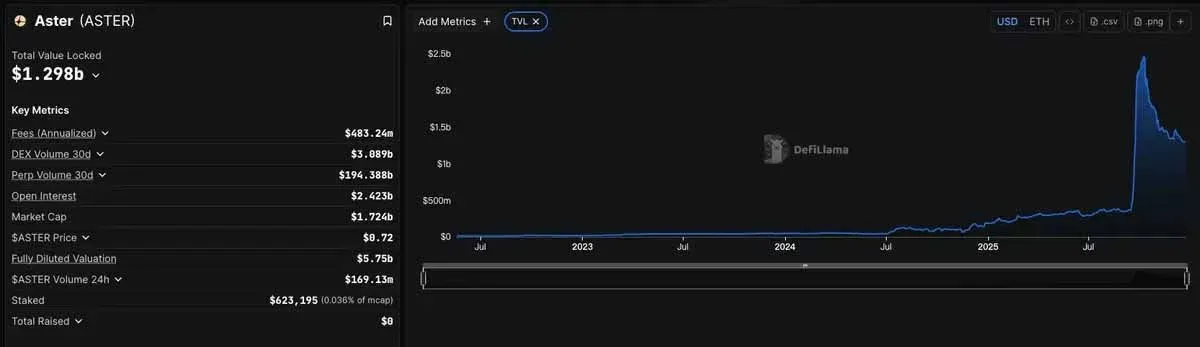
- Market performance: In the second half of 2025, Aster’s share of open interest (OI) and trading volume in the perpetual DEX market approached 20 %, positioning it as a primary competitor to Hyperliquid.
Risk Points
- Centralization concerns: Nodes, matching, and governance rights still exhibit centralization tendencies; early data was once questioned for possible wash‑trading or metric inflation.
- Intense competition: Hyperliquid, dYdX, GMX, Lighter, edgeX and others are all vying for market share in the perpetual DEX space.
- User onboarding barrier: Requires familiarity with creating and connecting Web3 wallets.
- Buy‑back narrative dependence: Token value heavily relies on fee‑generated buy‑backs and market speculation; a decline in trading activity could pressure the price.
Beginner’s Guide
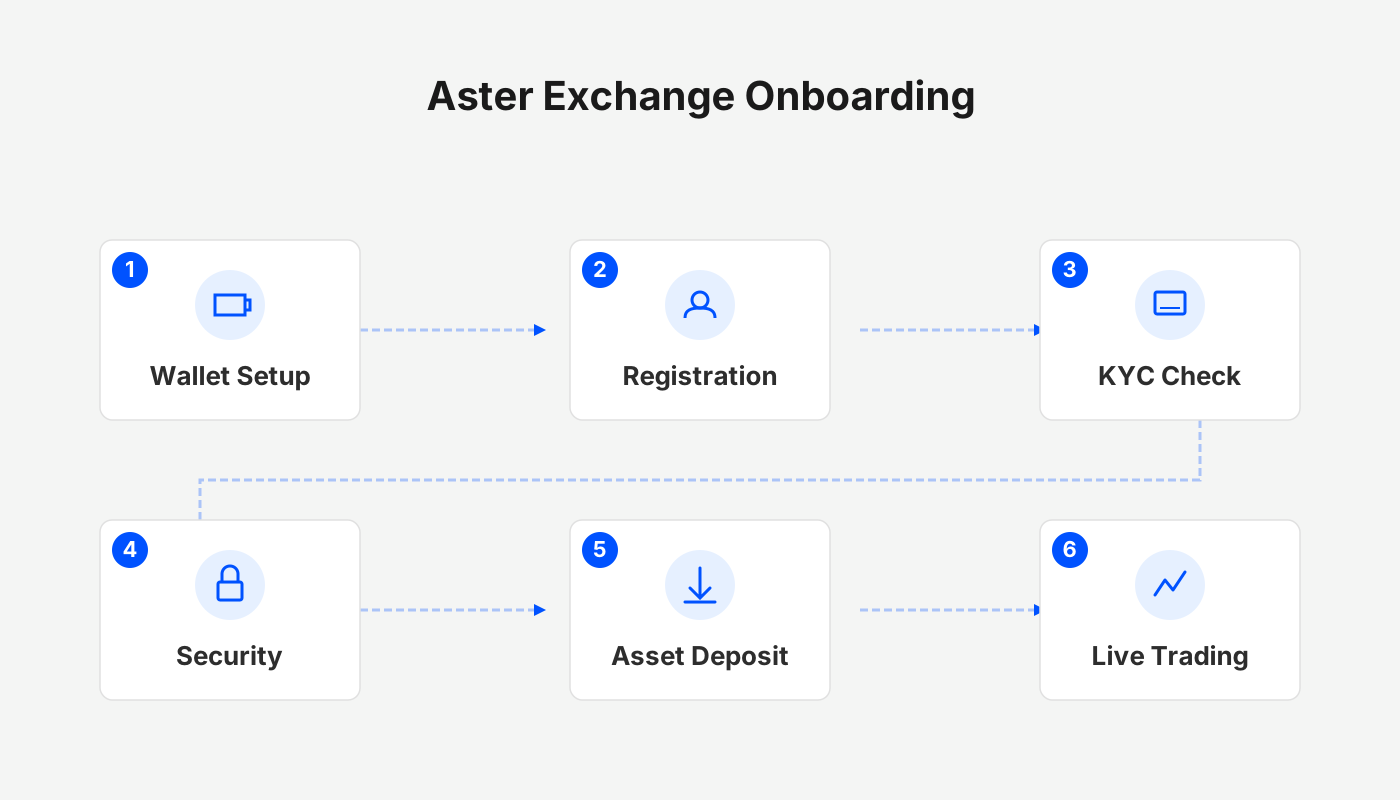
- Prepare a wallet: Download and set up an EVM‑compatible wallet (e.g., MetaMask).
- Prepare assets: Have USDT or other tokens supported by Aster on the Arbitrum network.
- Connect to the platform: Visit the official Aster website and click the “Connect Wallet” button at the top right.
- Deposit funds: Click “Deposit” and transfer assets into Aster’s official smart contract.
- Start trading: Once the funds are confirmed, you can open long or short positions on the desired trading pairs.
Note for global users: When moving fiat to USDT or other stablecoins, use reputable on‑ramps that support USD via SEPA, SWIFT, or local bank transfers. U.S. residents should use Binance.US rather than the global Binance platform.
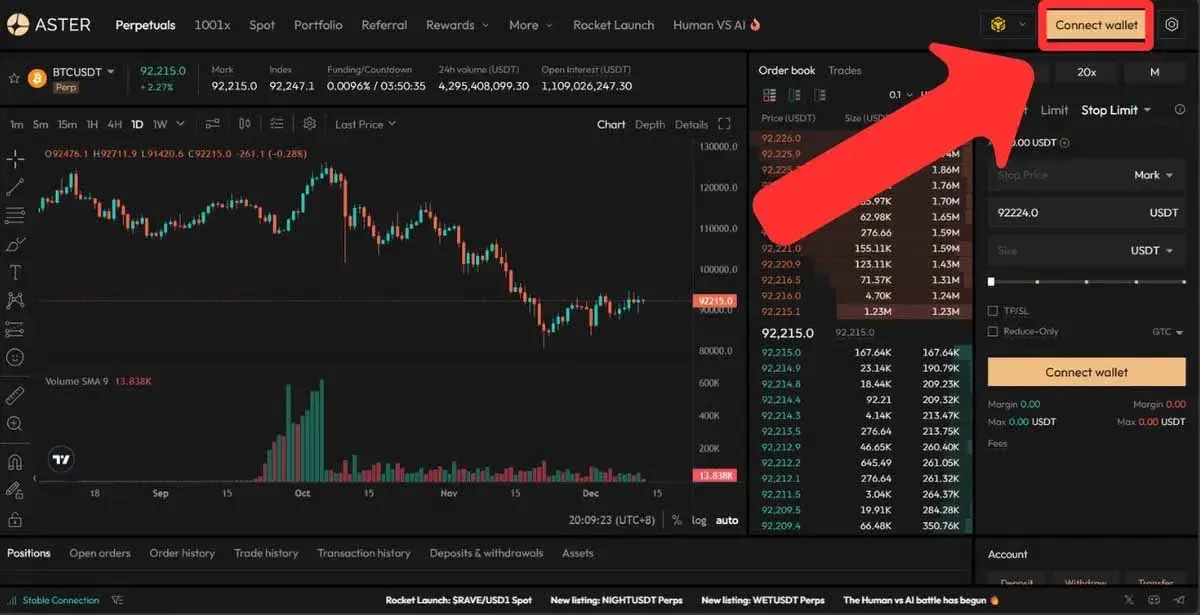
Wallet‑Connection Example
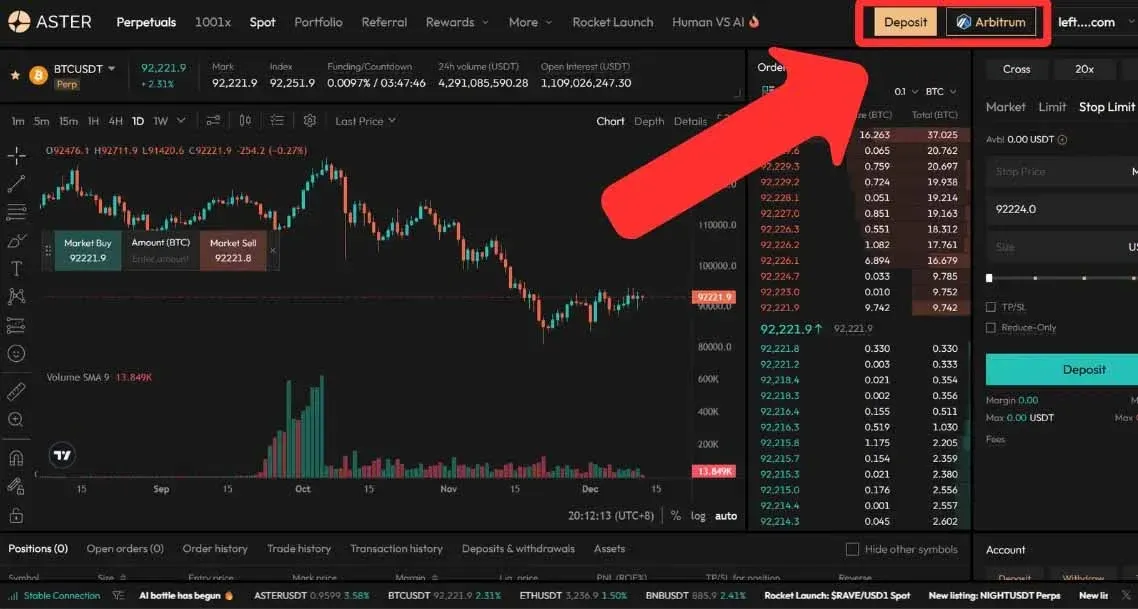
Deposit Funds Example
*(Screenshots omitted for brevity.)*
Tradable Assets Overview
Aster lists tokens quickly, covering a wide range of popular markets:
- Mainstream on‑chain assets: BTC, ETH, SOL, BNB, etc.
- Alt‑coins: Sui, Aptos, and others.
- Meme coins: PEPE, WIF, BONK, DOGE, etc.
- Pre‑Launch market: Occasionally the platform opens pre‑trading for projects that have not yet launched, allowing users to position early.
- U.S. stock perpetuals: APPL, TSLA, NVDA, and more.
- Real‑world assets (RWA): Currently supports XAU (gold) trading.
Fee Structure
- Trading fees: Maker fee for spot and perpetual contracts is 0.005 %, Taker fee is 0.04 %; using a referral link can shave roughly another 5 % off.
- ALP vault share: A portion of the vault’s earnings is taken as a market‑making reward.
- Funding rates: When perpetual positions trade at a premium or discount, a Funding Rate is charged to the side of the position accordingly.
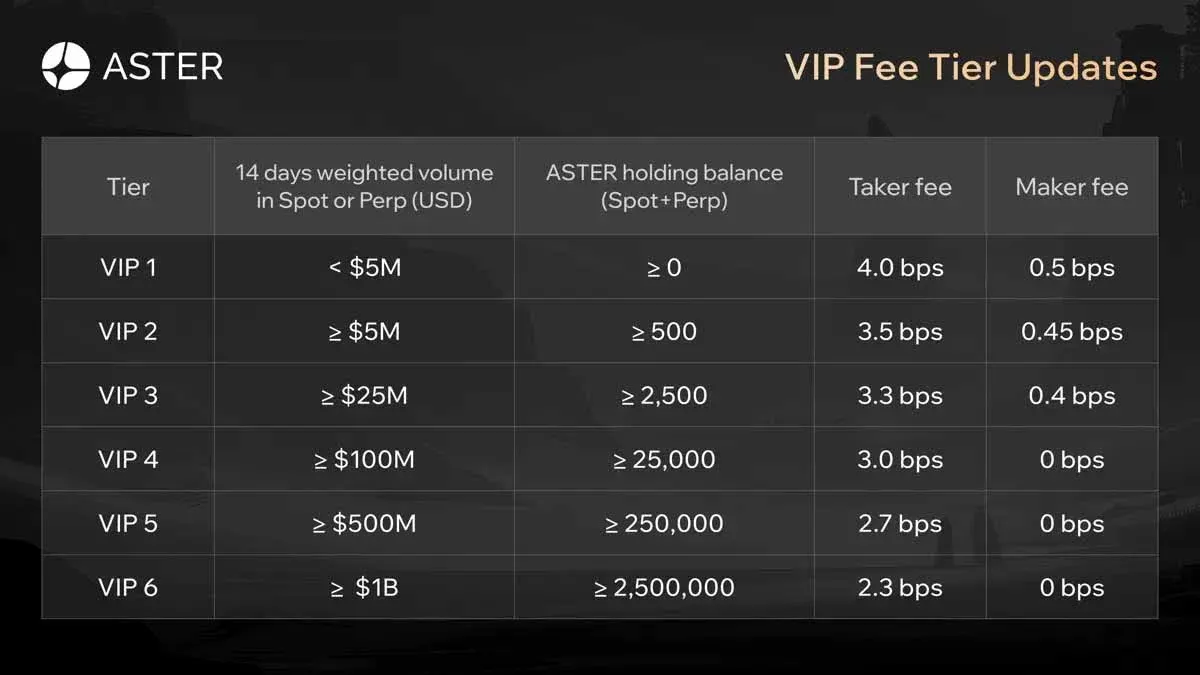
ASTER Token Fees and VIP Levels
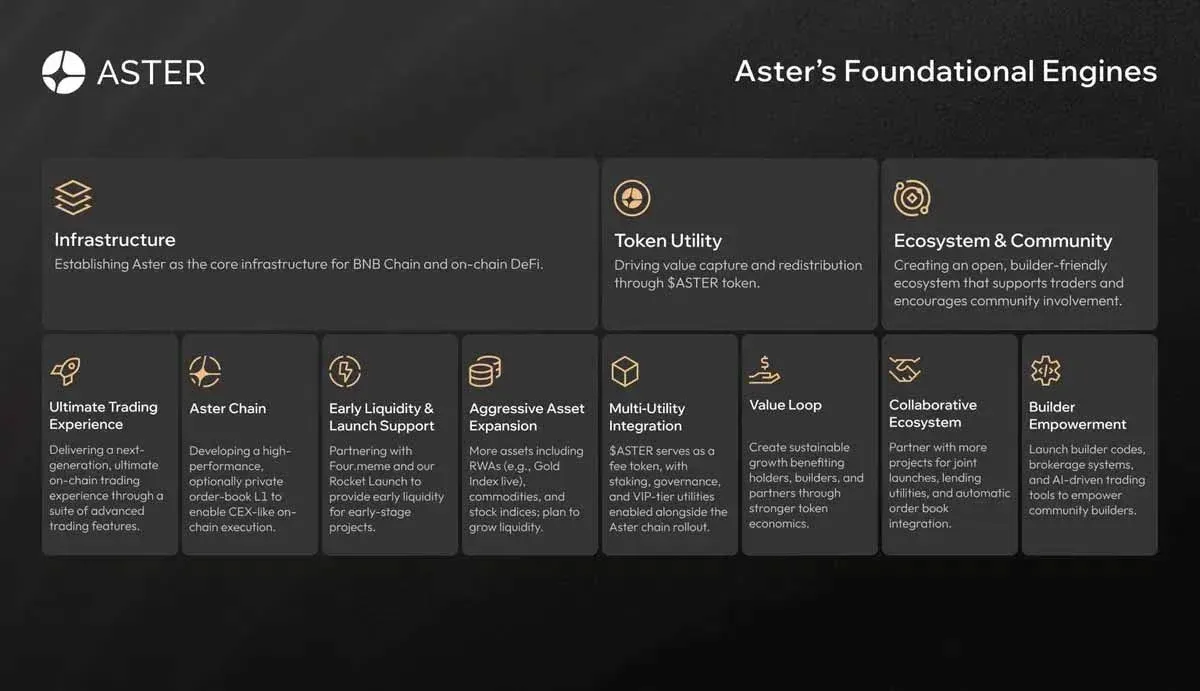
ASTER Token Overview
- Token name: Aster Token
- Symbol: ASTER
- Maximum supply: 8 billion
- Circulating supply: Approximately 2.2 billion
- Core functions: Governance voting, fee discounts, margin collateral, staking rewards, platform buy‑back and burn
As of 22 December 2025, one LINK was priced at roughly USD 0.9585 (≈ NT 29.93). Please check a reliable market data source for the latest ASTER price.
Tax reminder: Crypto gains may be taxable in your jurisdiction. Consult a tax professional to understand your obligations.
Practical Uses of ASTER
- Governance rights: Holders can vote on protocol upgrades, fee parameters, vault and buy‑back strategies, and other governance matters.
- Fee discounts & VIP: Paying fees with ASTER grants about a 5 % discount; combined with a CoinDaDa referral link, an additional 5 % discount applies.
- Margin collateral: ASTER can be used directly as margin for perpetual contracts at an approximate conversion rate of 80 %, enhancing capital efficiency.
- Staking yields: Holders may lock ASTER to earn staking rewards.
- Buy‑back & burn: A portion of the platform’s fee revenue is used to repurchase and burn ASTER, increasing token scarcity.
Investment Perspective
Arguments from Supporters
- Trading volume & market share: In H2 2025, Aster’s open interest (OI) and trading volume in the perpetual DEX sector neared a 20 % market share.
- Fee‑buy‑back mechanism: A large share of fees is allocated to ASTER repurchases and burns, providing a value‑supporting feedback loop.
- Capital & brand: Endorsements from YZi Labs and CZ, plus listings on several centralized exchanges, raise project visibility.
- Product innovation: Yield‑bearing collateral, grid trading, Rocket Launch, dark‑pool privacy trading, and the 1001× ultra‑high‑leverage feature are considered industry‑leading.
Counterpoints from Critics
- Valuation & circular risk: If the token price has already multiplied several times and depends heavily on the buy‑back narrative, a slowdown in trading activity or sentiment could trigger sharp corrections.
- Governance centralization: Despite claims of decentralization, actual governance and core operations remain somewhat centralized, appearing more limited than Hyperliquid.
- Data disputes: DefiLlama has previously questioned the authenticity of Aster’s on‑chain data, leading to concerns about “wash‑trading” and promotional tactics.
- Competition & regulation: Competitors such as Hyperliquid, dYdX, and Lighter continue to iterate; high leverage, stock perpetuals, and privacy‑focused L1 order books may attract regulatory scrutiny in various jurisdictions.
Future Roadmap & Vision
- Derivative infrastructure: Building on perpetual contracts, the team plans to launch more structured products and institution‑grade tools.
- Aster Chain: A purpose‑built L1 public chain for high‑frequency privacy trading, embedding a privacy layer to support a fully decentralized order‑book matching engine, offering a superior environment for market making and HFT.
- USDF stablecoin: Development of a yield‑bearing stablecoin tightly integrated with the derivatives market and Aster Chain, aiming for a closed‑loop ecosystem.

Competitive Landscape
Key rivals in the perpetual DEX arena include:
| Project | Token | Type | Key Features |
|---|---|---|---|
| Hyperliquid | HYPE | Native L1 perpetual DEX | On‑chain order book, CEX‑like matching experience, long‑term industry leader. |
| dYdX | DYDX | App‑chain perpetual DEX | Early pioneer, migrated to its own app‑chain, emphasizes high throughput and professional trading. |
| GMX | GMX | Pool‑based liquidity perpetual DEX (GLP) | Uses GLP liquidity pools, cross‑chain deployment, lowers market‑making barriers. |
| Lighter | — | High‑performance perpetual DEX (on‑chain order book) | Emerging project that promotes fee‑free trading. |
Centralized Exchanges Supporting ASTER
- Binance (global)
- OKX (global Web3 hub)
- MEXC (popular for buying alt‑coins)
- Gate.io (largest alt‑coin selection)
- Bybit (top for contract trading)
- BingX (favored for copy‑trading by beginners)
- Bitget (largest global copy‑trading platform)
Frequently Asked Questions
Founding Team
Aster’s CEO commonly goes by the pseudonym Leonard, who previously spent several years at Binance focusing on perpetual‑contract exchanges and underlying infrastructure development.
Is Aster an exchange?
Yes. Aster is a decentralized perpetual‑contract exchange (Perp DEX). The main distinction from centralized platforms is:
- Assets remain in the user’s own on‑chain wallet at all times; no custodial accounts are required.
- Matching and settlement logic execute on‑chain or on a designated public chain, offering high transparency.
What is the relationship with Binance?
Aster has historical and capital ties to Binance, but it is not an official Binance product. The primary investor, YZi Labs, originated from an entity founded by CZ and He Yi. CZ publicly expressed personal interest in Aster and holds roughly USD 2 million worth of ASTER. His role is limited to advisory and minority shareholder status, without direct operational control.
Security assessment
- The contracts have undergone multiple audits and incorporate risk‑control designs; however, DeFi inherently lacks absolute safety guarantees.
- Perpetual contracts carry inherent liquidation risk, extreme volatility, and oracle manipulation possibilities.
- Assets are self‑custodied in the user’s wallet; protocol‑level risk only applies when assets are deposited into contracts (e.g., ALP vaults, margin).
Recommendation: Only allocate capital you can afford to lose.
Can users from Taiwan access the platform?
Yes. Aster does not block IPs from Taiwan; users can connect directly via their wallets without a VPN, making it a viable alternative within the local regulatory environment.
Is this a scam project?
Aster is an operational DeFi protocol with publicly verifiable on‑chain data. Nevertheless, phishing sites impersonating the platform may appear online. Always verify the official domain and avoid
Related Reading
- Hyperliquid vs Aster: Decentralized Perpetual Trading Review
- Dypius (DYP) Token Review: Governance, Staking & Investment Outlook
- Boost (BOOST) Token: Design, Economics & Investment Outlook
💡 Register on Binance with referral code B2345 for the maximum trading fee discount. See Binance complete guide.



