
 Bitaigen Research
 From the 1.1 million Bitcoin that Satoshi Nakamoto has never moved, to the massive reserves held by MicroStrategy, governments and institutions worldwide, this article fully reveals the global Bitcoin ownership landscape in 2025.
As of 2025, the largest holder of Bitcoin is the cryptocurrency’s founder Satoshi Nakamoto, who is estimated to own about 1.1 million coins, roughly 5 % of the total supply.
We have compiled the Bitcoin ownership picture up to 2025, ranging from the founder to corporate giants and national governments, uncovering the hidden logic and trends behind wealth distribution. Using blockchain analysis and publicly available data, we help readers understand the identities and movements of the main holders – a read worth your time.
Who Owns the Most Bitcoin in 2025
The ownership structure of Bitcoin remains one of the most fascinating mysteries in the crypto world. Because blockchain technology is pseudonymous, it is virtually impossible to know with certainty which entities control which wallet addresses. A wallet address is typically a random string of letters and numbers; this design protects user privacy while making the true distribution of wealth difficult to discern.
The dominant‑holder landscape is constantly shifting: companies adjust their positions according to market conditions; governments acquire Bitcoin through seizures and auctions; individual “whales” quietly accumulate or diversify their assets. Through blockchain analytics and public disclosures, we can still sketch the outlines of the major holders.
Overall, holders can be divided into three broad categories: individual whales, corporate reserves, and government holdings. Together these three groups control millions of Bitcoin, worth several hundred billion USD.
Satoshi Nakamoto’s Mysterious stash
Satoshi Nakamoto is believed to be the single largest Bitcoin holder, estimated to own roughly 1.1 million coins spread across about 22,000 wallet addresses. These coins were all mined in Bitcoin’s early days, when virtually nobody understood or cared about the nascent digital asset.
Since they were mined, this batch of Bitcoin has never shown any transfer activity and remains dormant to this day. Representing about 5 % of the total supply, the assets have never been moved, and the market generally assumes they will stay locked forever. Should any transaction occur—whether a tiny transfer or a massive liquidation—it could trigger severe market volatility.
Major Individual‑Level Bitcoin Whales
A “whale” typically refers to an individual who holds at least 1,000 Bitcoin. Below are a few publicly known whales:
- Cameron and Tyler Winklevoss (the Winklevoss twins) together hold roughly 70,000 Bitcoin and founded the Gemini exchange in 2015.
- Tim Draper acquired at least 29,500 Bitcoin in a 2014 auction, paying around USD 18 million at the time.
- Michael Saylor disclosed in 2020 that he personally owned 17,732 Bitcoin while also leading MicroStrategy’s corporate‑level holdings.
Corporate Bitcoin Reserves
By 2025, MicroStrategy remains the corporate entity with the largest Bitcoin stash, holding about 640,418 Bitcoin. The company was the first to adopt Bitcoin as a treasury asset and has continued buying through debt and equity issuances.
Below is a Markdown table of publicly listed companies and their disclosed holdings (source: BitcoinTreasuries.Net):
| # | Country/Region | Institution | Ticker | Bitcoin Holdings | Value (USD) | Market Cap |
|---|---|---|---|---|---|---|
| 1 | United States | Strategy (MSTR) | MSTR | 640,418 | $70,475M | $81,578M |
| 2 | United States | MARA Holdings, Inc. (MARA) | MARA | 53,250 | $5,860M | $7,057M |
| 3 | United States | XXI (CEP) | CEP | 43,514 | $4,789M | $5,384M |
| 4 | Japan | Metaplanet Inc. (MTPLF) | MTPLF | 30,823 | $3,392M | $3,491M |
| 5 | United States | Bitcoin Standard Treasury Corp. (CEPO) | CEPO | 30,021 | $3,304M | $215M |
| 6 | United States | Bullish (BLSH) | BLSH | 24,300 | $2,674M | $6,217M |
| 7 | United States | Riot Platforms, Inc. (RIOT) | RIOT | 19,287 | $2,122M | $11,906M |
| 8 | United States | Trump Media & Technology Group (DJT) | DJT | 15,000 | $1,651M | $4,403M |
| 9 | United States | CleanSpark, Inc. (CLSK) | CLSK | 13,011 | $1,432M | $5,277M |
| 10 | United States | Coinbase Global, Inc. (COIN) | COIN | 11,776 | $1,296M | $87,836M |
| 11 | United States | Tesla, Inc. (TSLA) | TSLA | 11,509 | $1,267M | $1,405,634M |
| 12 | United States | Hut 8 Mining Corp (HUT) | HUT | 10,667 | $1,174M | $4,834M |
Marathon Digital Holdings, through its own mining operations, holds roughly 48,000 Bitcoin and follows a “mine‑then‑hold” strategy. Tesla invested USD 1.5 billion in Bitcoin in 2021 and, as of 2025, still retains about 11,500 coins.
Other corporate holdings (presented as a list):
- Block Inc.: 8,692 Bitcoin, digital payments business
- Galaxy Digital: 6,894 Bitcoin, crypto‑focused financial services
- Trump Media & Technology Group: 15,000 Bitcoin, media and technology
Private‑sector entities collectively own about 2.03 % of the total Bitcoin supply, including firms such as Block.one, the Tezos Foundation and Tether Holdings.
Bitcoin Holdings of Governments Around the World
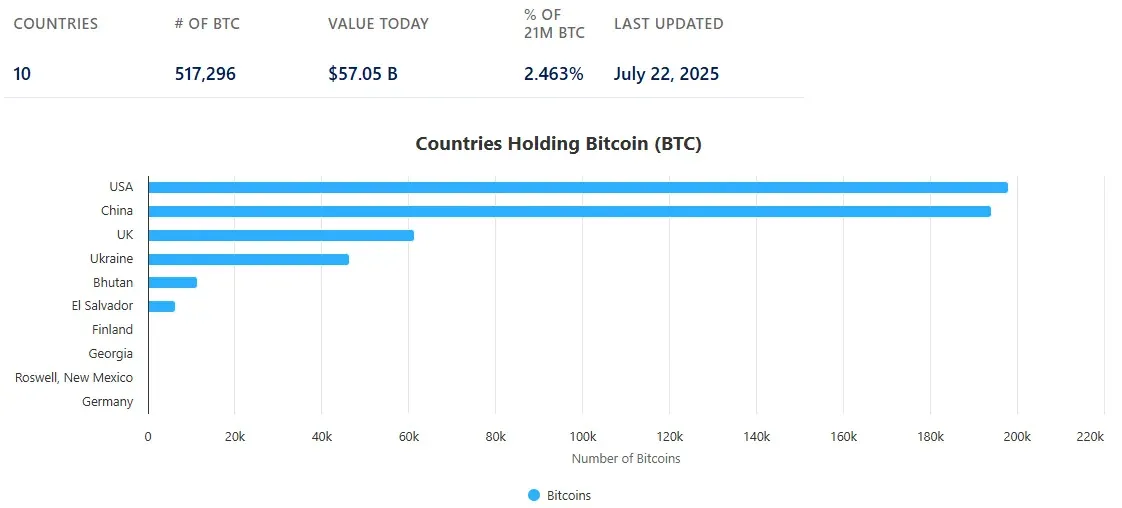
Governments mainly acquire Bitcoin through law‑enforcement seizures, although a few countries have engaged in strategic purchases.
- United States: External trackers estimate roughly 198,012 Bitcoin (about USD 21.8 billion), while official disclosures list only 28,988 Bitcoin (around USD 3.4 billion), a stark discrepancy.
- China: Approximately 194,000 Bitcoin, sourced from illegal mining operations seized after the 2021 mining ban and from fraud cases.
- United Kingdom: Controls about 61,245 Bitcoin through law‑enforcement actions.
- Ukraine: Holds 46,351 Bitcoin, primarily confiscated from cyber‑crime activities.
- North Korea: Estimated at 13,562 Bitcoin, derived from a mix of illicit channels.
- Bhutan: A secret hydro‑electric mining project is believed to have accumulated about 11,286 Bitcoin.
- El Salvador: Directly purchased 6,257 Bitcoin as part of its national policy, having declared Bitcoin legal tender.
The United States’ Strategic Bitcoin Reserve
In March 2025, President Donald Trump signed an executive order establishing a “Strategic Bitcoin Reserve,” intended to consolidate all Bitcoin seized by federal agencies—similar to traditional gold reserves such as Fort Knox. The reserve includes only assets that have completed legal proceedings and are unequivocally owned by the government; the coins are not slated for sale and are treated as a long‑term sovereign value store.
The concept was championed by Senator Cynthia Lummis together with a group of Bitcoin proponents, aiming to provide a digital‑asset backstop for the future economy.
Controversy Over U.S. Bitcoin Holdings
A large gap exists between the government’s reported and estimated Bitcoin holdings. When the strategic reserve was announced in March, crypto‑policy lead David Sacks estimated the U.S. possessed around 200,000 Bitcoin. External analytics platforms Arkham Intelligence and BiTBO later echoed similar figures.
However, independent journalist L0la L33tz, using a Freedom of Information Act (FOIA) request to the U.S. Marshals Service, uncovered that the actual holdings amount to only 28,988 Bitcoin—about 15 % of the high‑estimate. Senator Lummis expressed shock, calling the discrepancy a “significant strategic misstep.”
Difference Between Seizure and Forfeiture
- Seizure: Law‑enforcement agencies temporarily take control of the asset while legal proceedings are ongoing; the original owner retains the right to appeal, and the asset does not belong to the government.
- Forfeiture: All legal steps have been completed, a court order is final, and the asset becomes government property, eligible for inclusion in the strategic reserve.
Most tracking platforms do not differentiate the two, leading to inflated holding figures. Transfers between internal government wallets are also sometimes misinterpreted as new holdings.
Timeline of Bitcoin Reserve Controversies
| Date | Event | Details |
|---|---|---|
| 2013 | FBI seizes 144,000 Bitcoin | Largest government seizure to date |
| 2014 | U.S. Marshals auction “Silk Road” case | Tim Draper purchases 29,500 Bitcoin |
| Jan 2025 | President Trump pardons Ross Ulbricht | Founder of Silk Road released |
| Mar 2025 | Executive order creates strategic reserve | David Sacks estimates 200,000 Bitcoin |
| Aug 2025 | FOIA documents reveal actual holdings of 28,988 Bitcoin | Sparks debate |
| Oct 2025 | External platforms show 198,012 Bitcoin | High‑estimate resurfaces |
| 14 Oct 2025 | DOJ seizes Bitcoin worth USD 15 billion | Largest forfeiture ever |
Potential Impact on Bitcoin Prices
Any move by a large holder can sway the market. Satoshi Nakamoto’s 1.1 million Bitcoin represent a latent pressure point; any transfer would likely trigger sharp price swings. Changes in government inventories also affect market sentiment, and corporations deciding whether to add Bitcoin to their treasury watch government reserve sizes closely.
Historic Seizure That Changed Everything
The U.S. Department of Justice filed criminal charges and a civil forfeiture claim against Prince Group chairman Chen Zhi, seizing about 127,271 Bitcoin (valued at roughly USD 15 billion), marking the largest forfeiture in history.
*Note for U.S. residents:* When trading Bitcoin on Binance, you must use Binance.US, which complies with U.S. regulations, rather than the global Binance platform.
*Tax reminder:* Cryptocurrency gains may be subject to tax in your jurisdiction. Consult a qualified tax professional to understand your obligations.
Related Reading
- Satoshi Nakamoto Net Worth: How Many Bitcoins Does He Own?
- Bitcoin’s Top Holder: Satoshi Nakamoto’s 1.1 Million Coins
- Binance CEO: Nations, Bitcoin Reserves, US Policy & Pakistan
💡 Register on Binance with referral code B2345 for the maximum trading fee discount. See Binance complete guide.



