 Bitaigen Research
 Summary
Clore.AI is a GPU computing power rental platform built on a Proof‑of‑Work (PoW) model. Users can either rent computing power or lease idle graphics cards, and the platform mines using the KawPoW algorithm, distributing CLORE tokens as rewards.
In this article we outline the core concepts and technical framework of Clore.AI, explain how GPU power rental integrates with KawPoW, and dissect the incentive structure and primary use cases of the CLORE token. A brief compliance assessment of the team is also provided to help you quickly gauge the platform’s value. Continue reading for the details.
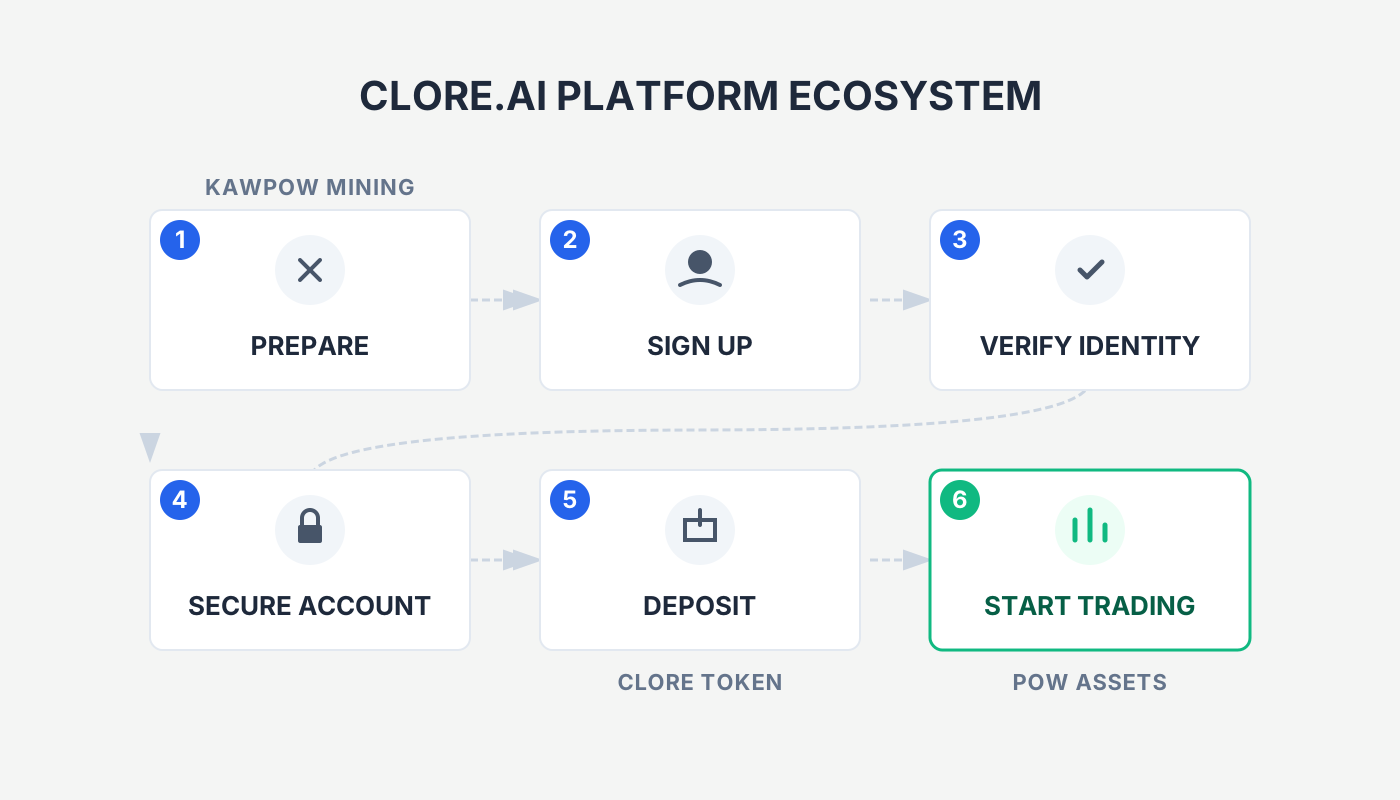
What is Clore.AI
Clore.AI employs a proof‑of‑work (PoW) mechanism to offer GPU computing power leasing services. When the network experiences demand for hash power, the system automatically assigns tasks; if there is no immediate demand, the platform switches to mining the most profitable cryptocurrency at that moment. Its business scenarios include:
- Artificial‑intelligence model training
- Film rendering
- VPN services
- Cryptocurrency mining
The project team is based in Europe and states that it strictly complies with local regulations to ensure lawful and reliable operations.
Technical Foundations Behind Clore.AI
The rapid growth of AI applications such as ChatGPT, Sora, and others has pushed computational demand into a new era. GPUs have become the essential infrastructure for AI training and inference, and Clore.AI is designed as a distributed super‑computing platform to meet this need. The platform embeds CLORE mining functionality into the power‑rental marketplace, giving service providers an efficient channel to monetize idle GPUs.
- KawPoW: An ASIC‑resistant PoW algorithm that lowers the barrier to entry, allowing anyone with a standard GPU to participate in mining.
- Reward structure: Parties that provide computing power receive CLORE tokens proportionate to their GPU performance; parties that consume power can pay with CLORE, Bitcoin (BTC), or USD (via SEPA/SWIFT).
- Mainstream GPUs: Currently the platform primarily supports RTX 30 and RTX 40 series cards, suitable for gaming, content creation, and rendering; large‑scale AI training tends to use high‑performance chips such as NVIDIA H100 or A100.
As of August 2 2024, the platform recorded a total of 13 883 GPUs, of which 9 222 are currently rented out and 3 488 are online and available.
Token Economics of Clore.AI
CLORE is a PoW token that utilizes the KawPoW algorithm and inherits its ASIC‑resistance. Token distribution details are as follows:
| Allocation | Recipient |
|---|---|
| 50% | Miners |
| 40% | Power leasers |
| 10% | Project team |
- Total supply: 1.3 billion CLORE
- Mining start date: December 2022
- Circulation plan: Expected to be almost fully circulating by 2042
- Current circulating supply: Approximately 220 million CLORE
Circulation history:
- End of 2023: 250 million (≈ 20%)
- End of 2024: 460 million (≈ 35%)
- End of 2025: 620 million (≈ 48%)
Proof of Holding (PoH) Mechanism
The platform’s Proof of Holding (PoH) program offers multiple incentives for CLORE holders:
- Token incentives – The more CLORE you hold, the higher the reward you receive for leasing equipment.
- Service discounts – Holders can enjoy up to a 50% discount on service commissions.
- Convenient usage – No need to transfer tokens to an official wallet; you can participate directly by signing with a desktop wallet.
- Optional participation – PoH is entirely voluntary and can be used as a yield‑maximizing tool.
- No lock‑up – Funds can be withdrawn, exchanged, or sold at any time.
- No penalties – Exiting PoH does not incur restrictions or penalties.
Official data indicates that more than 121.2 million CLORE are currently participating in PoH.

Conclusion
As the AI era unfolds, demand for compute power is set to grow exponentially. Clore.AI enables demand‑side users to obtain high‑quality GPU services at low cost, while owners of idle graphics cards can earn CLORE rewards by leasing them, generating substantial income. The platform offers a comprehensive API that supports seamless integration and custom management, making the GPU rental and utilization process more straightforward. With its technical advantages and innovative token‑economic model, Clore.AI has attracted considerable attention in the market and is poised for rapid development in the AI‑driven future.
The above provides a complete analysis of “What is Clore.AI? Technical Foundations and Token Economics of the Compute‑Power Rental Platform.” For more information, follow additional articles on Bitaigen (比特根).
Related Reading
- How to Mine Dogecoin: ASIC Scrypt Mining Guide & Tips
- Ethereum: From PoW to PoS – Ethash, Casper & Migration
- Proof‑of‑Stake vs Proof‑of‑Work: Complete Guide & Comparison
💡 Register on Binance with referral code B2345 for the maximum trading fee discount. See Binance complete guide.



