
 Bitaigen Research
 The world of cryptocurrency has moved far beyond simple buy‑and‑hold strategies. One of its most significant developments is the rise of Proof‑of‑Stake (PoS) staking – a mechanism that allows token holders to earn returns simply by committing assets to support blockchain operations.
Crypto staking refers to token holders locking their coins on a blockchain network, participating in transaction validation, receiving rewards in the same token, and helping the network maintain security and decentralisation.
At Bitaigen’s editorial team we have thoroughly examined the core principles of PoS staking, clarifying the complete workflow of token locking, validator selection, and reward distribution. By reading this analysis you will grasp the technical logic and risk considerations behind staking, providing a rational reference for future asset allocation. We recommend continuing to read the full content.
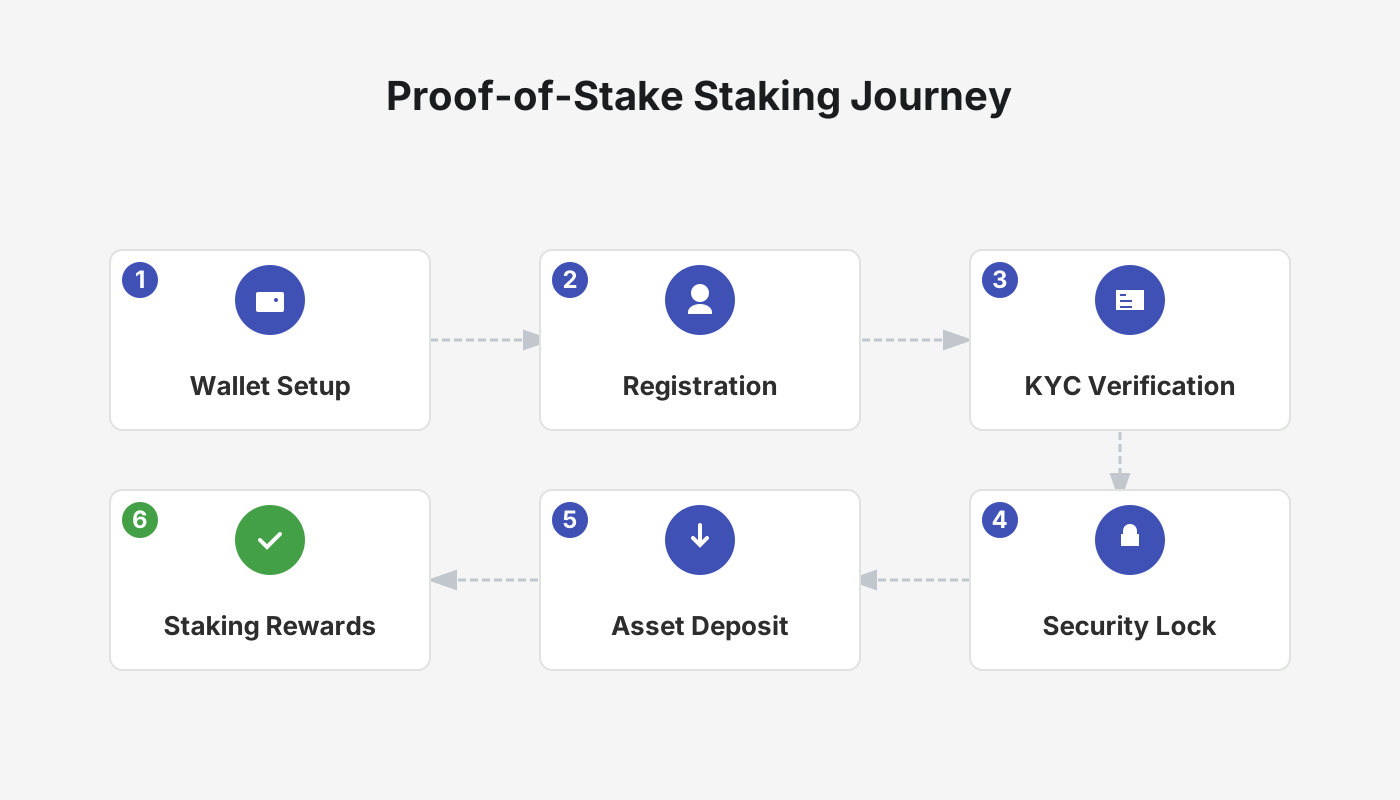
What Is Staking?
Staking is essentially a way for cryptocurrency holders to earn rewards by depositing their tokens into a blockchain network. Holders lock their digital assets in a designated wallet, and these staked tokens are used to validate transactions and keep the network running smoothly.
- The tokens remain under the user’s control and are not transferred to a third party.
- Rewards are issued directly by the blockchain, usually as additional units of the same token.
- The process is analogous to earning interest on a bank deposit, but the yield comes from contributing to a decentralized network.
How Does PoS Staking Work?
Within a PoS staking ecosystem, a user who locks a certain amount of the network’s native token becomes a validator. Validators are not chosen through computational power contests; instead, the protocol’s algorithm randomly selects them based on the following factors:
- The amount of tokens staked
- The length of time the tokens have been held
- Other on‑chain rules specific to the chain
The user must run client software and keep a node online; the system will pick the node at the appropriate moment to perform block‑validation tasks. The staked amount acts like an insurance policy – if a validator behaves maliciously or goes offline, the deposited collateral can be slashed (confiscated).
Proof‑of‑Stake: The System Behind the Rights
Proof‑of‑Stake (PoS) offers a more energy‑efficient alternative to the traditional Proof‑of‑Work (PoW) model. PoW relies on massive computational power to solve complex mathematical puzzles, which leads to high electricity consumption and the need for specialised hardware. PoS, by contrast, determines validator eligibility based on the quantity of tokens a user locks up, with advantages such as:
- A dramatic reduction in energy usage
- Lower hardware barriers, increasing participation
Ethereum completed its transition from PoW to PoS in 2022, cutting the network’s energy consumption sharply and achieving a more sustainable growth trajectory.

Why Not All Coins Can Be Staked
Staking functionality is only available on chains that use PoS or a variant thereof. Networks based on PoW (e.g., Bitcoin) still rely on mining to process transactions and cannot offer native staking. Staking rules differ from chain to chain; common parameters include:
- Minimum staking amount
- Lock‑up period
- Whether participation requires a staking pool
Projects that have implemented native staking include Ethereum, Cardano, Tezos, Polkadot, and others. In contrast, XRP employs a trusted validator model, neither using PoW nor supporting staking; its reward mechanisms are entirely different.
Staking Risks
- Liquidity lock‑up: Tokens are frozen for the staking period, preventing timely sales during sharp market swings.
- Validator slashing: Delegated validators that go offline or act improperly may cause a portion of the staked assets to be confiscated.
- Smart‑contract vulnerabilities: The staking protocol itself may contain security flaws.
- Opportunity cost: Locked assets cannot be deployed in DeFi, trading, or other high‑yield opportunities.
Among these, the liquidity risk stemming from asset freezing is the most concerning for most holders. *Note: crypto gains may be taxable in your local jurisdiction, so consider any potential tax obligations when earning staking rewards.*
A Key Aspect of Crypto
Staking has become a core component of modern blockchain operation. It encourages users to participate responsibly in network maintenance while providing token holders with a passive income stream that does not rely on traditional financial institutions. The rise of DeFi platforms further amplifies staking’s value, allowing more participants to protect network security and simultaneously grow their assets.
This article constitutes the complete breakdown of “The Amazing Mechanics of Crypto Staking” as presented by Bitaigen. To explore more staking‑related material, follow Bitaigen’s other publications.
*When converting staking rewards to fiat, global users typically use USD transfers via SEPA or SWIFT, while U.S. residents should use Binance.US rather than the global Binance platform.*
Related Reading
- Passive Income 2025: Staking vs Cloud Mining Explained
- Liquidity Mining Guide: Earn Passive Income & Avoid Risks
- Proof of Stake (PoS) Explained: How It Works vs. PoW
💡 Register on Binance with referral code B2345 for the maximum trading fee discount. See Binance complete guide.



