
 Bitaigen Research
 What Are the “Low‑Risk” Investment Options in the Crypto Space? Are They Really Safe? What Should You Watch Out For?
When people hear the terms “crypto” or “the coin circle,” the first thing that usually comes to mind is risk.
That perception is not unfounded. Compared with traditional finance, the crypto ecosystem is indeed a high‑risk arena, where exchange bankruptcies, project teams absconding with funds, and stablecoins losing their peg can happen unexpectedly.
Therefore, this article will introduce the most common “low‑risk” investment approaches in the crypto world and examine whether they truly carry low risk. If you are a newcomer to cryptocurrencies, please read carefully to avoid stepping into a minefield.
In this article we outline the relatively low‑risk investment paths that are frequently discussed in the crypto community, dissect the real factors behind their perceived safety, and highlight the key risk points newcomers should keep an eye on when choosing a strategy. Our goal is to help readers make more rational decisions in a highly volatile environment and to provide practical mitigation tips.
---
1. [Must‑Read] Are “Low‑Risk” Crypto Investments Really Low‑Risk?
Before we start, we need to define what “low risk” actually means.
In traditional finance, a time‑deposit or a government treasury bill is considered virtually risk‑free; corporate bonds and certain sovereign bonds fall into the low‑risk category; while stocks, foreign‑exchange, and commodities are classified as high‑risk assets.
Applying the same standard, all crypto‑related activities would be deemed ultra‑high‑risk. We constantly hear about leading exchanges collapsing, project teams vanishing with investors’ money, tokens experiencing extreme price swings, and even “stablecoins” that are supposed to be pegged to the US dollar losing that peg.
From the perspective of traditional finance, no investment inside the crypto ecosystem should be labeled “low risk.”
Consequently, the “low‑risk crypto investments” mentioned in this article—or the projects that appear low‑risk on the internet—are only relatively lower‑risk when compared with the overall high‑risk environment of the crypto market. Every activity in the crypto space is fundamentally high‑risk; reading this article is solely for informational reference and does not constitute investment advice.
---
2. The First Step to Reducing Risk: Choose a Reliable Exchange
In everyday life, most people do not worry about banks going bust because deposits are typically protected by government deposit insurance schemes, meaning you won’t lose your principal even if the bank fails.
In the crypto world, an exchange functions similarly to a bank. Unless you actively move your assets to a cold (offline) wallet, the majority of retail users keep their crypto holdings on an exchange for the long term.
History has shown us that large exchanges such as FTX and Mt. Gox have collapsed, reminding us to be extra‑cautious when selecting an exchange and to continuously monitor any negative news that may arise.
At present, Binance is the world’s largest cryptocurrency exchange. Although its founder was detained earlier this year on criminal charges, the allegations did not involve the misappropriation of customer assets, and he has since been released. Binance’s spot and derivatives trading volumes rank first globally, dwarfing the combined volume of the next several exchanges.
Based on this, prioritising an exchange with large scale and deep liquidity is a relatively rational approach. Nevertheless, rumors about exchange failures still circulate—most of them are false, but in a risk‑laden environment it is prudent to stay vigilant. If credible information about an exchange’s potential insolvency appears, you should promptly transfer your assets to a safer storage method (e.g., a hardware wallet).
Having understood this prerequisite, the next sections will explore several investment methods available within the Binance platform. Again, even though the headings use the term “low risk,” these products remain high‑risk in the broader crypto context, and this article does not constitute any investment recommendation.
Note for U.S. readers: Binance operates a separate platform called Binance.US for American users, which complies with U.S. regulations. The products described here are generally available on the global Binance platform; U.S. residents should use Binance.US where applicable.
Tax reminder: Crypto gains may be taxable in your jurisdiction. Please consult a tax professional to understand your local reporting obligations.
---
3. Supposedly Low‑Risk Crypto Investments: Savings, Deposits, Flexible and Fixed‑Term Products
On the Binance Earn (or “Binance Finance”) page, you will see a variety of “flexible” and “fixed‑term” products for different tokens, resembling a bank’s savings account and time‑deposit respectively.
However, it is crucial to understand that crypto flexible/fixed‑term products are not equivalent to bank deposits, because bank deposits are backed by government insurance while these crypto products have no such protection.
Take Binance’s USDT flexible‑interest product as an example. The interest rate is floating. The chart below shows recent flexible‑interest rates, which have peaked at 18.75 %—a figure driven by active market conditions and high demand for leveraged trading.
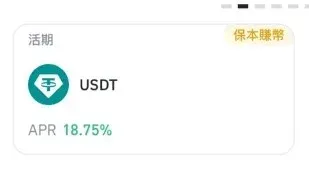
When market activity wanes, the USDT flexible‑interest rate can dip to roughly 2 %. Consequently, the rate can swing dramatically with market sentiment.
Besides USDT, a range of other tokens—including BTC, BONK, NEIRO, and more—also have flexible‑interest options.
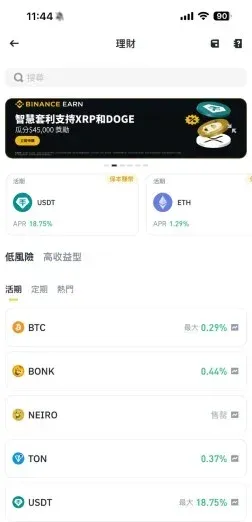
It is important to note that these products are settled in the original cryptocurrency. For instance, if you deposit 1 BTC, after one year you might receive 1.0029 BTC. The extra 0.0029 BTC, when converted to fiat at the prevailing market price, could be worth more or less than the original USD value of 1 BTC, depending on price movements. Thus, while the quantity of the token may increase, the value is not guaranteed to be preserved. Investors should fully understand this nuance.
---
4. Supposedly Low‑Risk Crypto Investments: “Zero‑Investment” (Zero‑Cost) Projects
The term “zero‑investment” (sometimes rendered as “zero‑cost” or “zero‑effort”) refers to projects that claim you can earn rewards without spending any capital, only by contributing time.
Such opportunities are not rare in the blockchain ecosystem. Many blockchain projects—especially games—offer daily check‑ins, interactive tasks, or community activities that reward participants with airdrop tokens upon completion.
A recent example is the NOT project, a Telegram mini‑app where users tap once per day to accumulate points. Those points can later be exchanged for tokens that can be sold for profit.
The primary risk of participating in “zero‑investment” projects lies in the time cost:
- The project may ultimately fail, leaving the promised airdrop tokens non‑existent.
- Even if tokens are issued, their market value might be only a few dollars, rendering the time spent unrewarded.
- The expected return often does not proportionally match the time invested, and it is difficult to predict the exact earnings before you start.
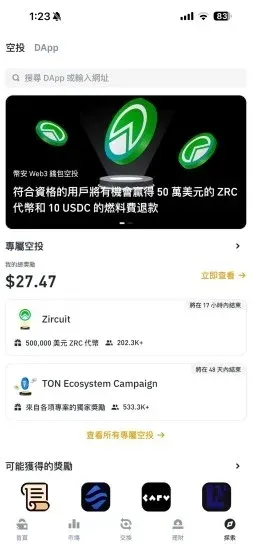
Binance hosts relatively few “zero‑investment” projects, but you can keep an eye on its marketing campaigns (e.g., daily iPhone giveaways) or the tasks available within the Binance Web3 Wallet.
---
5. Supposedly Low‑Risk Crypto Investments: New‑Token Mining (Launchpool, IEO)
New‑token mining is a marketing activity launched by Binance. By holding designated assets such as BNB, FDUSD, and others, the platform distributes newly issued tokens proportionally to your holdings.
Because you do not need to pay additional fees, the theoretical risk appears lower. Nevertheless, several risk factors remain:
- Asset price volatility – Participation requires you to hold BNB and FDUSD. If either of these assets declines in price during the mining period, the value of the newly earned tokens may not compensate for the loss in your original holdings.
- FDUSD premium/discount – Although FDUSD is a stablecoin that aims for a 1:1 peg with the US dollar, during new‑token mining events it often trades at a premium (above $1) or a discount (below $1). If you purchase FDUSD only after the announcement and sell it after the event ends, you could incur a small loss due to that price deviation.
In summary, while new‑token mining may look “low‑risk,” you still need to assess the price fluctuations of the underlying assets and the potential premium/discount risk of the stablecoin involved.
---
Final Thoughts
The above analysis answers the question: “What are the low‑risk investment options in the crypto space? Are they truly safe? What should you watch out for?” If you wish to explore more low‑risk‑styled crypto strategies, please follow Bitaigen (比特根) for additional articles.
*This translation is provided for informational purposes only and does not constitute financial or investment advice.*
💡 Register on Binance with referral code B2345 for the maximum trading fee discount. See Binance complete guide.



