
 Bitaigen Research
 In this article we outline the core concepts and technical advantages of DAG in blockchain, explain why it can break through the scaling bottleneck of traditional chain‑based architectures, and demonstrate through examples its potential improvements in parallel transaction accounting, confirmation speed, and network efficiency. If you want to understand how this emerging structure may shape the future of Blockchain 3.0, please continue reading.
Below is a brief explanation of the concept and advantages of blockchain DAG.
Blockchain DAG is based on a Directed Acyclic Graph data structure; it does not use the traditional chain‑style storage of a blockchain, but achieves high scalability and fast transactions by parallel accounting of transaction units.
What does blockchain DAG mean?
DAG (Directed Acyclic Graph) is a data structure commonly used in computer science. Its topology is one‑way and contains no cycles, making it suitable for dynamic‑programming scenarios such as path planning; for example, navigation systems use a DAG to compute the shortest route.
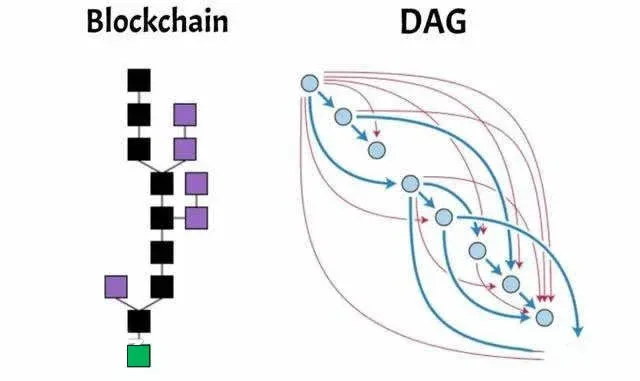
In the blockchain field, DAG replaces the traditional “chain” storage method. Traditional blockchains (e.g., Bitcoin) employ a Block 1.0 structure that packs transactions into blocks and links them in chronological order; Ethereum is regarded as Blockchain 2.0, providing a smart‑contract platform. As the technology evolves, the industry links Blockchain 3.0 with DAG technology, viewing it as the key to achieving high throughput.
The first proposal that combined DAG with blockchain appeared in the Nxt community, suggesting a shift from chain storage to a block DAG. By keeping the block‑generation interval unchanged, the network can package N blocks in parallel, thereby increasing transaction throughput by a factor of N.
Unlike traditional chain structures, DAG does not have a unified “block” concept. Each user can submit a data unit (transaction unit) that may contain various pieces of information. Taking RaiBlocks (later renamed Nano) as an example, it uses a “block lattice” technique where each account possesses an independent account chain that settles only between the two parties involved in a transaction. A single transaction requires only one UDP packet and is processed independently. Although each account has its own chain, the overall ledger can be represented uniformly as a DAG. After verification, transactions are added to the DAG, guaranteeing the immutability of the ledger and thereby enabling instant transactions and unlimited scalability.
What advantages does blockchain DAG have?
Compared with the traditional single‑chain structure, DAG exhibits fundamental differences in asynchronous concurrent accounting versus synchronous accounting. In conventional blockchains, blocks are written synchronously in the order they are produced, each block containing many transactions; DAG, however, consists of a network of transaction units that support asynchronous parallel accounting, with each unit recording a single transaction. Based on this design, DAG offers significant benefits in the following areas:
- Strong scalability
- Asynchronous accounting allows nodes to process new transactions without waiting for full‑network synchronization, eliminating idle time.
- As the number of nodes participating in accounting grows, the system’s processing capacity increases linearly.
- Fast transaction speed
- Traditional chains can only handle a fixed capacity of transactions per block, making it difficult to raise throughput.
- DAG supports local processing and parallel settlement; the more transactions and the higher the frequency, the faster the overall system operates, achieving a qualitative leap in performance.
For these reasons, the industry widely believes that DAG can address the high‑throughput challenges faced by public blockchains.
Related Reading
- ArcBlock Blockchain 3.0 Platform: Simplify dApp Development
- 2026 Bitcoin Market Outlook: 5 Key Factors Shaping Prices
💡 Register on Binance with referral code B2345 for the maximum trading fee discount. See Binance complete guide.



