
 Bitaigen Research
 Aster is a high‑performance decentralized perpetual contract exchange that offers both order‑book and dark‑pool trading. It is backed by capital from Binance founder CZ and YZi Labs, but it is not an official Binance product.
Below, the Bitaigen editorial team provides a complete analysis of Aster’s features, operating mechanisms, and its relationship with Binance.

In this article we dissect Aster’s core functionalities and operating model, explain how its decentralized perpetual contracts are technically implemented, and clarify the capital links and real‑world relationship with Binance. If you want to know whether it can deliver an experience close to that of centralized exchanges, keep reading.
Aster (ASTER) Current Price
ASTER Market‑Cap Information
- Market cap: $7.89 B
- Fully‑diluted market cap: $38.1 B
- Market‑cap / FDV ratio: 20.72 %
- Market sentiment: Bullish
ASTER Supply
- Circulating supply: 1.65 B ASTER
- Total supply: 8 B ASTER
- Maximum supply: 8 B ASTER
What Is Aster
Aster is a high‑performance decentralized perpetual‑contract exchange whose core combines an order book (Orderbook) with a private dark pool, delivering a trading experience that approaches that of centralized exchanges. It supports multiple chains including BNB Chain, Ethereum, Arbitrum, and Solana.
The platform was re‑branded after the merger of Astherus and APX Finance, and it receives investment from YZi Labs. YZi Labs has deep ties to former Binance founder CZ and Binance Labs, which is why Aster is often described as a “DEX with Binance lineage.”
Aster offers:
- Simple mode (easy‑trade)
- Pro mode (on‑chain CLOB)
- 1001x mode with up to 1001 × leverage
- Perpetual contracts on cryptocurrencies and stock indices
CZ publicly purchased more than $2 million worth of ASTER, helping the platform’s perpetual‑DEX trading volume surge quickly.
Founding Team
Aster’s CEO frequently uses the alias Leonard, who spent many years at Binance and focuses on the development of perpetual‑contract exchanges and underlying infrastructure.

Relationship Between Aster and Binance
- Historical and capital links: Aster’s predecessor Astherus received investment from YZi Labs, an entity co‑founded by CZ and He Yi and formerly an extension of Binance Labs.
- CZ’s holding: CZ disclosed on social media that he bought approximately $2 million worth of ASTER.
- Governance role: CZ participates only as a limited consultant and minority shareholder; he does not have direct control over Aster.
Security of Aster
- The smart contracts have undergone multiple audit rounds and include risk‑control designs, but DeFi never offers absolute security.
- Perpetual‑DEXs inherently face risks such as liquidation events, extreme volatility, and oracle manipulation.
- Assets remain self‑custodied by users; if assets are deposited into contracts (e.g., ALP or margin pools), users assume the associated protocol risk.
- No major hacks have been reported to date, but users should only allocate funds they can afford to lose.
Aster Quick‑Reference Overview
| Item | Details |
|---|---|
| **Chinese name** | Aster |
| **English name** | Aster / Aster DEX |
| **Core type** | Multi‑chain decentralized perpetual‑contract exchange (Perpetual DEX) with spot and stock‑derived derivatives |
| **Launch date** | 31 March 2025, operating under the Aster brand after the Astherus + APX Finance merger |
| **Investment background** | YZi Labs (a family office spun out of the former Binance Labs team) with deep connections to CZ and He Yi |
| **Supported chains** | BNB Chain, Ethereum, Arbitrum, Solana |
| **Main products** | Perpetual contracts (Simple / Pro), 1001x high‑leverage, stock perpetuals, spot trading, ALP liquidity pools, USDF stablecoin, etc. |
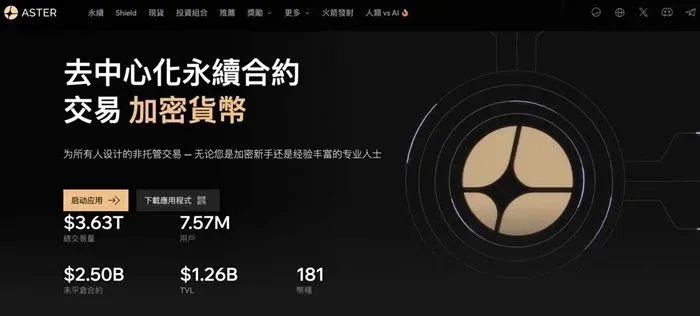
Highlighted Features of Aster
- Spot trading – Order‑book (CLOB) reduces slippage and supports early‑stage tokens as well as blue‑chip assets.
- Perpetual contracts – On‑chain order book combined with a dark pool delivers low slippage and privacy‑preserving trades.
- 1001x mode – Extremely high leverage aimed at risk‑tolerant speculators.
- Prediction mode – Enables rise/fall forecasts in 1 hour, 30‑minute windows, useful around major data releases.
- ALP liquidity vault – Users can allocate idle assets to earn fees and liquidation rewards.
- Yield‑bearing assets – Inherited from Astherus, offering staking yields on asUSDF, asBNB, asCAKE, etc.
- Other tools – Grid trading, Rocket Launch, and more, designed to mimic the UX of centralized exchanges.
How Aster Works
Aster runs on a high‑performance App Chain and adopts a hybrid off‑chain matching / on‑chain settlement architecture:
- Off‑chain matching – Orders are matched on high‑speed servers; the results are batch‑written to the blockchain, achieving millisecond‑level order placement.
- Cross‑chain liquidity – Smart contracts manage assets across BSC, Solana, Ethereum, and Arbitrum, enabling unified settlement.
- Aster Chain – A Layer‑1 public chain built specifically for a centralized‑order‑book (CLOB); slated for launch in Q1 2026 to improve transparency and decentralization.
- ZK proofs – Leveraging Brevis’s ZK‑Proof service, large dark‑pool orders can enjoy on‑chain privacy.
Advantages and Disadvantages of Aster
Advantages
- CEX‑like experience – Fast order entry, professional UI, hidden orders, sub‑accounts, multi‑asset margin.
- Competitive fees – Maker 0.005 % / Taker 0.04 %; an invitation link grants an additional 5 % discount.
- Asset diversity – Multi‑chain crypto, stock perpetuals, real‑world assets (RWA), etc.
- Yield‑bearing collateral & ALP vault – Assets can simultaneously serve as margin, earn interest, or provide liquidity.
- Strong capital backing – Endorsements from YZi Labs and CZ boost brand credibility.
- Market traction – In the second half of 2025, Aster quickly captured a sizable share of the perpetual‑DEX market and was viewed as a primary competitor to Hyperliquid.
Disadvantages
- Centralization concerns – Nodes, matching engine, and governance remain concentrated; some data have been questioned for possible “wash‑trading.”
- Intense competition – Hyperliquid, dYdX, GMX, Lighter, edgeX, and others are all vying for dominance in the perpetual‑DEX space.
- User onboarding barrier – Requires familiarity with Web3 wallets.
- Price reliance on buy‑backs – Token valuation is heavily driven by buy‑back programs and marketing; a drop in trading volume could exert downward pressure.
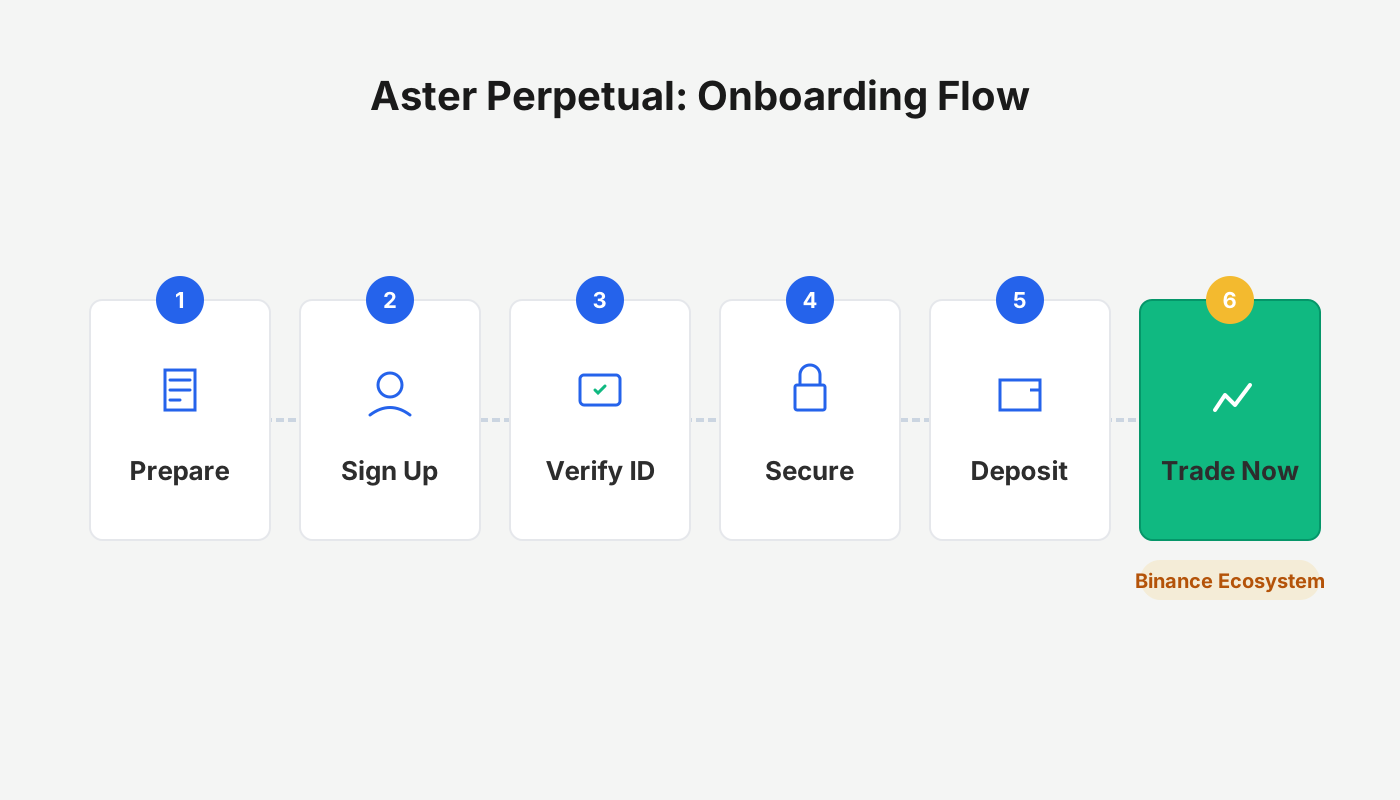
Aster User Guide
- Prepare a wallet – Install and configure an EVM‑compatible wallet such as MetaMask.
- Fund the wallet – Hold USDT (or any asset supported by Aster) on Arbitrum or another compatible chain.
- Connect to the site – Visit Aster’s official website and click the “Connect Wallet” button at the top‑right.
- Deposit funds – Click “Deposit” and transfer assets into Aster’s official smart contract.
- Start trading – Once the deposit is confirmed, select a trading pair and open a long or short position.
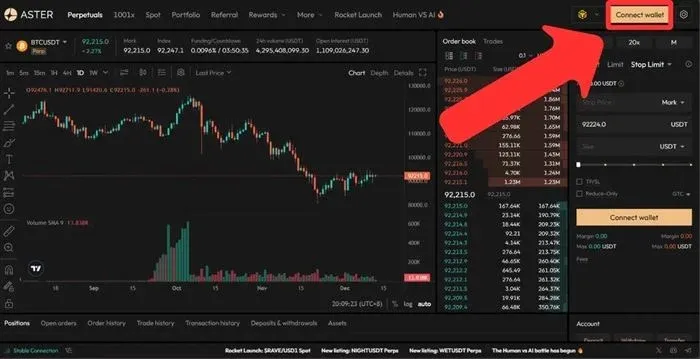
Aster – Connect Wallet
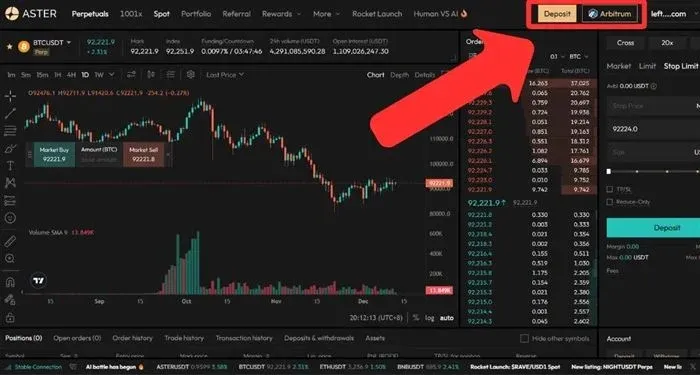
Aster – Deposit Funds
Tokens Supported on Aster
- Major assets – BTC, ETH, SOL, BNB, etc.
- Altcoins – Sui, Aptos, and others.
- Popular memecoins – PEPE, WIF, BONK, DOGE, etc.
- Pre‑Launch – The platform periodically opens pre‑launch trading for projects that have not yet been listed.
- Stocks – US equities such as AAPL, TSLA, NVDA, etc.
- RWA – Currently tradable XAU (gold).
Aster Fee Structure
| Scenario | Fee Type | Rate |
|---|---|---|
| Spot / perpetual trade execution | Maker | **0.005 %** |
| Spot / perpetual trade execution | Taker | **0.04 %** (additional 5 % discount when using an invitation link) |
| ALP vault | Revenue share | Portion distributed to market makers as rewards |
| Perpetual contracts | Funding Rate | Charged according to premium/discount direction |
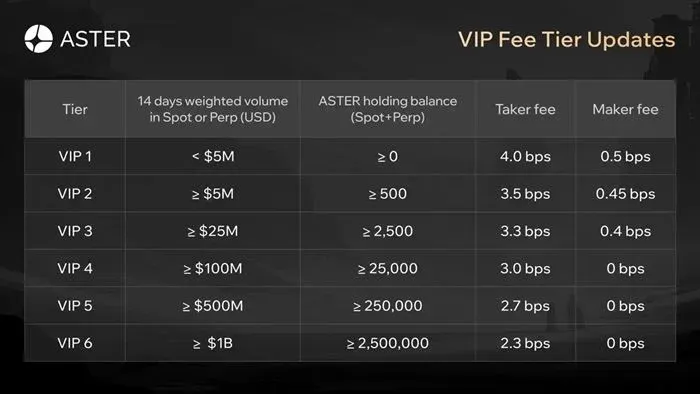
ASTER Trading Fees, VIP Requirements, and Staking Levels
Platform Token ASTER Overview
| Item | Details |
|---|---|
| **Token name** | Aster Token |
| **Ticker** | **ASTER** |
| **Maximum supply** | 8 000 000 000 tokens |
| **Circulating supply** | Approximately 220 million tokens |
| **Primary utilities** | Governance, fee discounts, margin collateral, staking rewards, buy‑back & burn |
Functions of ASTER
- Governance rights – Holders can vote on protocol upgrades, fee parameters, vault and buy‑back strategies, etc.
- Fee discount & VIP – Paying fees with ASTER grants roughly a 5 % discount and upgrades VIP status.
- Margin asset – ASTER can be used directly as margin for perpetual contracts, yielding about an 80 % discount and improving capital efficiency.
- Staking rewards – Stakers earn additional rewards for locking ASTER.
- Buy‑back & burn – A portion of fee revenue is used to repurchase and burn ASTER, enhancing token scarcity.
Market Outlook
Bullish Viewpoints
- Volume & market share – At its peak, Aster’s open interest (OI) and trading volume approached a 20 % share of the perpetual‑DEX market.
- Buy‑back mechanism – A large share of fees is allocated to ASTER repurchases, supporting token value.
- Capital endorsement – Backing from YZi Labs, CZ, and listings on multiple CEXs increase brand exposure.
- Technical innovation – Yield‑bearing collateral, grid trading, Rocket Launch, dark‑pool, and the 1001× leverage feature differentiate the platform.
Bearish Viewpoints
- Valuation risk – Token price is heavily dependent on buy‑backs and narrative; a decline in trading activity could trigger sharp price drops.
- Centralized governance – Core governance and operations remain concentrated, making decentralization less robust than that of Hyperliquid.
- Data disputes – Platforms such as DefiLlama have questioned the authenticity of Aster’s reported data, raising “wash‑trading” concerns.
- Competition & regulation – Heavy competition from Hyperliquid, dYdX, Lighter, etc., and the high‑leverage/dark‑pool model may attract regulatory scrutiny in various jurisdictions.
Future Vision and Roadmap for ASTER
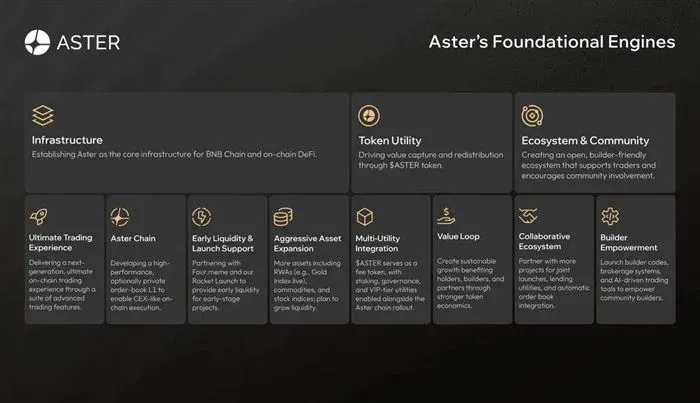
- Derivative infrastructure – Expand beyond perpetual contracts to include more derivatives, structured products, and institution‑grade tools.
- Aster Chain – A Layer‑1 public chain dedicated to high‑frequency privacy trading, embedding a privacy‑consensus layer; planned launch in Q1 2026.
- USDF stablecoin – Develop a yield‑bearing stablecoin tightly integrated with the derivatives market and Aster Chain.
Historical Price of Aster (ASTER)
| Timeframe | Price Change | Percentage |
|---|---|---|
| 1 H | $0.02393 | -0.5 % |
| 24 H | $0.07891 | -1.63 % |
| 7 D | $0.1111 | -2.28 % |
| 30 D | +$0.6012 | +14.45 % |
| 1 Y | +$4.18 | +719.39 % |
Price Forecast for Aster (ASTER)
| Year | Low | High | Avg. | Expected Growth |
|---|---|---|---|---|
| 2026 | $2.82 | $5.69 | $4.78 | — |
| 2027 | $3.71 | $5.60 | $5.23 | +9.00 % |
| 2028 | $3.14 | $7.91 | $5.41 | +13.00 % |
| 2029 | $3.86 | $7.39 | $6.66 | +39.00 % |
| 2030 | $4.57 | $7.66 | $7.03 | +47.00 % |
| 2031 | $4.70 | $8.23 | $7.34 | +54.00 % |
The above forecasts are for reference only and do not constitute investment advice.
Competitors of Aster
| Project (Token) | Type | Description |
|---|---|---|
| **Hyperliquid (HYPE)** | Proprietary L1 · Perpetual‑DEX | Uses an on‑chain order book to deliver a CEX‑like matching experience; has long held a leading position in the perpetual‑DEX market. |
| **dYdX (DYDX)** | App‑chain · Perpetual‑DEX | Early flagship perpetual platform, now operating as an independent app‑chain emphasizing high throughput and professional trading tools. |
| **GMX (GMX)** | Pool‑based liquidity · Perpetual‑DEX (GLP) | Utilizes a GLP liquidity pool as the counter‑party, supports multi‑chain deployment and lowers market‑making barriers. |
| **Lighter (unreleased)** | On‑chain order book | A newcomer |
Related Reading
- PIXEL Token Review: Tech Analysis & Trading Platforms
- Pig Coin (PIG) Listings: Top Exchanges & Security Guide
- PancakeSwap DeFi Deep Dive: Team, Security & Binance Ties
💡 Register on Binance with referral code B2345 for the maximum trading fee discount. See Binance complete guide.



